
Leave Your Message
0102030405
Why Do Robot Arm Prices Vary So Much?
2026-05-21
Why Do Robot Arm Prices Vary So Much?3
If you’ve ever shopped for a robotic arm—whether for injection molding automation, assembly, material handling, or pick-and-place operations—you’ve likely noticed huge price differences between seemingly similar models. One supplier quotes a few thousand dollars; another offers a comparable-spec unit at double the cost. Why such wide gaps?
This guide breaks down the real reasons robot arm prices vary so dramatically, helping you evaluate quotes objectively and choose equipment that matches your production needs, budget, and long-term ROI.
Table of Contents
- Core Hardware & Component Quality
- Payload, Reach, and Working Envelope
- Axis Count and Motion Complexity
- Precision, Repeatability, and Accuracy
- Control System, Software, and Programming
- Application-Specific Design and Customization
- Brand, Certification, and After-Sales Support
- Production Volume, Supply Chain, and Lead Time
- How to Compare Robot Arm Prices Fairly
- FAQs About Robot Arm Pricing
1. Core Hardware & Component Quality
The single biggest driver of price is component grade. High-Performance Robotic arms rely on precision parts that directly affect durability, speed, and uptime.
- Servo motors & drives: Premium servo systems deliver smoother motion, faster response, and longer lifespan. Budget models often use lower-grade motors with higher failure rates.
- Precision reducers: High-end harmonic drives or planetary gearboxes improve accuracy and reduce backlash; cheaper reducers wear faster and hurt positioning stability.
- Structural materials: Aircraft-grade aluminum, hardened alloys, and rigid castings reduce deflection under load. Thin or low-grade materials lower cost but compromise stability.
- Bearings, cables, and connectors: Industrial-grade components resist fatigue, dust, and oil—critical for 24/7 factory use.
Even if two arms look identical externally, internal components can create a 30–80% cost difference.
2. Payload, Reach, and Working Envelope
Price scales strongly with how much the arm can lift and how far it can reach.
- Payload capacity: A 50kg payload arm costs significantly more than a 10kg model due to reinforced structures, larger motors, and upgraded gearboxes.
- Reach and stroke: Longer arms need stiffer design, extended linear guides, and stronger drive systems.
- Working envelope: Vertical stroke, horizontal reach, and rotation range all affect material and engineering costs.
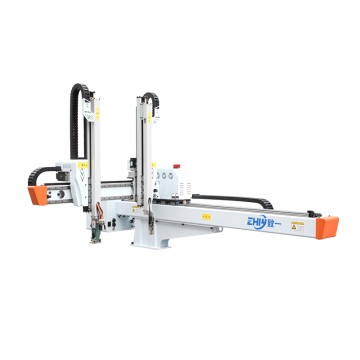
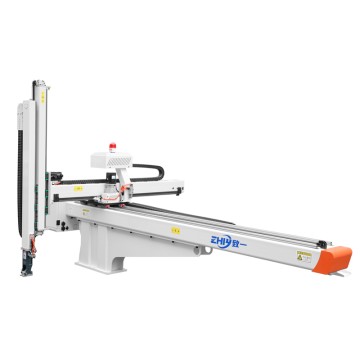
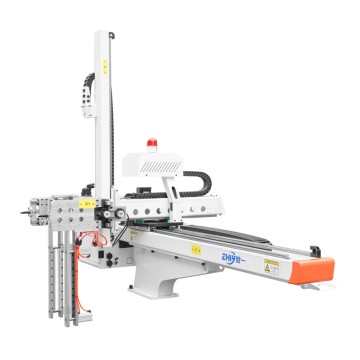
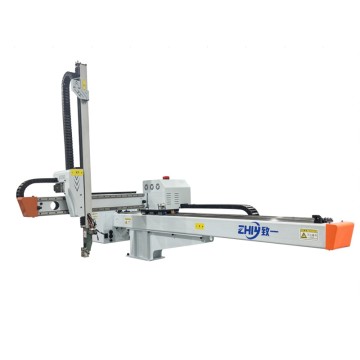
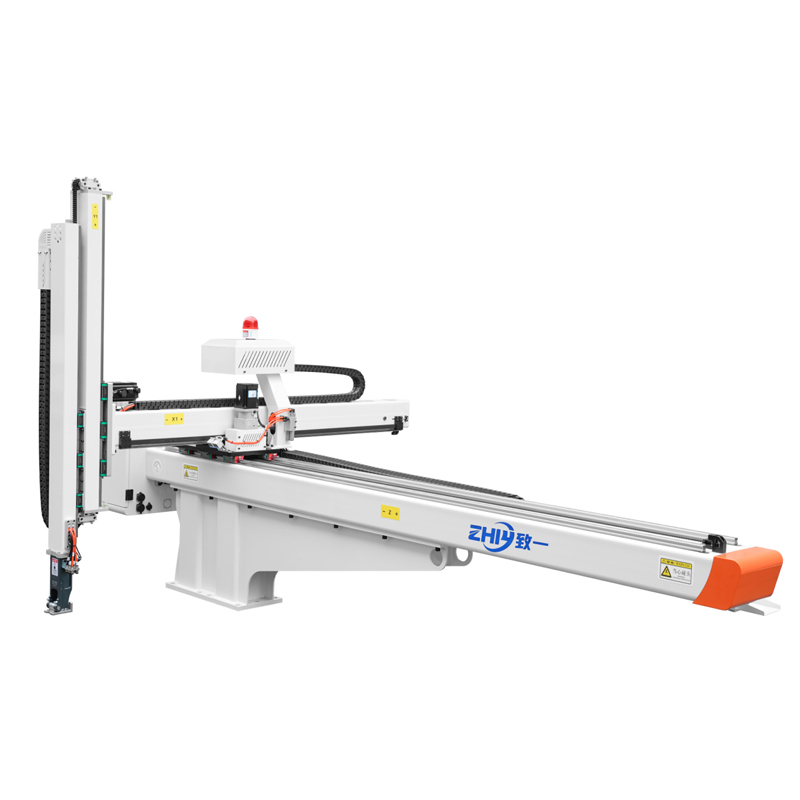
For injection molding automation, for example, a long-reach three-axis robot designed for large machines will cost more than a compact unit for small-tonnage presses.
3. Axis Count and Motion Complexity
More axes mean more motors, reducers, drivers, and control logic—directly raising price.
- 3-axis arms: Basic pick-and-place, entry-level automation; most affordable.
- 4-axis arms: Add rotation for oriented part placement.
- 5-axis & 6-axis arms: Full spatial freedom for complex tasks like insert molding, assembly, or stacking.
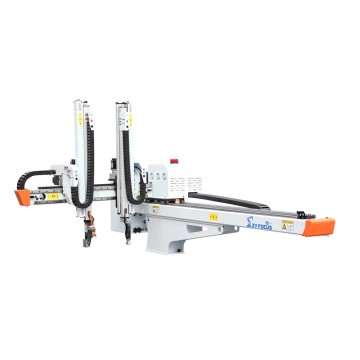
- Dual-arm & multi-station systems: Highest cost, designed for high-output synchronized production.
Doubling axis count rarely doubles price, but it increases total cost by 40–120% depending on precision and build quality.
4. Precision, Repeatability, and Accuracy
High-precision applications demand tighter manufacturing tolerances and premium components.
- Repeatability: ±0.01mm vs. ±0.1mm changes cost drastically.
- Accuracy: Consistent performance across speed and temperature ranges requires advanced calibration.
- Dynamic performance: High-speed, low-vibration motion needs better motion control algorithms and hardware.
If your process requires inserting small parts or consistent product placement, you must pay for precision.
5. Control System, Software, and Programming
The “brain” of the robot heavily influences price.
- Controller performance: High-speed bus systems, multi-axis interpolation, and advanced motion planning cost more.
- Software features: User-friendly programming, offline simulation, fault detection, and data logging add value.
- Compatibility: Seamless integration with injection molding machines, conveyors, and I/O systems reduces deployment time.
Budget robots often use basic controls with limited functionality, while premium systems simplify operation and reduce downtime.
6. Application-Specific Design and Customization
Standard vs. customized robots have very different price tags.
- Standard models: Mass-produced, lower cost, fast delivery.
- Modified options: Special grippers, anti-corrosion treatment, cleanroom design, or extended cables.
- Fully customized solutions: Tailored kinematics, dual stations, special safety features, or unique mounting.
Customization can add 20–150% to base price but delivers better fit for your production line.
7. Brand, Certification, and After-Sales Support
Well-known brands include costs for R&D, compliance, and global support.
- Certifications: ISO9001, CE, and industry-specific approvals ensure safety and market access.
- Warranty & service: 24/7 technical support, on-site repair, and spare parts availability protect uptime.
- R&D investment: Continuous improvement in efficiency, reliability, and ease of use.
A cheaper robot without support may cost far more in unplanned downtime.
8. Production Volume, Supply Chain, and Lead Time
Economies of scale shape pricing.
- Mass-produced models: Lower unit cost due to high-volume manufacturing.
- Low-volume or specialized robots: Higher cost from smaller batches and bespoke parts.
- Supply chain stability: Premium suppliers maintain consistent component quality and availability.
- Lead time: Expedited production often includes a premium.
High annual production capacity helps manufacturers keep prices competitive while maintaining quality.
9. How to Compare Robot Arm Prices Fairly
Use this checklist to avoid misleading quotes:
- Match payload, reach, and axis count exactly.
- Verify repeatability, accuracy, and speed specs.
- Check motor, reducer, and controller brands.
- Confirm included software, training, and warranty.
- Calculate total cost of ownership (purchase + installation + maintenance + downtime).
- Prioritize certified, supported equipment for long-term use.
The cheapest robot isn’t always the most economical.
FAQs About Robot Arm Pricing
Q: Why do similar robot arms have different prices?
A: Differences in components, precision, control systems, customization, certifications, and support create large gaps.
Q: Is a more expensive robot arm always better?
A: Not necessarily. Choose based on your application: high-precision tasks need premium units; simple pick-and-place may work well with a standard model.
Q: How can I reduce robot arm costs without sacrificing quality?
A: Select standard models, plan long lead times, choose reliable mid-range brands, and calculate total cost of ownership.
Q: What adds the most to robot arm cost?
A: Precision components, multi-axis design, high payload capacity, and application-specific customization.
Q: Should I prioritize price or reliability?
A: For 24/7 manufacturing, reliability and support deliver better long-term savings than upfront low cost.
Conclusion
Robot arm prices vary so much because they reflect real differences in components, engineering, precision, functionality, certification, and support. Understanding these factors helps you move past sticker shock and select equipment that boosts productivity, reduces labor cost, and stabilizes production.
When evaluating suppliers, focus on total value—not just upfront price. A well-built, supported robotic arm will deliver consistent performance and strong ROI for years.