
Leave Your Message
0102030405
How to Choose Robot for Injection Machine 3000T+
2026-06-15
How to Choose Robot for Injection Machine 3000T+
Large-tonnage Injection Molding Machines (3000T and above) are widely deployed across industries for manufacturing oversized, heavy-duty plastic products such as large automotive exterior parts, industrial plastic pallets, large storage containers, spa bathtubs and oversized furniture components. Automating these production lines with suitable robots is critical to boosting operational efficiency, stabilizing product quality and cutting down labor risks in heavy-load working scenarios. However,robot selection for 3000T+ injection machines differs greatly from that for small and medium-tonnage equipment due to larger mold dimensions, heavier workpieces, expanded working ranges and stricter operational stability requirements. This guide breaks down every key consideration to help you pick the ideal robot tailored to your production environment and long-term operational goals.
Understand the Unique Working Demands of 3000T+ Injection Machine Production
Before diving into specific Robot Models and parameters, it is essential to clarify the inherent characteristics of production with 3000T+ injection machines, as these factors set the baseline for all selection criteria.
First, workpieces from 3000T+ injection machines are usually bulky and heavy. Unlike tiny electronic accessories or daily plastic goods, most finished products here weigh dozens of kilograms, and some even come with thick sprues and runners that add extra load. Manual handling is not only inefficient but also likely to cause surface scratches, deformation or safety accidents. Robots for this scenario must maintain stable operation under continuous heavy loads.
Second, the molds matched with 3000T+ injection machines feature large overall sizes and long opening strokes. The robot needs a sufficient working stroke and extended reach to smoothly enter the mold area, grasp products and complete material delivery without collision or position deviation. Limited stroke is one of the most common mistakes buyers make, which will directly lead to production stagnation after equipment installation.
Third, large-tonnage injection molding lines generally run continuous, high-volume production. Most factories operate in multi-shift modes, so the selected robot must deliver outstanding durability and low failure rates. Frequent downtime for maintenance will cause massive losses to mass production lines. Meanwhile, the robot’s operating cycle must coordinate perfectly with the injection machine’s cycle to avoid becoming a bottleneck for overall production efficiency.
Fourth, the on-site installation space for 3000T+ injection machines is often complex. Large molds, auxiliary equipment and material conveying systems occupy plenty of space, so the robot’s structural design, installation method and moving trajectory need to adapt to narrow or irregular working areas.
Core Parameter Matching: The Foundation of Robot Selection for 3000T+ Injection Machines
Parameter matching is the most critical step in robot selection. Every index must be verified against your actual production conditions, and blind pursuit of high configurations or low prices will result in mismatched equipment. Below are the non-negotiable core parameters for reference.
1. Payload Capacity
Payload is the top priority for robots serving 3000T+ injection machines. The rated payload of the robot must cover the total weight of the finished product, sprue, runners and end-of-arm tooling (EOAT). Industry best practices suggest reserving a safety margin of no less than 20% to 50% on the basis of the total weight. Running a robot at its maximum rated load for a long time will accelerate wear on servo motors, transmission parts and mechanical structures, reduce positioning accuracy and greatly shorten service life.
For most standard products of 3000T+ injection machines, robots with a payload ranging from 15kg to 60kg are mainstream options. If you produce ultra-heavy large plastic parts or need to complete secondary handling, stacking and other combined tasks, choose models with higher load specifications. Do not ignore potential load changes caused by mold adjustments or product upgrades in future production.
2. Working Stroke and Effective Reach
The working stroke includes vertical stroke and horizontal crosswise stroke, which must fully match the mold opening stroke and overall dimensions of the 3000T+ injection machine. Measure the maximum distance from the mold center to the product placement area, conveyor or stacking position on site to confirm the robot’s effective moving range.
Robots for 3000T+ equipment are mostly customized with extended strokes. Ensure the robot arm can reach every corner of the mold when the mold is fully open, and the moving path will not collide with the injection machine body, mold frames and peripheral auxiliary equipment. In addition to basic pick-and-place, if your production requires multi-directional stacking or offset placement, you also need to check the robot’s effective working radius in different directions.
3. Repeat Positioning Accuracy
Although large plastic products do not require ultra-high precision like tiny precision electronic parts, stable repeat positioning accuracy is still indispensable. Reliable accuracy ensures consistent grabbing positions every time, preventing product slipping, falling or surface damage during high-speed movement. For conventional product picking and sprue cutting tasks, a repeat accuracy of ±0.1mm can meet daily production demands.
If your production involves special processes such as in-mold labeling, metal part embedding or post-mold assembly, you need to upgrade to robots with higher positioning accuracy. Stable accuracy also helps extend the service life of EOAT and reduce the frequency of tool replacement and debugging.
4. Operating Speed and Cycle Coordination
Robot speed cannot be pursued blindly. The core principle is that the robot’s single action cycle must be shorter than the overall production cycle of the injection machine, so as to avoid delaying the entire production line. For large workpieces, excessively fast movement will cause shaking, which affects grabbing stability.
Servo-driven robots can realize stepless speed adjustment, allowing operators to set different speeds according to product weight and moving distance: slow down when entering and exiting the mold to ensure safety, and appropriately increase speed during long-distance conveying to improve efficiency. When communicating with suppliers, ask for the actual cycle time data tested with workpieces of the same specification, rather than just referring to the theoretical maximum speed on the parameter sheet.
Choose the Right Robot Type Based on Production Tasks
Combined with the production characteristics of 3000T+ injection machines, different types of robots have their own applicable scenarios. Select the appropriate type according to your main production tasks, product forms and process requirements.
1. Three-Axis Gantry Robots (Beam Robots)
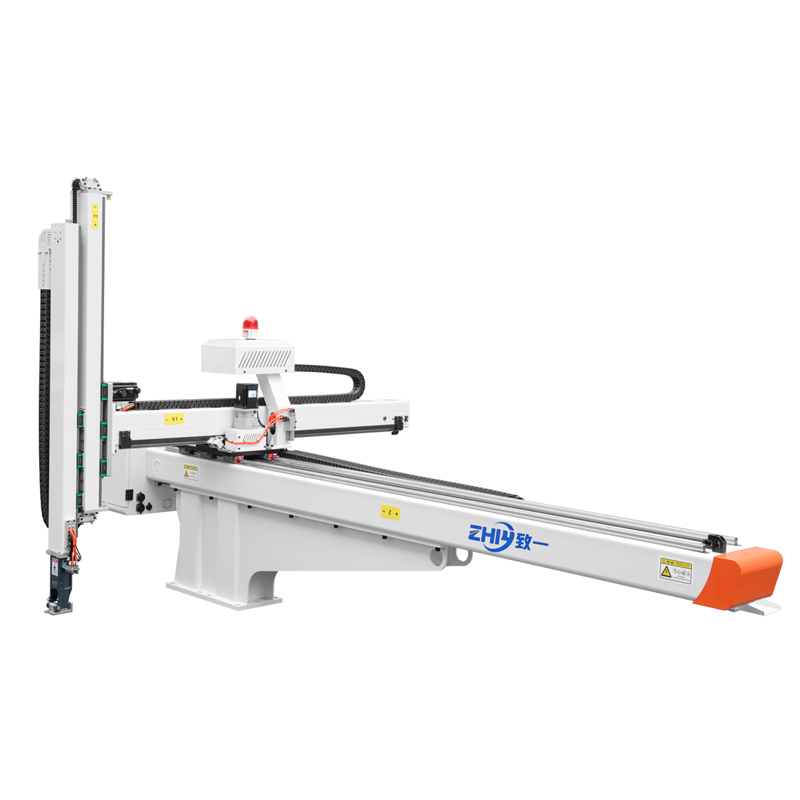
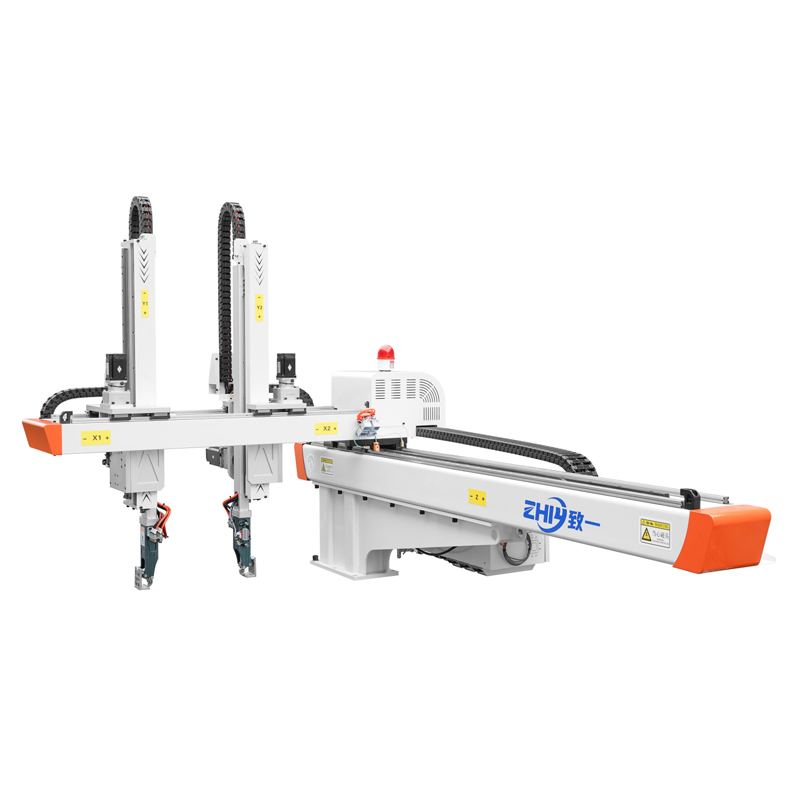
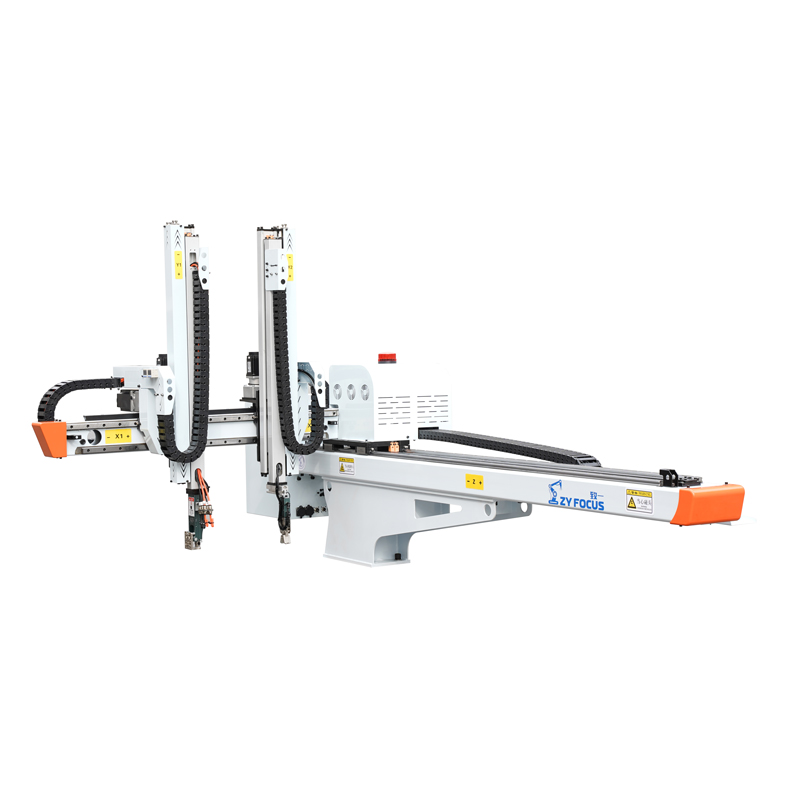
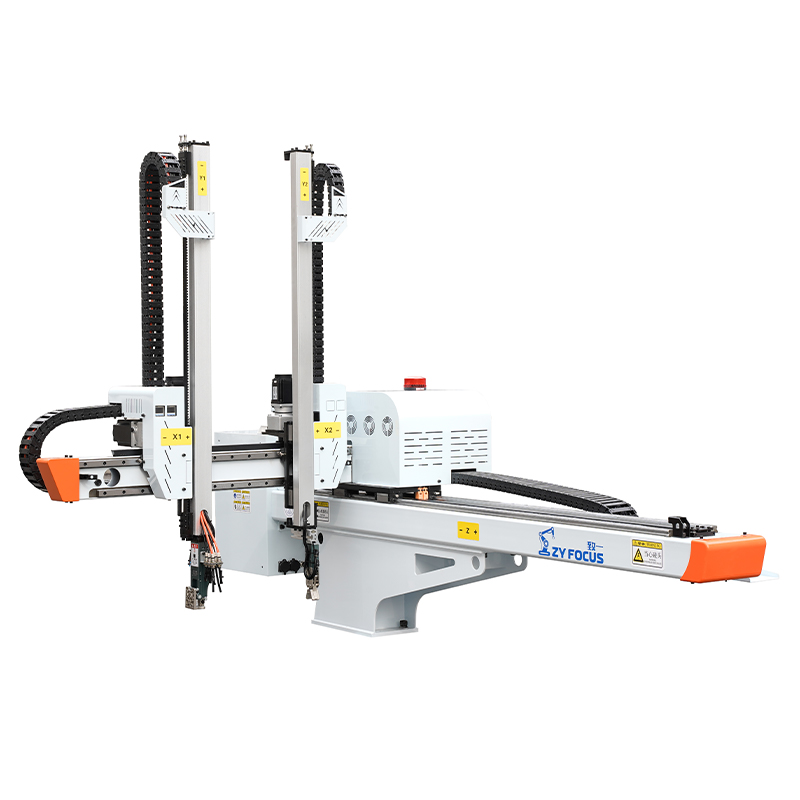
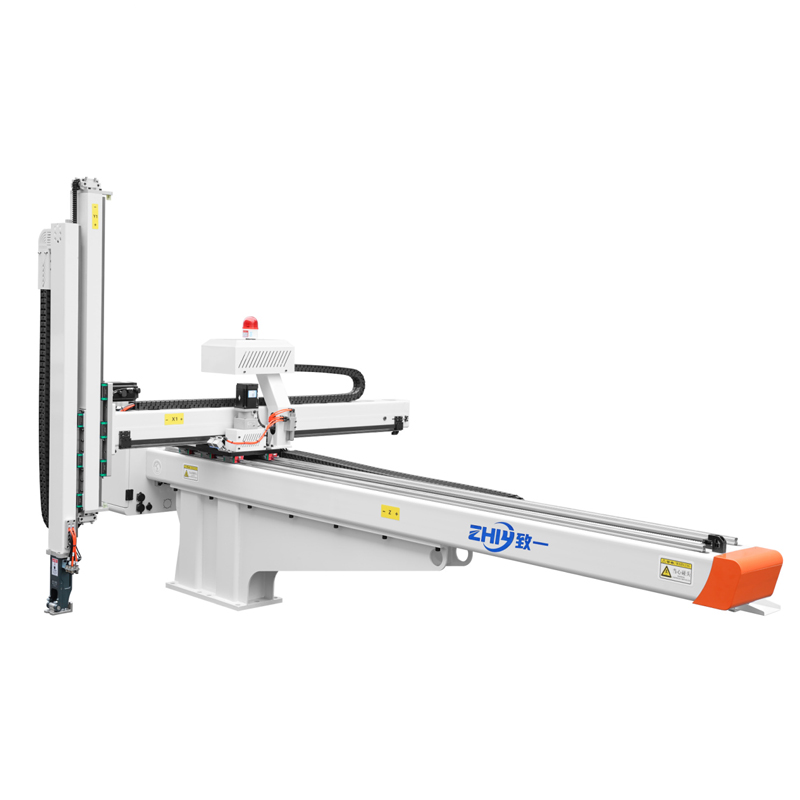
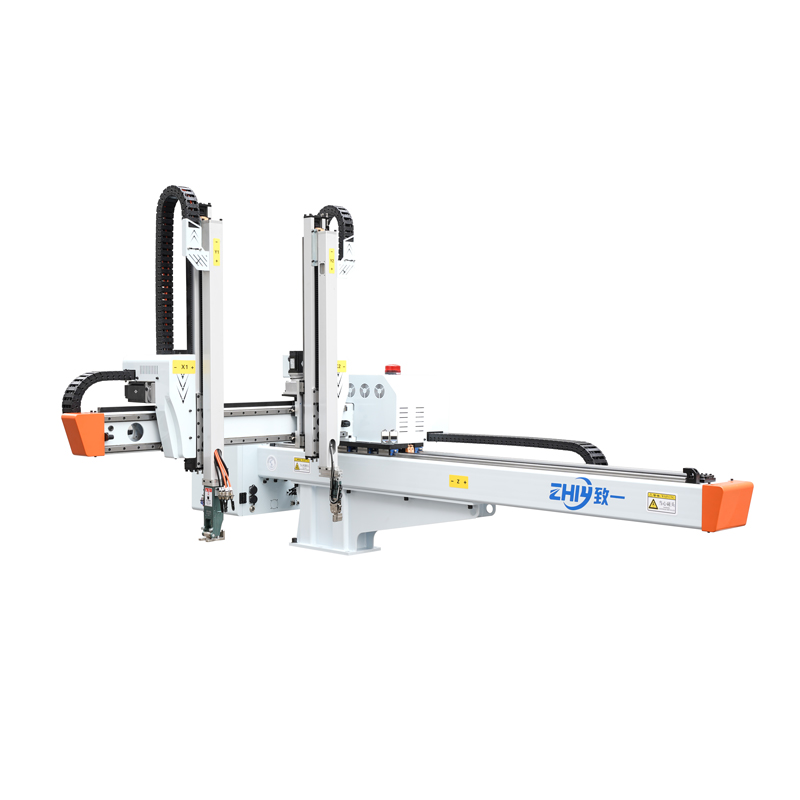
This is the most widely used robot type for 3000T and above large injection molding machines. Featuring a rigid overall structure, strong load-bearing capacity and stable linear movement, three-axis gantry robots are specially designed for heavy-load picking and long-stroke operation. They are suitable for most conventional production tasks, including finished product picking, sprue removal, simple horizontal conveying and regular stacking.
These robots adopt a top-mounted installation method, which does not occupy ground space and adapts well to the complex layout around large injection machines. Their control logic is simple, debugging is convenient, and the failure rate is low during long-term continuous operation. They are the preferred choice for factories focusing on mass production of standard large plastic parts.
2. Five-Axis Servo Robots
On the basis of three-axis movement, five-axis servo robots add rotating and flipping functions of the arm end, with more flexible movement trajectories. They are ideal for production lines with complex post-processing requirements. If your products need angle flipping, multi-layer staggered stacking, or cooperation with multiple stations such as conveyor belts and packaging platforms, five-axis servo robots can fully meet the demands.
Compared with three-axis models, five-axis robots have richer expandable functions and can be compatible with multiple auxiliary processes. Their disadvantage lies in relatively higher cost and slightly more complex programming and operation. They are suitable for manufacturers with diverse product categories and flexible production arrangements.
3. Articulated Robots
Articulated robots have the strongest movement flexibility and can adapt to extremely complex working spaces and multi-station collaborative operations. They are mostly used in production lines that integrate injection molding, assembly, testing and packaging into one unit. However, their effective load and working stroke are limited compared with gantry robots, and the equipment cost and later maintenance cost are higher. For single pick-and-place tasks of large injection parts, articulated robots are not cost-effective and are usually used for supporting auxiliary links rather than direct product picking from 3000T+ injection machines.
Evaluate Drive System and Control Performance
The drive system directly determines the robot’s running stability, response speed and energy consumption. For large-load robots matched with 3000T+ injection machines, full servo drive has become the mainstream configuration.
Servo drive systems deliver precise torque control, smooth acceleration and deceleration, and strong anti-interference ability. When grabbing heavy workpieces, there will be no obvious shaking or jitter, which effectively protects product appearance. Meanwhile, servo motors have high energy efficiency and lower long-term operating costs compared with traditional pneumatic drive. Pneumatic robots are low in price, but their load capacity, running stability and speed adjustability are insufficient, so they are rarely used in 3000T+ large injection molding scenarios.
In terms of control systems, prioritize robots equipped with intuitive touch screen operation interfaces. The system should support quick parameter setting, mold switching and program storage. For factories with multiple production lines, it is recommended to select robots that can be connected with mainstream production management systems. This realizes data synchronization between robots, injection machines and MES systems, facilitating unified production monitoring, output statistics and equipment operation management. Simple and easy-to-learn control systems can also reduce the training cost for on-site operators.
Match End-of-Arm Tooling (EOAT) for Different Products
A high-performance robot also needs supporting end-of-arm tooling to exert its full capacity. EOAT is customized according to the shape, material, surface and weight of injection products, and it is a key link that cannot be ignored in the selection process.
For large-area flat products such as plastic pallets and bathtub shells, vacuum suction cup tooling is the best choice. Multiple sets of suction cups are arranged evenly to ensure uniform stress on the product surface and avoid deformation or local indentation. For rigid products with regular outlines such as large container shells and furniture parts, pneumatic or servo gripper tooling is more reliable, which provides strong clamping force and is not affected by surface roughness.
For production lines that need to cut sprues and runners synchronously, the EOAT can be integrated with shearing components to complete picking and sprue removal in one cycle. When customizing tooling, inform the supplier of the maximum product size, surface material and special appearance requirements to avoid tooling scratching or failing to grab products firmly.
Consider Installation, Maintenance and On-Site Adaptability
1. Installation and Layout
Before purchasing, confirm the robot’s installation method and required space with the supplier. Most robots for 3000T+ injection machines adopt top mounting, which needs to match the reserved installation interface of the injection machine. Check whether the on-site hoisting conditions, power supply and gas circuit layout meet the installation requirements. A standardized installation process can shorten the downtime of the production line and realize rapid commissioning.
2. Environmental Adaptability
The working environment of injection molding workshops is usually accompanied by plastic dust, high temperature and oil stains. Select robots with a high protection level to prevent dust and oil from entering the internal transmission and control components and causing failures. Robots with sealed structural design are more suitable for long-term operation in harsh workshop environments.
3. Daily Maintenance and After-Sales Service
Large industrial robots belong to long-term investment equipment, and convenient daily maintenance is crucial to reducing operating costs. Choose models with modular structural design. Key wearing parts such as belts, bearings and guide rails should be easy to disassemble and replace.
Meanwhile, focus on the supplier’s after-sales service capability, including on-site debugging, regular maintenance, spare parts supply and technical support. Once a robot breaks down on a continuous production line, timely after-sales support can minimize production losses. Learn about the supplier’s service network and response speed in advance.
Budget and Long-Term Return on Investment (ROI) Analysis
Robot selection is not simply about choosing the lowest-priced product. It is necessary to balance initial procurement cost and long-term operating cost to calculate the overall return on investment.
Robots with basic three-axis servo configuration have moderate procurement costs and low later maintenance costs, which are cost-effective choices for factories with single product types and stable production. Multi-axis high-flexibility robots have higher upfront investment, but they can adapt to product updates and process upgrades, extending the service life of the equipment and bringing higher long-term benefits for enterprises with diversified production plans.
Do not cut corners on core configurations such as load, stroke and drive system just to save initial costs. Low-specification robots will face frequent failures, reduced production efficiency and early replacement problems in the later stage, resulting in higher comprehensive costs. Calculate labor cost savings, production capacity improvement and product yield growth after automation to judge whether the selected robot matches your budget and profit expectations.
Final Selection Checklist
Before confirming the order, go through the following checklist one by one to avoid omissions:
- Confirm that the robot’s rated payload has reserved a sufficient safety margin based on the total weight of products and tooling
- Verify that vertical and horizontal strokes fully match the mold size and on-site conveying distance of the 3000T+ injection machine
- Select the robot type (three-axis/five-axis) according to production tasks and process complexity
- Confirm full servo drive and protection level adapted to the injection molding workshop environment
- Complete the customized scheme of end-of-arm tooling combined with product characteristics
- Check the compatibility of the control system with on-site equipment and operation difficulty
- Learn about equipment installation conditions, daily maintenance difficulty and supplier after-sales service terms
- Evaluate the rationality of the overall cost and long-term use value
Wrap Up
Selecting a suitable robot for 3000T+ injection machines is a systematic work that combines production demand, parameter matching, equipment type and after-sales support. The core logic is to take large workpieces, large molds and continuous heavy-load production as the starting point, prioritize stability and matching, and then consider flexibility and expandability.
A well-matched robot can fully release the production capacity of 3000T+ large injection molding machines, realize stable and efficient automated production, and help enterprises gain advantages in product quality and production efficiency in the long-term market competition. By following the above selection guidelines and combining your actual production conditions for comprehensive evaluation, you can find the most ideal robotic automation solution for your production line.