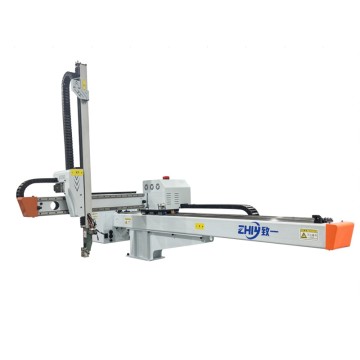
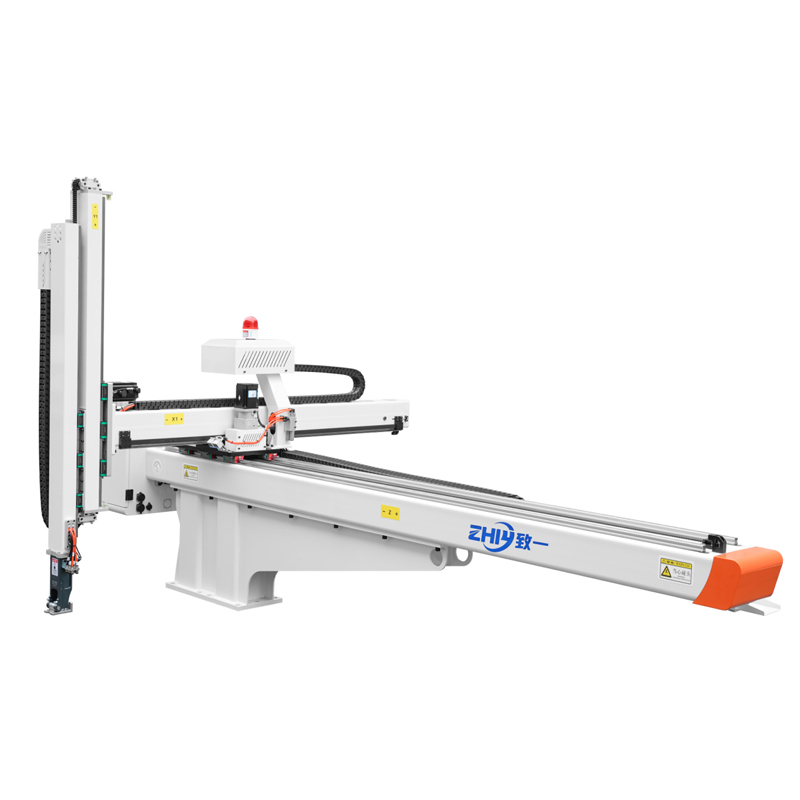
How to Choose a 5 Servo Robot for the Plastic Industry
Automation has become a key driver of productivity, consistency, and cost control in the plastics industry. Whether producing consumer goods, automotive components, medical products, packaging items, or electronic housings, manufacturers are increasingly relying on servo robots to improve efficiency and reduce manual intervention.
Among the available automation solutions, 5 servo robots have gained significant attention because they offer a balance between speed, flexibility, precision, and investment cost. Compared with traditional 3-Axis Robots, they provide greater freedom of movement and can handle more complex molding applications. Compared with fully articulated 6-axis robots, they often deliver faster cycle times and easier integration for injection molding operations.
However, choosing the right 5 servo robot requires more than comparing specifications. Buyers must evaluate production requirements, part characteristics, machine compatibility, future expansion needs, and long-term operating costs.
This guide outlines the most important factors procurement teams, plant managers, and automation engineers should consider when selecting a 5 servo robot for plastic manufacturing operations.
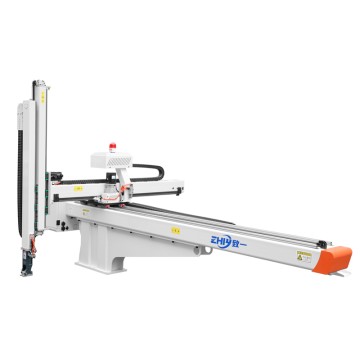
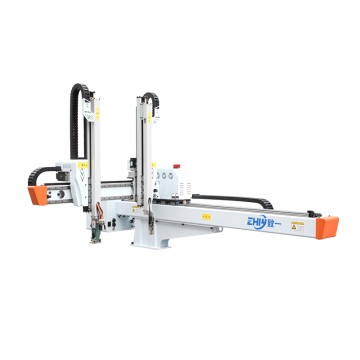
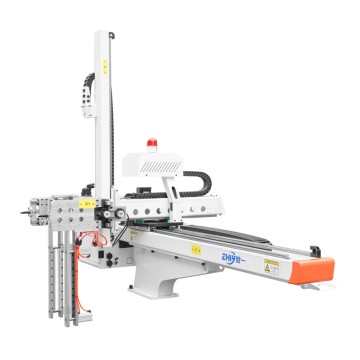
What Is a 5 Servo Robot?
A 5 servo robot typically combines three linear axes (X, Y, and Z) with two additional servo-controlled rotational axes. This configuration allows the robot to remove molded parts, rotate components, perform insert loading, execute secondary operations, and place products in precise orientations without requiring manual handling.
The additional rotational axes enable movements that closely resemble human wrist actions, allowing the robot to access complex mold geometries and manipulate parts more efficiently. In many injection molding applications, a 5 servo robot provides nearly all the flexibility required while maintaining the speed advantages of top-entry automation systems.
Why the Plastic Industry Is Adopting 5 Servo Robots
Plastic manufacturers face several ongoing challenges:
- Rising labor costs
- Increasing quality requirements
- Shorter production cycles
- Demand for traceability and consistency
- Growing pressure to reduce scrap rates
A properly selected 5 servo Robot Can address these challenges by:
- Reducing part removal time
- Improving cycle consistency
- Minimizing product damage
- Supporting lights-out production
- Increasing machine utilization
- Enabling automated downstream operations
For complex molded parts, rotational movement allows the robot to extract products safely from molds where straight-line removal would be difficult or impossible. This capability can significantly reduce defects and improve overall production efficiency.
Start with Your Production Requirements
The biggest mistake buyers make is selecting a Robot Based solely on specifications rather than application needs.
Before evaluating suppliers or models, answer the following questions:
What products are being molded?
Part geometry directly affects robot selection.
Simple packaging components may only require basic pick-and-place functions.
Complex products with:
- Deep cavities
- Undercuts
- Inserts
- Thin walls
- Decorative surfaces
often require rotational extraction capabilities that a 5 servo robot can provide.
What is the production volume?
High-volume operations require robots capable of maintaining speed and repeatability over millions of cycles.
A robot that appears adequate in a demonstration environment may struggle under continuous production conditions.
What downstream processes are involved?
Many modern plastic manufacturing cells require robots to perform more than part removal.
Examples include:
- Insert loading
- Product assembly
- Vision inspection
- Labeling
- Gate cutting
- Packaging
- Palletizing
Understanding future automation requirements helps prevent under-specification.
Evaluate Payload Requirements Carefully
Payload capacity is one of the most important selection criteria.
However, larger is not always better.
The payload calculation should include:
- Product weight
- End-of-arm tooling weight
- Vacuum systems
- Grippers
- Sensors
- Additional fixtures
Industry experts generally recommend maintaining a safety margin above the actual working load. This improves stability and extends component life.
Oversized robots often introduce disadvantages:
- Higher purchase costs
- Greater energy consumption
- Reduced acceleration
- Longer cycle times
For example, selecting a 15 kg payload robot to handle a 2 kg molded component may reduce overall efficiency rather than improve it.
Verify Reach and Stroke Dimensions
A robot must comfortably cover the entire operating area of the molding machine.
Buyers should evaluate:
Mold Dimensions
The robot should access every required pickup point without approaching mechanical limits.
Machine Size
Stroke lengths must accommodate:
- Mold opening distance
- Part extraction distance
- Product placement positions
Future Flexibility
If new molds are expected within the next few years, additional reach may be justified.
Industry specialists recommend avoiding designs that operate continuously near maximum travel limits because this reduces flexibility and may affect long-term performance.
Focus on Repeatability Instead of Accuracy
Many buyers mistakenly focus on absolute accuracy.
In most injection molding applications, repeatability is far more important.
Repeatability measures how consistently the robot returns to the same position over thousands of cycles.
For operations such as:
- Part removal
- Insert placement
- Assembly
- Packaging
consistent positioning delivers greater value than theoretical positioning accuracy. Industry professionals frequently emphasize the distinction between accuracy and repeatability when evaluating industrial robots.
For high-precision molding operations, repeatability specifications may become a critical purchasing factor.
Analyze Cycle Time Requirements
Cycle time directly impacts profitability.
A robot that removes just one second from every molding cycle can generate substantial productivity gains over a year.
When comparing robots, evaluate:
- Extraction speed
- Acceleration performance
- Simultaneous axis motion
- Settling time
- Gripper response speed
Experienced automation engineers recommend measuring actual production conditions rather than relying solely on theoretical machine specifications. Real-world cycle performance often differs from brochure values.
Consider End-of-Arm Tooling Compatibility
The robot is only part of the automation solution.
Its effectiveness depends heavily on end-of-arm tooling (EOAT).
The chosen robot should support:
- Vacuum cups
- Mechanical grippers
- Insert loading devices
- Vision-guided tooling
- Multi-product tooling systems
For facilities running frequent mold changes, quick-change EOAT systems can dramatically reduce downtime and improve production flexibility. User feedback from injection molding professionals consistently highlights EOAT adaptability as a critical purchasing factor.
Evaluate Control System Integration
Modern plastic manufacturing increasingly relies on connected production environments.
A robot should integrate easily with:
- Injection molding machines
- Conveyors
- Vision systems
- Quality inspection equipment
- Manufacturing execution systems
- Factory automation platforms
Advanced controllers can coordinate multiple peripheral devices, enabling more sophisticated automation workflows while simplifying production management.
Review Environmental Conditions
Production environments vary significantly across the plastics industry.
Consider factors such as:
Temperature
High-temperature molding operations may require enhanced motor and controller protection.
Dust and Contamination
Certain manufacturing environments demand sealed components and protective enclosures.
Humidity
Facilities with elevated humidity levels may require higher ingress protection ratings.
Environmental compatibility plays a major role in long-term reliability and maintenance costs.
Examine Reliability and Maintenance Requirements
A robot is a long-term capital investment.
Downtime often costs more than the initial purchase price difference between competing systems.
Evaluate:
- Component quality
- Servo motor reliability
- Maintenance intervals
- Spare parts availability
- Diagnostic capabilities
- Technical support network
Experienced processors often rank reliability and service support among the most important purchasing criteria because these factors directly affect long-term production stability.
Think Beyond Current Production Needs
The best robot is not necessarily the one that meets today's requirements.
It is the one that supports future growth.
Consider whether the robot can accommodate:
- New product families
- Additional tooling
- Vision systems
- Assembly operations
- Increased production volumes
A scalable automation platform often provides a better return on investment than a solution designed solely for current production requirements.
Questions to Ask Before Making a Final Decision
Before approving a purchase, procurement teams should ask:
- Does the payload include tooling weight?
- Can the robot achieve the required cycle time under actual production conditions?
- What repeatability is guaranteed during continuous operation?
- How easily can EOAT be changed?
- Can the controller communicate with existing equipment?
- What preventive maintenance is required?
- How quickly are spare parts available?
- Is local technical support available?
- Can the robot support future automation projects?
- What is the expected lifecycle cost rather than just the purchase price?
Final Thoughts
Choosing a 5 servo robot for the plastic industry involves far more than selecting the model with the highest speed or payload rating. The ideal solution must align with part characteristics, production volumes, machine specifications, cycle time targets, and future automation plans.
Successful buyers focus on practical performance indicators such as repeatability, cycle efficiency, reach, tooling compatibility, reliability, and system integration rather than headline specifications alone. By evaluating these factors carefully, manufacturers can select a robot that delivers consistent quality, higher productivity, and long-term operational value throughout the life of the production cell.