Leave Your Message
0102030405
The Five Key Elements of Imported Injection Molding Machine Servo Manipulators
2026-04-22
The Five Key Elements of Imported Injection Molding Machine Servo Manipulators
In the global injection molding industry, imported servo manipulators have become core automation equipment for optimizing production efficiency, stabilizing product quality, and reducing labor costs. For international buyers, choosing a reliable imported injection molding machine servo manipulator is not just about purchasing equipment—it is about investing in long‑term production stability and operational profitability.
This article breaks down the five key elements you must evaluate when selecting imported injection molding machine servo manipulators, helping you make data‑driven, risk‑controlled purchasing decisions that align with your production line and business goals.
Table of Contents
- Core Servo Drive System Performance
- Structural Rigidity & Load‑Stroke Matching
- Control System Stability & Compatibility
- Certification, Quality & Safety Standards
- After‑Sales Support & Global Service Network
1. Core Servo Drive System Performance
The servo drive system is the heart of an injection molding machine servo manipulator. It directly determines positioning accuracy, response speed, motion smoothness, and long‑term durability—all critical for high‑speed, high‑precision injection molding automation.
When evaluating imported models, focus on these indicators:
- Positioning accuracy: Ideally within ±0.1 mm, ensuring stable picking, placing, and inserting.
- Repeatability: Consistency in cycle after cycle to avoid defective products.
- Dynamic response: Fast acceleration and deceleration to shorten takt time without causing vibration.
- Motor & drive brand: High‑quality imported servo components ensure lower failure rates and longer service life.
- Energy efficiency: Advanced servo systems reduce power consumption compared to traditional pneumatic or hydraulic solutions.
A high‑performance servo system improves production efficiency and lowers long‑term operating expenses, making it the first priority for buyers.
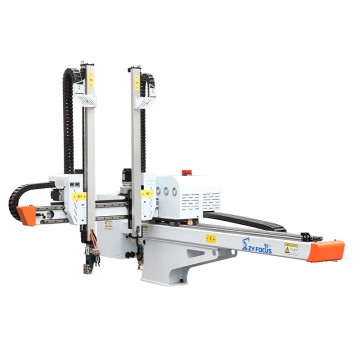
2. Structural Rigidity & Load‑Stroke Matching
Mechanical structure and load‑stroke parameters determine whether the manipulator can safely and stably meet your actual production needs. Many buyers overlook matching, leading to overload, vibration, shortened service life, or insufficient working range.
Key points to verify:
- Rated load: Must match your heaviest molded parts or inserts; leave a safety margin.
- Stroke dimensions: X, Y, Z strokes must fit your injection machine size and mold layout.
- Structural material: High‑strength aluminum alloy or steel ensures rigidity and reduces deformation.
- Design stability: Single‑arm, double‑arm, single‑section, or double‑section structures should match your application—take‑out, insertion, in‑mold labeling, etc.
- Lifespan design: Fatigue‑resistant design supports high‑frequency, 24‑hour continuous operation.
Correct load‑stroke matching avoids premature wear and keeps your line running smoothly.
3. Control System Stability & Compatibility
The control system acts as the brain of the servo manipulator. It affects ease of use, programming efficiency, fault diagnosis, and compatibility with your existing injection molding machines.
For imported equipment, prioritize:
- Intuitive human‑machine interface (HMI): Easy programming with simple teaching functions.
- Multi‑axis linkage capability: Smooth coordinated motion for complex trajectories.
- Fault self‑diagnosis: Real‑time alarms and troubleshooting guidance reduce downtime.
- Wide compatibility: Seamless connection with most mainstream injection molding machine brands.
- Expandability: Supports upgrades like I/O expansion, vision guidance, or conveyor integration.
Stable, compatible controls reduce training costs and improve line adaptability.
4. Certification, Quality & Safety Standards
For cross‑border buyers, certifications and quality systems are non‑negotiable. They prove compliance with international regulations and reflect the manufacturer’s quality commitment.
Widely recognized certifications include:
- ISO 9001: Ensures consistent quality management.
- CE: Meets EU health, safety, and environmental protection requirements.
- Other regional certifications: Depending on your market, such as FCC or national safety marks.
You should also confirm:
- Strict incoming material inspection
- Precision machining and assembly processes
- Full load and aging tests before delivery
- Stable component supply chains
Certified, rigorously tested manipulators lower risks of customs clearance issues, workplace accidents, and unplanned downtime.
5. After‑Sales Support & Global Service Network
Even the most reliable equipment requires maintenance, spare parts, and technical support. For imported injection molding servo manipulators, global after‑sales service directly impacts your production continuity.
Evaluate these service capabilities:
- Response speed: Local or regional service teams to minimize waiting time.
- Spare parts availability: Quick access to common wearing parts.
- Installation & commissioning: Professional on‑site or remote guidance.
- Operator training: Clear training for daily use and basic maintenance.
- Warranty terms: Fair warranty period and clear after‑sales policy.
Strong after‑sales support turns one‑time purchase into long‑term partnership.
How to Balance the Five Elements in Real Purchasing
Every production line has unique requirements. Here is a simple practical framework:
- Clarify your injection machine model, product weight, and required stroke.
- Prioritize servo performance for high‑precision or high‑speed projects.
- Confirm certifications that match your target market.
- Verify control compatibility with your existing line.
- Evaluate after‑sales coverage in your region.
Balancing these five elements helps you select high‑cost‑performance imported servo manipulators that improve efficiency, stabilize quality, and strengthen competitiveness.
Conclusion
Imported injection molding machine servo manipulators are strategic automation assets. The five core elements—servo system performance, structural rigidity & matching, control stability & compatibility, certification & quality, and global after‑sales support—form a complete evaluation system for international buyers.
By focusing on these factors, you can avoid blind selection, reduce investment risk, and build a stable, efficient, and profitable automated injection molding production line.
Email:sales@zhiyirobotics.com
Whatsapp:15215884071