
Leave Your Message
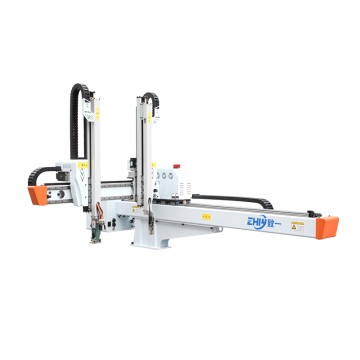
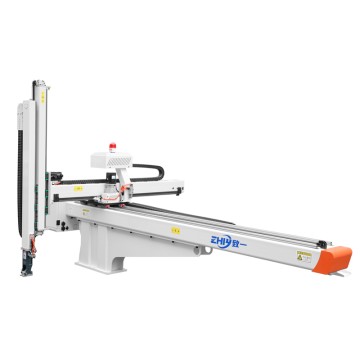
Robot Selection: A Case Study of Five-Axis Robots in Injection Molding of Motor Housings for New Energy Vehicles
Robot Selection: A Case Study of Five-Axis Robots in Injection Molding of Motor Housings for New Energy Vehicles
The rapid development of the new energy vehicle industry has led to increasingly stringent production requirements for core injection-molded components like motor housings. High precision, high consistency, and high production efficiency have become stringent standards, making traditional three-axis robots insufficient for the complex molding processes. Five-axis servo robots, with their flexible multi-axis linkage and high-precision positioning control, have become core automated equipment in the injection molding production of new energy vehicle motor housings. This article will analyze the selection logic of five-axis robots, starting from the pain points of injection molding production of new energy vehicle motor housings, and provide a suitable reference for injection molding companies based on practical application cases.
I. Injection Molding of New Energy Vehicle Motor Housings: Why Have Five-Axis Robots Become a Necessity?
Whether made of engineering plastics or metal composite injection molding, new energy vehicle motor housings are characterized by irregular structures, high dimensional accuracy, and difficulty in demolding. Simultaneously, the demanding production cycle time under mass production requirements dictates the core requirements for robots, which is the key reason why five-axis robots are replacing traditional equipment.
The complexity of the molding process requires multi-dimensional operation: Motor housings, designed to accommodate motor assembly, often incorporate complex structures such as heat dissipation fins, mounting clips, and positioning holes. Molds frequently feature core-pulling and angled ejector mechanisms. Three-axis robots can only achieve linear motion along the X/Y/Z axes, making them unable to perform angled part removal or multi-angle posture adjustments, and prone to interference with mold components. In contrast, five-axis robots, with their synchronized rotary axes, can achieve 360° operation without blind spots, easily avoiding mold structures to achieve precise part removal.
Precision requirements dictate high positioning standards: The dimensional tolerances of new energy vehicle motor housings must be controlled within micrometers, with stringent requirements for coaxiality, parallelism, and other geometric tolerances. Failure to meet these requirements will directly impact motor assembly accuracy and operational stability. Five-axis servo robots achieve a repeatability accuracy within ±0.05mm. Combined with the smooth operation of a servo drive system, this effectively avoids bumps and positional deviations during part removal and placement, ensuring product consistency.
High-efficiency adaptation to mass production demands: The large-scale production of new energy vehicles requires 24-hour continuous operation of motor housing injection molding. A five-axis Robot Can integrate multiple processes such as gate separation, product inspection, and pallet stacking, eliminating the need for manual intervention. A single cycle time can be reduced to within 8 seconds, increasing efficiency by over 60% compared to manual production, while significantly reducing labor costs and scrap rates.
Adaptability to high-temperature molding environments: Motor housings often use high-temperature resistant engineering plastics such as PPS and PA66. The surface temperature of the product is high during demolding. A five-axis robot can be equipped with high-temperature resistant flexible clamps and heat insulation devices to prevent product damage caused by high-temperature deformation of the clamps during part removal. It also enables automated continuous part removal, solving the safety issues associated with high-temperature operations during manual part removal.
II. Injection Molding of Motor Housings for New Energy Vehicles: Key Selection Considerations for Five-Axis Robots
Given the production characteristics of motor housings for new energy vehicles, the selection of a five-axis robot should focus on five core dimensions: load capacity, positioning accuracy, motion flexibility, process integration capability, and stability. Simultaneously, it should be customized based on the actual mold specifications, injection molding machine tonnage, and production cycle time. The specific selection criteria are as follows:
1. Load Capacity: Match Product Weight + Fixture Weight, with a Safety Margin
The weight of the motor housing varies depending on the vehicle model and design. A single motor housing for a small new energy passenger vehicle weighs approximately 1-3 kg, while commercial vehicle models can reach 5-8 kg. When selecting a five-axis robot, its rated load must cover the product weight + the weight of the customized fixture, with a safety margin of at least 50% to avoid vibration and accuracy deviations due to insufficient load during high-speed movement. For example, for a 3 kg motor housing, it is recommended to select a five-axis robot with a rated load ≥ 8 kg. If integrating vision inspection and gate shearing devices, the load capacity needs to be further increased.
2. Positioning Accuracy: Repeatability ≤ ±0.05mm, adapting to geometric tolerance requirements.
The coaxiality and positional accuracy requirements of the motor housing directly determine the robot's accuracy standard. Core selection indicators should focus on repeatability and path positioning accuracy. Repeatability must be ≤ ±0.05mm to ensure consistent placement and pickup positions each time. Simultaneously, a five-axis robot equipped with a high-precision linear scale and servo drive system should be selected to achieve precise speed control during movement, avoiding product deviation caused by sudden stops or accelerations.
3. Motion Flexibility: Rotary Axis Travel and Speed Adapted to Mold Structure.
The travel and rotational speed of the five-axis robot's A/C axes (rotary axes) are crucial for adapting to the mold structure. For motor housing molds with multiple angled ejectors and core pulling mechanisms, the A-axis rotation angle must be ≥ ±180°, and the C-axis rotation angle must be 360° without dead angles. Simultaneously, the rotational speed should be adjustable to meet the production needs of slow-walk positioning and fast-walk acceleration, ensuring accuracy during pickup without affecting the production cycle.
4. Process Integration Capability: Supports Multi-Process Linkage, Reducing Production Line Equipment Investment
A high-quality five-axis robot must possess strong process integration capabilities, directly integrating functions such as automatic gate shearing, initial product appearance inspection, automatic tray placement, and raw material feeding. Multi-process linkage can be achieved through a programmable control system. For example, after retrieving the motor housing, the robot's end effector can precisely shear the gate, then send the product to the inspection station for initial dimensional inspection. Qualified products are directly trayed, while unqualified products are automatically sorted, achieving integrated "retrieving-processing-inspection-sorting" operations, significantly shortening the production line workflow.
5. Stability and Protection: Adaptable to industrial production environments, meeting 24-hour operation requirements.
Injection molding production lines for motor housings typically operate continuously for 24 hours, making the structural rigidity and protection level of the robotic arm crucial. The body must be constructed of high-rigidity steel to prevent structural deformation caused by prolonged high-speed movement; the protection level must reach IP54 or higher to withstand the dust, oil, and moisture corrosion of the injection molding workshop; it should also be equipped with fault self-diagnosis, emergency stop protection, and mold anti-collision functions, allowing for immediate shutdown in case of abnormalities to prevent damage to equipment and molds and ensure continuous operation of the production line.
6. Adaptability: Seamless Integration with Injection Molding Machines and Molds
When selecting a robot, ensure seamless integration with existing injection molding machine tonnage and mold specifications. For large injection molding machines of 800T and above, it is recommended to choose a heavy-duty five-axis servo robot with an extended arm to meet the part-removal stroke requirements of large molds. Simultaneously, the robot's control system must support signal communication with the injection molding machine and mold, enabling real-time linkage of injection completion signals, robot part-removal signals, and mold opening/closing signals to avoid waiting time between devices.
III. Injection Molding of Motor Housings for New Energy Vehicles: A Case Study of Five-Axis Robotic Arm Application
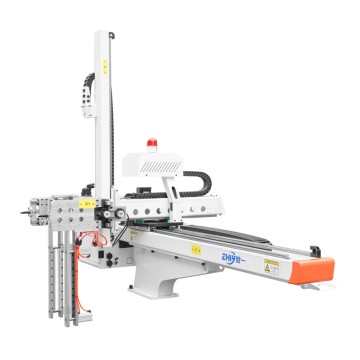
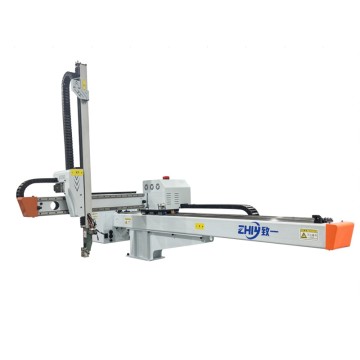
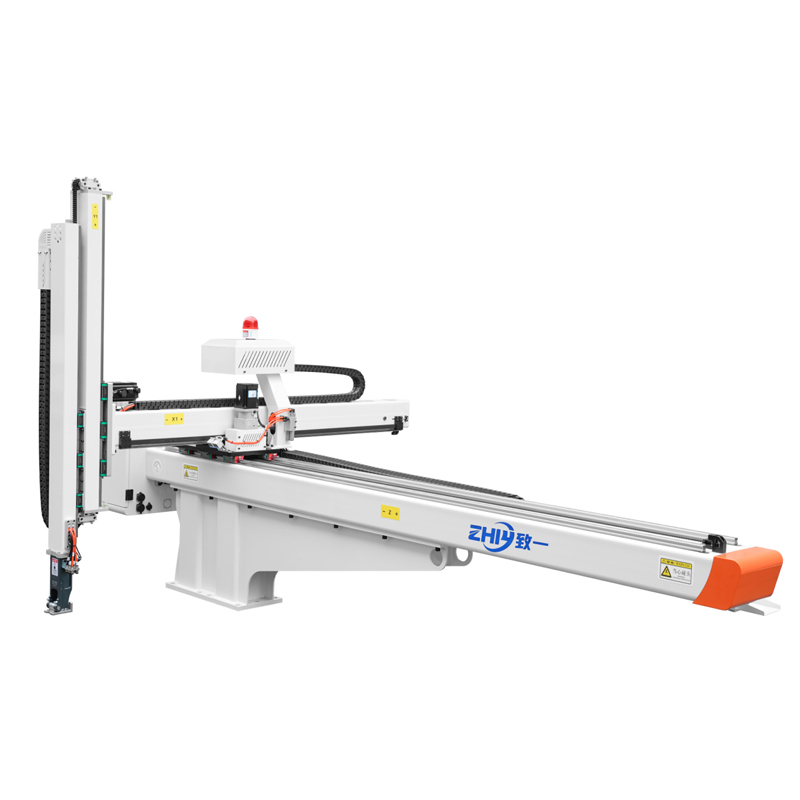
Case Background: A core component manufacturer for new energy vehicles specializes in the injection molding of motor housings for new energy passenger vehicles. The products are made of PPS engineering plastic, weighing 2.8kg each, with a dimensional tolerance requirement of ±0.03mm. The original production model used a three-axis robotic arm plus manual assistance, which suffered from problems such as part handling interference, high scrap rate (approximately 5%), and slow production cycle (15 seconds per cycle). To meet the production demand of 500,000 units per year, a ZHIYI five-axis dual-arm servo robotic arm was introduced to upgrade the production line.
Selection and Matching
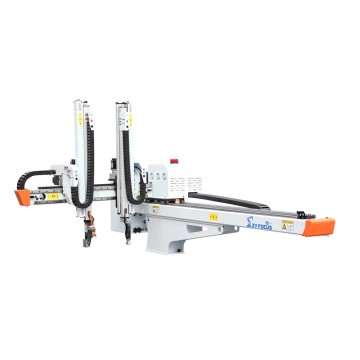
Based on product characteristics and production requirements, the ZHIYI customized five-axis dual-arm servo robot was ultimately selected. Its core configuration is as follows:
Rated load: 10kg, with sufficient safety margin, capable of accommodating high-temperature resistant flexible fixtures and gate shearing devices;
Repeatability: ±0.03mm, meeting the product's micron-level tolerance requirements;
A/C axis rotation angle: A-axis ±180°, C-axis 360°, adaptable to mold angled ejector and core-pulling structures, achieving interference-free angled part removal;
Process integration: Integrates automatic gate shearing, CCD vision initial inspection, and automatic tray placement functions, achieving multi-process integration;
Injection molding machine compatibility: 800T large injection molding machine, the extended arm meets the mold part removal stroke requirements, and the control system seamlessly integrates with the injection molding machine.
Application Results
Significantly Improved Production Efficiency: Single cycle time reduced from 15 seconds to 9 seconds, hourly capacity increased by 66.7%, and 24-hour continuous operation can achieve an annual production of 600,000 units, exceeding production targets;
Significantly Reduced Scrap Rate: The high-precision positioning and stable operation of the five-axis robotic arm completely solves the problems of part collisions and positional deviations during part handling, reducing the scrap rate from 5% to 0.8%, significantly reducing material waste;
Optimized Labor Costs: The number of workers per production line reduced from 3 to 1 (only responsible for equipment monitoring), reducing labor costs by 66%. Combined with 24-hour operation, annual labor cost savings exceed one million yuan;
Automation Upgrade of Production Line: Achieves full automation of the entire process from "injection molding - part handling - gate shearing - inspection - tray placement," with no human intervention. Product consistency reaches 99.9%, meeting the supply standards of new energy vehicle OEMs;
Excellent Equipment Stability: The equipment is equipped with an IP55 protection system and fault self-diagnosis function, and the equipment failure rate during 24-hour continuous operation is less than [percentage missing]. 0.5%, ensuring efficient production line operation.
Case Study Core Value: This case study fully validates the suitability of five-axis robots in the injection molding production of new energy vehicle motor housings. Through customized selection and process integration, it not only solves the pain points of traditional production models but also achieves a triple improvement in production efficiency, product quality, and cost control, providing a replicable automation solution for the large-scale production of core injection-molded components for new energy vehicles.
IV. Avoiding Key Misconceptions in Five-Axis Robot Selection
In selecting five-axis robots for the injection molding of new energy vehicle motor housings, many companies easily fall into the trap of "parameter-only" and "blindly choosing the most expensive." Common misconceptions that lead to equipment mismatch with production needs and wasted costs can be avoided. Here are the key points to avoid these pitfalls:
Avoid focusing solely on parameters without considering actual compatibility: Some companies blindly pursue high load capacity and high precision, neglecting the actual requirements of mold specifications and injection molding machine tonnage. For example, using a heavy-duty five-axis robot for a small mold not only increases equipment investment but also affects production cycle time due to excessive stroke.
Avoid neglecting process integration capabilities: If only a five-axis robot with a single part-picking function is selected, it still needs to be combined with other equipment to complete processes such as gate shearing and inspection, failing to achieve production line integration and ultimately requiring additional investment.
Avoid neglecting after-sales service and technical support: The debugging and maintenance of five-axis robots require a professional technical team. When selecting a robot, pay attention to the supplier's global after-sales service network and technical training support to ensure timely maintenance and debugging even at overseas production bases.
Avoid neglecting equipment compatibility and scalability: New energy vehicle products are rapidly updated, and the design of motor housings also changes accordingly. When selecting a robot, choose one with strong programmability and flexible end effector replacement to meet production needs after product upgrades and avoid secondary equipment investment. V. Conclusion The injection molding production of motor housings for new energy vehicles has upgraded its requirements for automation equipment from "simple part handling" to "high precision, high efficiency, and integration." Five-axis servo robots, with their multi-axis linkage flexibility, high-precision positioning control, and powerful process integration capabilities, have become the optimal solution in this field. During the selection process, companies need to focus on three core aspects: product characteristics, production needs, and mold specifications. Customized matching should be performed from dimensions such as load capacity, positioning accuracy, and motion flexibility. At the same time, selection pitfalls should be avoided, and suppliers with strong technical capabilities and comprehensive after-sales service should be chosen.
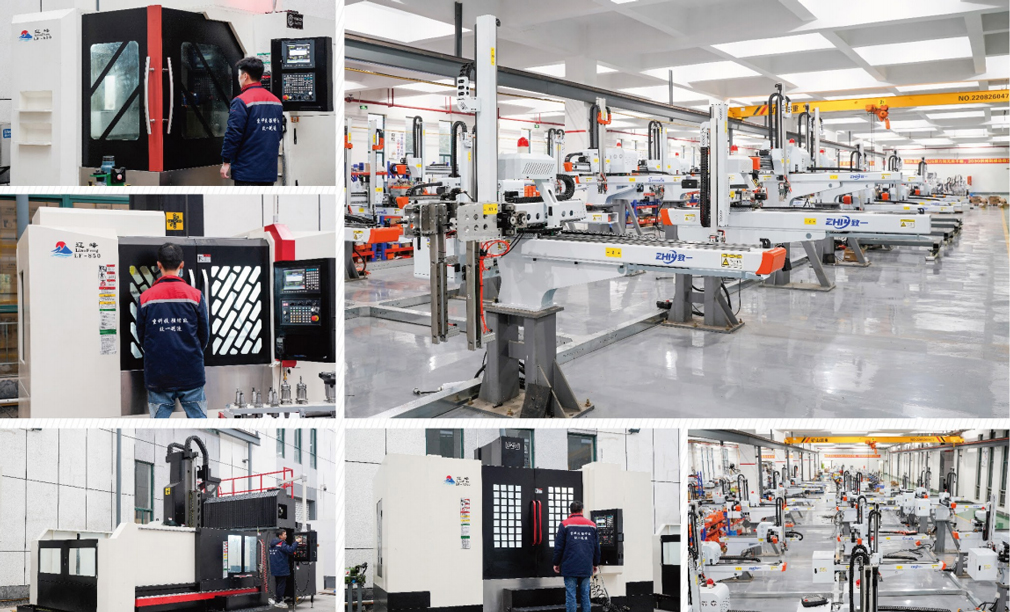
ZHIYI, as a professional equipment provider in the field of industrial automation, has deep expertise in the R&D and production of servo robots for injection molding machines. It can provide customized five-axis robot solutions according to the different production needs of new energy vehicle motor housings, providing a one-stop service throughout the entire process, from selection and design, equipment manufacturing, on-site commissioning to after-sales support. This helps injection molding companies complete their automation upgrades and match the large-scale production needs of the new energy vehicle industry.
#5-axis robot #New energy vehicle motor housing #Injection molding machine servo robot #Robot selection #New energy vehicle motor housing injection molding robot selection #5-axis servo robot application case #5-axis robot for motor housing injection molding #800T 5-axis robot for injection molding machine #PPS motor housing injection molding robot