
Leave Your Message
Precision Comparison: How Much More Precise is a 5-Axis Servo Robot for Injection Molding Machines Compared to a 3-Axis Robot?
Precision Comparison: How Much More Precise is a 5-Axis Servo Robot for Injection Molding Machines Compared to a 3-Axis Robot?
In the automation upgrade of injection molding processes, the precision of servo robots directly determines product yield, production efficiency, and market competitiveness. The precision difference between 3-axis and 5-axis servo robots for injection molding machines is a core consideration for international wholesale buyers. As core automation equipment in injection molding production, 5-Axis Robots, with their multi-dimensional motion control and precise transmission design, achieve a significant leap in precision compared to 3-axis robots. The precision difference is not only reflected in numerical values but also in core dimensions such as error control and adaptation to complex working conditions in actual production. This article will comprehensively analyze the precision advantages of 5-axis servo robots over 3-axis robots from the perspectives of precision values, error causes, and practical applications, providing professional reference for injection molding companies in selecting automation equipment.
Core Precision Stats: Five-Axis Robots Offer Several Times the Precision of Three-Axis Robots; Micron-Level Differences Create a Quality Gap
The core precision metrics for injection molding machine servo robots are repeatability and positioning accuracy. These two metrics directly determine the precision of the robot's part handling, placement, and in-mold operations. The difference between five-axis and three-axis robots in these two core metrics is significant, and this gap widens further as production demands increase in precision.
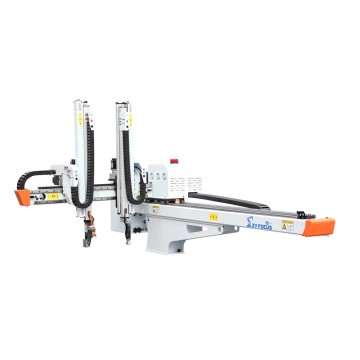
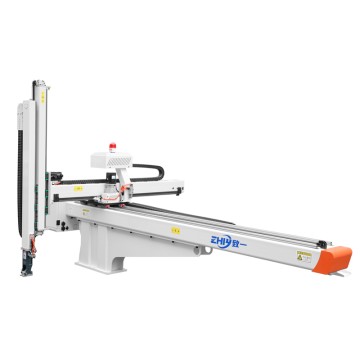
Three-axis injection molding machine servo robots use the X, Y, and Z linear motion axes as their core. The repeatability of mainstream models is approximately ±0.05mm to ±0.1mm. Some heavy-duty three-axis robots (such as bull-head three-axis servo robots) have slightly lower repeatability of around ±0.1mm due to load and stroke limitations. Their positioning accuracy is affected by the backlash of the linear transmission mechanism, with an error of approximately ±0.1mm to ±0.2mm under normal operating conditions, which only meets the precision requirements for ordinary injection molded parts (such as daily necessities and ordinary appliance casings).
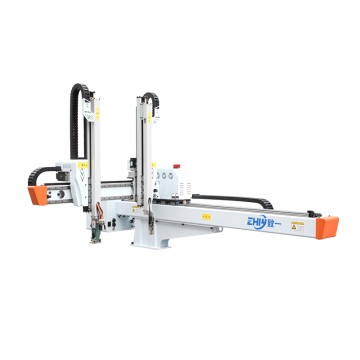
Five-axis injection molding machine servo robots, building upon the three-axis linear motion, add two rotary axes. Combined with a closed-loop servo control system and high-precision transmission components, their repeatability can stably reach ±0.01mm~±0.02mm. High-end five-axis dual-Arm Robots can even break through the micron-level threshold of ±0.01mm in repeatability. Their positioning accuracy error can be controlled within ±0.02mm, a 5-10 times improvement over three-axis robots, perfectly suited for injection molding production scenarios with stringent precision requirements, such as precision electronic components, medical consumables, and automotive precision parts.
Industry testing data shows that after 24 hours of continuous operation, three-axis robots experience a cumulative accuracy error of 0.03mm~0.05mm due to slight wear on transmission components. In contrast, five-axis robots, with their independent servo control of the rotary axes and automatic error compensation, accumulate an accuracy error of no more than 0.005mm after continuous operation, demonstrating significantly superior long-term accuracy stability compared to three-axis robots.
The Core Reason for the Precision Gap: Fundamental Differences in Motion Freedom and Control Technology
The precision gap between a five-axis injection molding machine servo robot and a three-axis robot is not simply a matter of "adding more axes," but rather stems from fundamental differences in motion freedom, transmission technology, and control systems. This is also the core reason why five-axis robots can achieve high-precision control.
1. Motion Freedom: From "Plane Operation" to "All-Around Precise Control"
A three-axis robot has only three linear axes (X, Y, Z), limiting its workpiece handling to linear movements in three-dimensional space. When faced with complex mold structures (such as undercuts and deep cavities), repeated adjustments to the workpiece or mold position are necessary. Each adjustment introduces positioning errors, which accumulate and directly affect overall precision. In contrast, the two additional rotary axes of a five-axis robot allow for multi-angle rotation and attitude adjustment at the robot's end effector. This eliminates the need for repeated mold clamping or adjustments; a single positioning operation completes all in-mold operations, fundamentally avoiding the accumulation of errors from multiple positioning steps. This is the core premise that five-axis robots achieve significantly higher precision than three-axis robots.
2. Transmission and Control Technology: Dual Guarantee of High-Precision Components and Closed-Loop
Compensation Five-axis injection molding machine servo robots utilize precision planetary reducers, high-rigidity linear guides, and imported servo motors. Combined with RTCP (Rotation Control of Tool Center Point) technology, the system automatically compensates for the displacement of the linear axes during rotary axis movement, ensuring the robot's end effector remains on the preset path and preventing accuracy deviations caused by rotation. In contrast, three-axis robots have relatively simple transmission structures, often using ordinary linear guides and reducers, lacking automatic error compensation. Backlash and wear during transmission can easily lead to accuracy deviations.
Furthermore, the multi-axis linkage closed-loop control system of a five-axis robot can monitor the position and speed of each axis in real time, comparing the actual motion data with preset commands. If an error occurs, it immediately performs dynamic compensation. Three-axis robot control systems are mostly open-loop or simple closed-loop, only capable of basic position control and unable to correct errors during operation in real time.
3. Structural Design: The Difference in Balancing Heavy Load and Precision
Three-axis robots are designed with "simplicity and efficiency" as their core principle, and are mostly used in low-to-medium load injection molding production. When the load increases (e.g., above 50kg), transmission precision is sacrificed to ensure structural stability, leading to a further decrease in precision under heavy load conditions. Five-axis robots, on the other hand, employ a modular dual-arm structure and a high-rigidity body design. While meeting high load requirements (some models can handle over 50kg), they reduce vibration during movement through independent axis damping and counterweight design, avoiding the impact of vibration on precision, thus achieving a balance between "heavy load and high precision."
Precision in Actual Production: Five-Axis Robots Enable Seamless Precision Injection Molding Production
In actual injection molding production, the precision difference between five-axis and three-axis robots is not simply a numerical comparison, but is directly reflected in three core dimensions: product yield, adaptability to complex working conditions, and production efficiency. This is the key reason why international buyers choose five-axis robots for precision injection molding production lines.
1. Product Yield: Micron-Level Precision Significantly Reduces Defect Rate
For precision electronic components (such as sensor brackets and mobile phone connectors) and medical consumable injection molding, the wall thickness error must be controlled within 0.05mm. A three-axis robot's ±0.1mm precision error can lead to uneven wall thickness and dimensional deviations, with a defect rate typically exceeding 1%. In contrast, a five-axis robot's ±0.02mm precision can control the wall thickness error within 0.03mm, reducing the defect rate to below 0.03%, significantly decreasing scrap losses and production costs.
2. Complex Working Conditions: Easily Adaptable to Precision Molds with Undercuts and Deep Cavities
Three-axis robots, due to their limited degrees of freedom, cannot precisely manipulate undercuts and deep cavities within molds. These operations require manual assistance, which is not only inefficient but also prone to errors due to human intervention. Five-axis robots, through multi-angle adjustments of their rotary axes, can penetrate deep into complex mold structures, achieving precise part removal, in-mold insert placement, and sprue cutting without human intervention. This improves production efficiency and avoids the precision deviations inherent in manual operation.
3. Production Efficiency: High Precision Enables High-Speed Continuous Operation
The high precision and stability of five-axis robots allow them to adapt to higher motion speeds. During high-speed part removal and placement, issues such as workpiece detachment and scratches due to insufficient precision are avoided. Three-axis robots, to maintain precision, must appropriately reduce their motion speed; otherwise, positioning deviations are likely to occur. Actual test data shows that, under the same injection molding production cycle, the five-axis robot's operating efficiency is 30%~50% higher than that of a three-axis robot, and it can achieve 24-hour uninterrupted high-speed continuous operation. Selection Recommendations: Choose based on production needs; precise matching is the optimal solution.
Five-axis injection molding machine servo robots offer significant advantages in precision, but not all injection molding production scenarios require five-axis robots. International wholesale buyers should select robots based on product precision requirements, injection molding machine tonnage, and production scenario to achieve the optimal balance between precision and cost.
Scenarios for choosing five-axis robots: Injection molding production of precision electronic components, medical consumables, and automotive precision parts, requiring precision within ±0.05mm; processing injection molded parts with complex structures such as undercuts and deep cavities; production lines with high loads (above 20kg) and requiring multiple in-mold operations.
Scenarios for choosing three-axis robots: Production of ordinary injection molded parts such as daily necessities, general household appliance casings, and toys, requiring precision within ±0.1mm; standardized injection molding production lines with medium to low loads (below 20kg) and simple mold structures; small and medium-sized injection molding companies seeking high cost-effectiveness and undergoing initial automation upgrades.
For injection molding companies that need to handle the production of multiple product categories, the flexibility of five-axis servo robots for injection molding machines is more prominent. They can quickly switch operating modes through programming to adapt to the production of injection molded parts with different precision and structures. Three-axis robots, on the other hand, have relatively limited adaptability and struggle to meet the precision production needs of multiple product categories.
In summary, the precision improvement of five-axis servo robots over three-axis robots is not a simple numerical difference, but rather a 5-10 times increase in core precision and long-term stability without error accumulation. This difference stems from fundamental differences in motion degrees of freedom, transmission technology, and control systems, ultimately reflected in product yield, adaptability to complex working conditions, and production efficiency. With the global injection molding industry trending towards precision, intelligence, and flexibility, five-axis robots have become the core choice for high-end injection molding production lines, while three-axis robots remain a cost-effective solution for ordinary injection molding production.
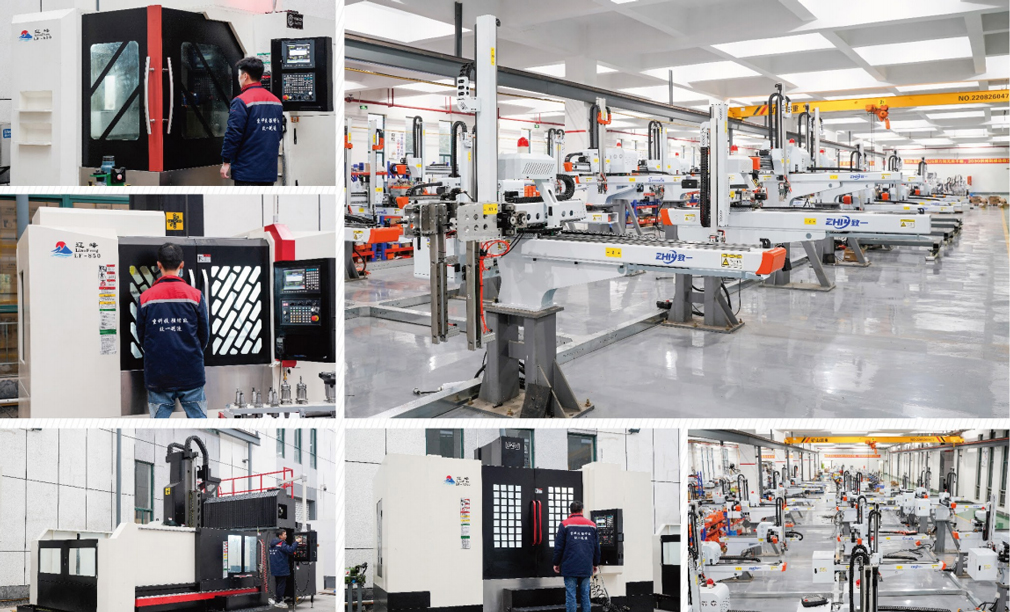
As a professional supplier of injection molding automation equipment, ZHIYI's three-axis and five-axis servo robots for injection molding machines are both ISO9001 and CE certified. With high-precision transmission design, stable servo control systems, and customized solutions, they can meet the automation upgrade needs of various injection molding companies worldwide. ZHIYI provides international buyers with a full-process service from equipment selection to on-site commissioning, helping injection molding companies achieve a dual improvement in precision and efficiency.
#InjectionMoldingMachineSergeobot #FiveAxisRobot #ThreeAxisRobot #RobotPrecision #HowMeticulousIsFiveAxisRobotBeyondThreeAxisRobot #InjectionMoldingMachineBobotRepeatPositionAccuracy #PrecisionInjectionMoldingRobotSelection #FiveAxisServoRobotPrecisionIndicators #ThreeAxisRobotPrecisionError