Leave Your Message
Planar Part Handling: A Cost-Effectiveness Analysis of Three-Axis Servo Robots
Planar Part Handling: A Cost-Effectiveness Analysis of Three-Axis Servo Robots
In the automation upgrade process of injection molding production, planar part handling, as a core process, places stringent requirements on equipment efficiency, precision, and cost control. Three-axis servo robots, with their strong adaptability, stable operation, and high return on investment, have become the mainstream choice for planar part handling in the injection molding industry, and are also a cost-effective option for international wholesale buyers deploying automated production lines. This article will deeply analyze the cost-effectiveness advantages of three-axis servo robots in planar part handling scenarios from the perspectives of technical characteristics, cost control, and production efficiency, providing professional reference for industrial automation procurement decisions.
I. Core Technical Characteristics of Three-Axis Servo Robots for Planar Part Handling
The core requirement of injection molding planar part handling is to achieve precise, fast, and stable material handling within the X/Y/Z three-axis space. The structural and performance design of three-axis servo robots perfectly matches this requirement, which is the technical basis for their cost-effectiveness advantage.
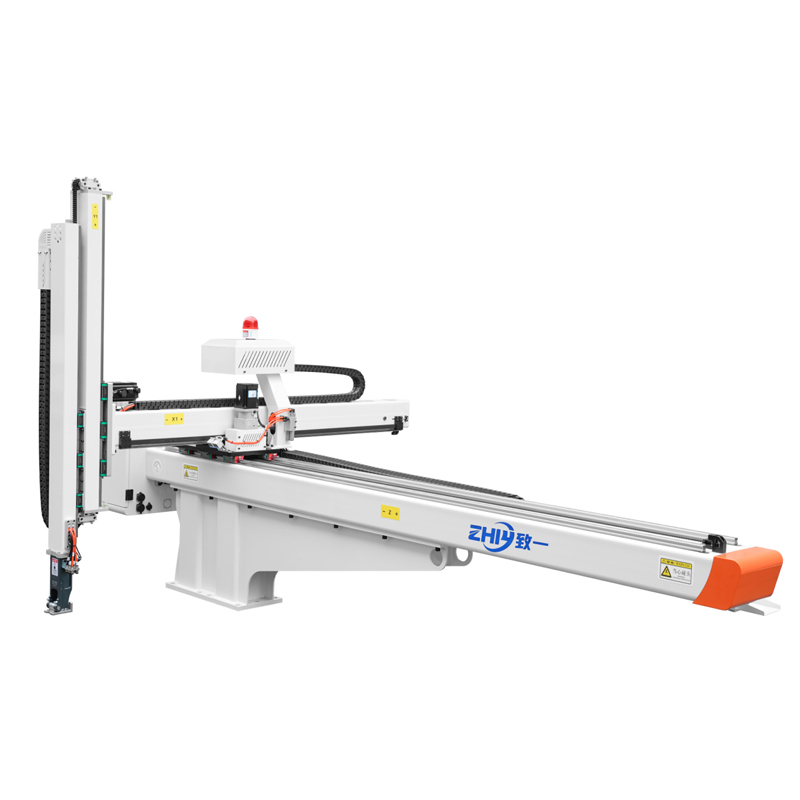
The three-axis servo robot is built on a Cartesian coordinate system. Its horizontal and vertical axes form a planar motion system, while the Z-axis enables vertical lifting and placement. These three axes are perpendicular and independently driven, precisely covering the planar part-removal area after the Injection Molding Machine mold opens and closes, with no redundant motion trajectories, thus fundamentally improving work efficiency. Its servo motor drive system, combined with high-precision transmission components such as ball screws and linear guides, achieves a repeatability accuracy of ±0.1mm, fully meeting the precision requirements for planar part removal in injection molding, effectively preventing product scratches and drops, and improving product yield.
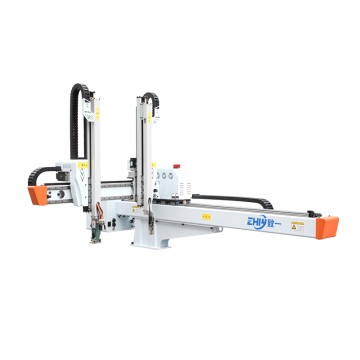
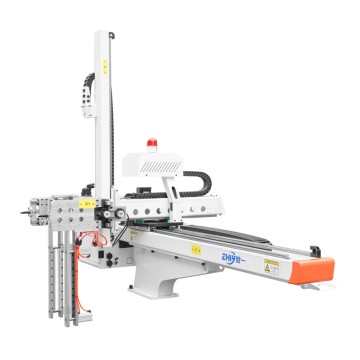
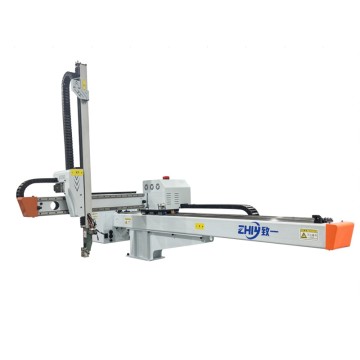
For the industrial environment of injection molding production, high-quality three-axis servo robots, such as the ZHIYI Bull Head three-axis servo robot, have a maximum load capacity of 50kg, easily handling the planar part removal needs of complex molds and large injection molded products. They also feature dustproof and oil-proof protective designs, enabling long-term stable operation in the harsh environment of the injection molding workshop, reducing equipment downtime. Furthermore, the modular design of the three-axis servo robot allows for flexible adjustment based on different injection molding machine models and part-picking strokes, eliminating the need for complex customization and enabling rapid adaptation to planar part-picking production lines of varying specifications, thus reducing equipment and production line adaptation costs.
II. Cost Dimension: The Cost-Effectiveness Advantage of the Three-Axis Servo Robot Throughout its Lifecycle
For international wholesale buyers, the cost-effectiveness of equipment is not only reflected in the unit purchase price but also extends throughout the entire lifecycle of procurement, installation, use, and maintenance. The three-axis servo robot demonstrates significant cost control advantages at each stage.
(I) Procurement Cost: High Adaptability Reduces Initial Investment
Compared to five-axis, six-axis, and other multi-Axis Robots, the three-axis servo robot has a simpler structural design, mature R&D and manufacturing processes for core components, and a more advantageous unit purchase price. Simultaneously, it is specifically optimized for planar part-picking scenarios, eliminating the need to pay a premium for additional motion axis functions, achieving "pay-as-you-go." For small and medium-sized injection molding enterprises or production lines focused on planar part handling processes, the initial investment in a three-axis servo robot is far lower than that of a multi-axis robot, yet it can fully meet core operational needs, making it the preferred choice for cost-sensitive procurement.
(II) Deployment and Debugging Costs: Rapid Deployment Reduces Production Line Downtime
The installation process of a three-axis servo robot is simple, requiring no complex foundation modifications or space planning. Coupled with a graphical programming interface and drag-and-drop teaching functionality, technicians can quickly complete debugging and program settings, significantly shortening the equipment deployment cycle. Compared to the weeks-long debugging time of multi-axis robots, three-axis servo robots can typically be put into production within days, effectively reducing economic losses caused by production line downtime, making them particularly suitable for injection molding production lines requiring rapid automation upgrades.
(III) Usage and Maintenance Costs: Low Consumption and High Efficiency Reduce Operational Burden
In terms of usage costs, the servo drive system of a three-axis servo robot is energy-saving, reducing energy consumption by more than 30% compared to traditional Pneumatic Robots, resulting in significant savings in electricity costs over the long term. Meanwhile, its core components are highly standardized with low wear rates, requiring only simple lubrication and inspection for routine maintenance, without the need for a specialized technical team. Furthermore, its spare parts are highly interchangeable and widely available, resulting in maintenance costs far lower than those of complex multi-axis robots. In addition, three-axis servo robots from brands like ZHIYI have passed international certifications such as ISO9001 and CE, undergoing rigorous quality testing and boasting a long service life, further reducing the average cost of ownership over their entire lifecycle.
III. Production Efficiency: The Core Value of Three-Axis Servo Robots in Enhancing Planar Part Removal Operations
The ultimate manifestation of cost-effectiveness is the actual benefits that equipment can create for production. In the injection molding planar part removal process, three-axis servo robots improve production efficiency, ensure product quality, and optimize manpower allocation, achieving a comprehensive improvement in production efficiency and quickly translating equipment investment into corporate profits.
(I) Improved Operational Efficiency and Doubling of Production Capacity
The three-axis servo robot boasts high operating speeds, with X/Y axis high-speed operation reaching 120m/min and Z-axis lifting speed sufficient for high-frequency part handling. A single unit can operate 24/7, perfectly matching the production cycle of injection molding machines and eliminating the speed limitations and rest intervals of manual part handling. Compared to manual part handling, the three-axis servo robot increases part handling efficiency by over 80%, effectively boosting the overall production capacity of injection molding lines, and is particularly suitable for mass production of standardized injection molded products.
(II) Guaranteed Product Quality and Reduced Scrap Rate
Manual part handling is susceptible to fatigue and operational errors, leading to product handling deviations, scratches, and even damage. The precise positioning and stable operation of the three-axis servo robot ensure consistent part handling actions, fundamentally reducing product defects caused by human factors. Simultaneously, the robot can precisely control the handling force and angle, preventing mold damage due to improper operation, extending mold life, and further reducing production losses. Practice has proven that injection molding production lines equipped with three-axis servo robots can reduce product scrap rates by more than 50%, significantly saving raw material costs.
(III) Optimizing Human Resource Allocation and Solving Labor Shortages
Currently, the global manufacturing industry faces labor shortages and rising labor costs. The high temperatures and repetitive work environments in injection molding workshops also make it difficult to attract a stable workforce. Three-axis servo robots can completely replace manual labor in planar part-picking operations. A single unit can replace 2-3 workers, not only significantly reducing labor costs but also freeing workers from heavy repetitive labor, allowing them to be reassigned to more technically demanding positions. For international buyers, this advantage effectively solves the labor shortage problems of overseas factories, improves the efficiency of human resource allocation on production lines, and avoids production instability caused by personnel turnover.
IV. Cost-Effectiveness Comparison of Three-Axis Servo Robots in Planar Part-Picking Scenarios
In the selection of automated equipment for planar part-picking in injection molding, three-axis servo robots, compared with pneumatic robots and multi-axis robots, form a core competitive advantage of "balancing performance and cost" in terms of cost-effectiveness, becoming the optimal solution for most buyers. Compared to pneumatic robotic arms, three-axis servo robotic arms offer higher precision, more stable operation, and energy efficiency. While the initial purchase cost is slightly higher, long-term energy consumption and maintenance costs are lower, making them more suitable for planar part-picking scenarios requiring high precision and efficiency. The payback period is typically 1-2 years, demonstrating a significant long-term cost-effectiveness advantage. Compared to five-axis and six-axis multi-axis robotic arms, while lacking complex rotation and swing arm functions, three-axis servo robotic arms are essential for the single and core process of planar part-picking, where no extra functions are needed. Their cost is only 1/3 to 1/2 that of multi-axis robotic arms, yet they achieve over 90% of the operational efficiency. For injection molding production lines focused on planar part-picking, they are the best "high-performance alternative."
Furthermore, three-axis servo robotic arms are highly compatible, seamlessly integrating with injection molding machines, conveyors, and testing equipment, easily fitting into existing automated production lines without requiring large-scale modifications. Meanwhile, it supports customized welding and inlay upgrade solutions, allowing for functional expansion based on production needs. This provides space for future production line upgrades, achieving "one-time investment, multiple uses" and further enhancing the overall cost-effectiveness of the equipment.
V. Key Considerations for International Buyers Selecting Three-Axis Servo Robots
For international wholesale buyers of injection molding equipment, when selecting a three-axis servo robot, it is necessary to consider the actual needs of planar part handling, focusing on brand strength, product parameters, and service guarantees to ensure that the selected equipment offers both cost-effectiveness and long-term value.
Matching Core Parameters: Based on the weight and size of the injection molded product, select a robot with appropriate load and stroke. For example, for handling large products, a bull-head type three-axis servo robot with a load capacity of 50kg can be selected. Simultaneously, pay attention to core indicators such as repeatability and operating speed to ensure compatibility with the production line's pace.
Recognizing International Certifications: Prioritize products with international quality certifications such as ISO9001 and CE to ensure that the equipment meets the production standards of overseas factories and avoids customs and usage issues caused by missing certifications.
Focus on Brand Services: Choose brands with global pre-sales consultation and after-sales technical support. For example, ZHIYI has a 24/7 professional service team that provides international buyers with full-process services including equipment commissioning, training, and maintenance, ensuring smooth operation of equipment on overseas production lines and reducing after-sales costs.
Refer to Project Cases: Prioritize brands with extensive project experience in the injection molding industry. Mature application experience ensures better equipment adaptation to different regions and specifications of flat-plate part-removal production lines, reducing procurement risks.
Conclusion: Upgrading the automation of the injection molding flat-plate part-removal process is not about blindly pursuing high-configuration, multi-functional equipment, but rather choosing a solution with optimal adaptability and the highest return on investment. Three-axis servo robots, with their technical characteristics perfectly suited to flat-plate part-removal needs, cost control advantages throughout the entire lifecycle, and immediate production efficiency improvements, have become the benchmark choice for cost-effectiveness in this scenario.
#Three-axis servo robot for injection molding machines #Three-axis robot for planar part removal #Injection molding robot cost-effectiveness #Three-axis servo robot load capacity #Injection molding planar part removal equipment selection #Three-axis robot life cycle cost #Internationally certified injection molding robot