
Leave Your Message
0102030405
Medical Packaging Injection Molding: Complete Analysis of FDA Compliance Requirements for 5-Axis Manipulators
2026-04-07
Medical Packaging Injection Molding: Complete Analysis of FDA Compliance Requirements for 5-Axis Manipulators
Table of Contents
Core Connection Between Medical Packaging Injection Molding and FDA Compliance
Core Advantages of 5-Axis Manipulators for Medical Packaging Injection Molding
General FDA Compliance Guidelines for Medical Packaging Injection Molding Equipment
Design Requirements for 5-Axis Manipulators to Meet FDA Compliance
Operational Compliance Norms for 5-Axis Manipulators in Medical Packaging Injection Molding
Testing and Verification Process for FDA Compliance Certification
Maintenance and Calibration Requirements for FDA-Compliant 5-Axis Manipulators
Common FDA Compliance Issues of 5-Axis Manipulators in Medical Packaging Injection Molding
Conclusion
Related Articles
The medical packaging injection molding industry has stringent requirements for the accuracy, stability and compliance of production equipment, and FDA compliance is the core threshold for entering the global medical packaging market. As the core equipment for automated medical packaging injection molding, whether the entire process of design, operation and maintenance of 5-axis manipulators complies with FDA specifications directly determines the quality of medical packaging products and market access qualifications. For wholesale buyers in the injection molding industry, mastering the FDA compliance requirements of 5-axis manipulators in medical packaging injection molding scenarios is the key to screening equipment and ensuring production compliance.
Different types of medical packaging injection molding products, from syringe packages, vial stoppers to medical blister boxes, have different requirements for the motion accuracy, contact materials and cleaning capabilities of manipulators. The FDA compliance standards set a unified and detailed red line for these requirements. This article will comprehensively analyze the FDA compliance key points of 5-axis manipulators in medical packaging injection molding from multiple dimensions such as core compliance requirements, equipment design and operational norms, providing professional references for buyers and manufacturers.
Core Connection Between Medical Packaging Injection Molding and FDA Compliance
As an important part of medical consumables, medical packaging injection molding products are in direct or indirect contact with pharmaceuticals and medical devices. Their material safety, production process cleanliness and product consistency are directly related to the safety of medical use, which is the core reason why the FDA has put forward strict compliance requirements for the medical packaging injection molding industry. FDA compliance is not a single certification standard, but a full-chain normative system covering production equipment, raw materials, production processes and quality testing, among which the compliance of production equipment is the foundation - design defects and irregular operation of equipment may lead to product contamination and inaccurate precision, thus violating FDA regulations.
In the automated production of medical packaging injection molding, manipulators are the core equipment for material handling, mold operation and product picking and placing. Their contact links with injection molding products, motion accuracy and cleaning and maintenance capabilities are all key regulatory contents of the FDA. For 5-axis manipulators, their multi-dimensional motion characteristics adapt to the complex injection molding processes of medical packaging, but at the same time put forward higher requirements for their compliance design. Only when the entire process of manipulators complies with FDA specifications can the compliance of medical packaging injection molding production be guaranteed, ensuring that products pass FDA testing smoothly and enter the North American and global markets that recognize FDA standards.
In addition, the FDA's compliance requirements for medical packaging injection molding equipment are dynamically updated and will be continuously optimized according to the technological development and safety needs of the medical packaging industry. This requires the design and use of 5-axis manipulators to have a certain adaptability to complete compliance upgrades following the update of FDA standards.
Core Advantages of 5-Axis Manipulators for Medical Packaging Injection Molding
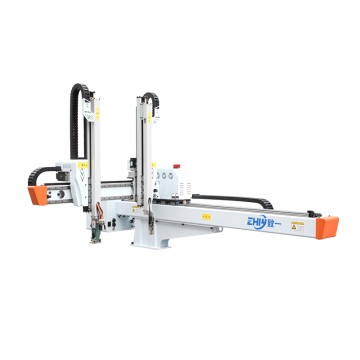
Most medical packaging injection molding products are components with fine structures and extremely small dimensional tolerance requirements, such as medical dropper packages and vaccine bottle protective sleeves. Traditional 3-axis and 4-axis manipulators are difficult to meet the requirements of complex injection molding processes. However, 5-axis Servo Manipulators have become the ideal choice for medical packaging injection molding by virtue of their multi-joint and multi-dimensional motion advantages, which is also the hardware foundation for them to meet the stringent FDA compliance requirements.
- High motion accuracy: The multi-axis linkage design of 5-axis manipulators can achieve micron-level positioning accuracy, meeting the dimensional tolerance requirement of ±0.01mm for medical packaging injection molding products, avoiding product deformation and damage caused by position deviation during picking, placing and handling processes, ensuring product consistency, which is highly consistent with the FDA's requirement for dimensional stability of medical packaging products.
- Strong operational flexibility: It can realize multi-angle and multi-directional mold operation and product picking and placing, adapting to special-shaped and complex-structured medical packaging injection molds without frequent replacement of tooling and fixtures, reducing equipment adjustment links in the production process, lowering the risk of product contamination, and complying with the FDA's requirements for simplifying production processes and preventing pollution.
- Good operation stability: The servo drive system enables the motion speed and force of 5-axis manipulators to be precisely regulated, maintaining stable operation in high-speed injection molding production, avoiding defects of injection molding products caused by equipment vibration, and reducing equipment wear at the same time, extending service life, ensuring production continuity, and meeting the FDA's dual requirements for production efficiency and product qualification rate.
- High automation integration: It can be seamlessly connected with Injection Molding Machines, cleaning equipment and testing equipment to realize fully automated production of medical packaging injection molding from raw material feeding, product picking to quality testing, reducing manual intervention. The reduction of manual intervention is one of the core FDA requirements for preventing human contamination in the production process.
It is these core advantages that make 5-axis manipulators the core equipment for realizing FDA-compliant automated production in the medical packaging injection molding industry, and also determine the professionalism and detail of their compliance requirements.
General FDA Compliance Guidelines for Medical Packaging Injection Molding Equipment
The FDA's compliance requirements for medical packaging injection molding equipment revolve around the three cores of product safety, production cleanliness and process traceability. These are the general guidelines that all injection molding production equipment including 5-axis manipulators must follow, and also the basic basis for equipment design, production and use.
- Material safety guidelines: Equipment components in direct or indirect contact with medical packaging products must use FDA-certified food-grade/medical-grade materials, such as 304/316 stainless steel and food-grade engineering plastics. The use of materials containing harmful heavy metals, plasticizers and other harmful substances is prohibited. In addition, the materials must have the characteristics of high and low temperature resistance, chemical corrosion resistance, and not easy to absorb dust and bacteria to prevent product contamination by material precipitates.
- Clean design guidelines: The equipment structure must follow the principle of "easy to clean and no dead corners", avoiding structural designs such as grooves, gaps and threads that are easy to harbor dirt and bacteria. The equipment surface must be smooth and polished, with roughness meeting the FDA-specified standard of Ra≤0.8μm; at the same time, the equipment must have the ability to be used in clean workshops (Class 10,000/Class 100,000), and can withstand cleaning methods such as high-pressure spray and alcohol disinfection without cleaning blind spots.
- Process traceability guidelines: The equipment must be equipped with a complete data collection and recording system, which can record the operating parameters during production in real time, such as the motion speed, positioning accuracy, operating time and maintenance records of the manipulator. The data must be saved for at least 3 years to support random inspections by the FDA; the parameter records must have the non-tamperable characteristic to ensure the traceability of the production process.
- Safe operation guidelines: The equipment must be equipped with a complete safety protection system, such as emergency stop buttons, anti-collision sensors and overload protection, to prevent production accidents and product contamination caused by equipment failures; at the same time, the operating noise and vibration of the equipment must be controlled within the FDA-specified clean workshop standards to avoid affecting the production environment.
- Environmental compliance guidelines: There is no emission of harmful gases and liquids during the operation of the equipment. The auxiliary consumables such as lubricating oil and hydraulic oil of the equipment must use FDA-certified food-grade oil products to prevent product and production environment contamination caused by consumable leakage.
These general guidelines are the basic threshold for 5-axis manipulators to enter the medical packaging injection molding industry. Failure to meet any of them will result in the equipment being unable to meet FDA compliance requirements.
Design Requirements for 5-Axis Manipulators to Meet FDA Compliance
The design of 5-axis manipulators is the core link for them to meet FDA compliance requirements. For the application scenarios of medical packaging injection molding, their design needs to be specially optimized based on the general compliance guidelines combined with the characteristics of 5-axis motion, to achieve compliance design from multiple dimensions such as structure, material and control system. The specific requirements are as follows:
Structural Design Compliance Requirements
- Dead-corner-free integrated structure: The arms, joints, fixtures and other components of 5-axis manipulators must adopt integrated molding or seamless connection design, cancel unnecessary structural designs such as grooves, rivets and exposed bolts, and adopt sealed design at joints to avoid dust and material residue accumulation, ensuring no dead corners during cleaning; the base and bracket of the manipulator must adopt anti-water accumulation design with inclined angles on the surface to prevent cleaning water residue.
- Lightweight and high rigidity: On the premise of ensuring the motion accuracy and load capacity of the manipulator, adopt lightweight design to reduce vibration during equipment operation and improve the response speed of the equipment at the same time; the arms and joints of the manipulator must have high rigidity to prevent structural deformation caused by long-term operation, ensure the stability of positioning accuracy, and comply with the FDA's requirement for product consistency.
- Fixture adaptability design: The supporting injection molding product fixtures must be customized according to the material and structure of medical packaging products, using soft medical-grade silica gel or rubber materials to avoid scratching and damage caused by contact between fixtures and products; the opening and closing force of fixtures can be precisely regulated to adapt to medical packaging products of different sizes and thicknesses. In addition, the fixture structure is simple, easy to disassemble and clean, and can be individually subjected to high-temperature disinfection.
Material Selection Compliance Requirements
- Medical-grade materials for contact components: The grippers, arm front ends and other components of the manipulator that are in direct contact with medical packaging products and injection raw materials must use 316 medical stainless steel or FDA-certified engineering plastics such as PEEK and POM. The 316 stainless steel components must be electropolished with surface roughness Ra≤0.4μm, having the characteristics of corrosion resistance, easy cleaning and not easy to breed bacteria.
- Environmentally friendly materials for non-contact components: The motors, shells, brackets and other non-contact components of the manipulator must use environmentally friendly cold-rolled steel plates or aluminum alloys, with surface spray coating or anodizing treatment, no risk of paint peeling and harmful substance precipitation, and can withstand the disinfection environment of clean workshops.
- FDA-certified auxiliary consumables: The auxiliary consumables such as lubricating oil, bearing grease and seals of the manipulator must use FDA-certified food-grade/medical-grade products. The lubricating oil must have the characteristics of non-volatility, no peculiar smell and not easy to leak to prevent consumable contamination of the production environment and products.
Control System Design Compliance Requirements
- Precise regulation and data collection: The control system must support micron-level positioning accuracy regulation of 5-axis manipulators, and can collect and record the operating parameters of the manipulator in real time, including motion speed, acceleration, positioning coordinates, fixture opening and closing force, operating time, etc. The data can be stored through cloud or local servers and supports one-click export to meet the FDA's traceability requirements.
- Misoperation prevention and authority management: The control system must set multi-level operation authorities to distinguish the operation authorities of operators, maintenance personnel and managers to prevent unauthorized personnel from arbitrarily modifying equipment parameters; at the same time, it is equipped with an operation record function to record all personnel's operation behaviors, including parameter modification, equipment start and stop, maintenance and repair, etc.
- Clean workshop adaptability: The main unit of the control system must have the characteristics of dustproof, waterproof and corrosion resistance with a protection grade of not less than IP65, and can be directly installed in the clean workshop; the operation panel adopts touch screen design with anti-fingerprint and easy cleaning treatment on the surface, supporting alcohol wipe disinfection without the problem of dirt accumulation in key gaps.
Operational Compliance Norms for 5-Axis Manipulators in Medical Packaging Injection Molding
Even if the design of 5-axis manipulators is fully in line with FDA compliance requirements, irregular operation may still lead to the production process violating FDA guidelines, thereby affecting the compliance of medical packaging products. For the clean production scenarios of medical packaging injection molding, the operation of 5-axis manipulators must follow strict compliance norms, covering the entire process before startup, during production and after shutdown.
Pre-Startup Operational Compliance Requirements
- Equipment inspection and cleaning: Before startup, conduct a comprehensive inspection of the 5-axis manipulator, including the sealing status of each joint, the integrity of fixtures, the parameter settings of the control system, etc., to confirm no equipment failures; at the same time, clean the contact components of the manipulator with FDA-certified medical cleaning agents, rinse with sterile pure water after cleaning, and dry with a dust-free cloth to ensure no cleaning agent residue.
- Parameter calibration and verification: Calibrate the motion parameters, fixture opening and closing force of the manipulator according to the specifications of medical packaging products produced on the day. Conduct trial production after calibration, take 3-5 samples for dimensional accuracy testing, and start formal production only after confirming that the samples meet the product standards specified by the FDA.
- Production environment confirmation: Confirm that the clean workshop environment where the manipulator is located meets the FDA requirements, with temperature and humidity controlled at 22±2℃ and 45±5%RH, cleanliness reaching Class 10,000/Class 100,000 standards, and no pollution factors such as dust and peculiar smell in the workshop to avoid product contamination caused by unqualified production environment.
In-Production Operational Compliance Requirements
- Real-time monitoring and parameter stability: Arrange special personnel to monitor the operation status of the 5-axis manipulator in real time during production to ensure no abnormal fluctuations in equipment parameters and stable positioning accuracy and operation speed; if the equipment parameters deviate from the preset values, stop the machine immediately for inspection, investigate the cause of the failure and record it. After the failure is solved, re-calibrate the parameters and test the samples, and resume production only after passing the test.
- Prohibition of arbitrary manual intervention: It is forbidden for unauthorized personnel to approach the operation area of the manipulator during production. If manual intervention is required (such as replacing fixtures, cleaning material residues), the machine must be stopped and the power cut off first, and then the operation can be carried out after wearing protective equipment such as sterile gloves and dust-free clothes. After the operation is completed, re-clean and disinfect the contact components of the manipulator.
- Compliant material handling: The injection raw materials and semi-finished products handled by the manipulator must use FDA-certified sterile packaging. Avoid contact between materials and non-contact components of the manipulator during the handling process to prevent cross-contamination; sterile protective devices must be set at the feeding and blanking stations of materials to avoid contamination of materials by the external environment.
Post-Shutdown Operational Compliance Requirements
- Equipment cleaning and disinfection: After shutdown, timely clean up material residues and dust on the surface of the manipulator, conduct in-depth cleaning of contact components with medical cleaning agents, then disinfect with 75% medical alcohol, and let the equipment air dry naturally in the clean workshop to avoid secondary pollution caused by using equipment such as hair dryers.
- Parameter saving and recording: Before shutdown, save and back up the production parameters, equipment operation status, fault records and other data of the day, and record the production output, product qualification rate, equipment maintenance status and other information of the day to ensure the traceability of the production process.
- Equipment protection: After cleaning and disinfection, cover the manipulator with a sterile dust cover to prevent dust in the clean workshop from falling on the equipment surface; at the same time, turn off the power and air source of the equipment, do a good job in equipment protection, and prepare for the next startup production.
Testing and Verification Process for FDA Compliance Certification
For 5-axis manipulators to be officially applied to FDA-compliant production of medical packaging injection molding, they need to pass professional FDA compliance testing and verification. The process is executed by a third-party testing institution recognized by the FDA, covering all dimensions of equipment design, materials, operation and data recording. Only by passing all testing items can the FDA compliance certification be obtained. The specific process is as follows:
- Document submission and review: The equipment manufacturer must submit the design drawings, material test reports, control system descriptions, operation manuals and other documents of the 5-axis manipulator to the third-party testing institution. The testing institution reviews the documents according to FDA guidelines to confirm whether the documents are complete and meet the basic compliance requirements. If the document review fails, the enterprise needs to modify and resubmit.
- Material testing: The testing institution samples and tests the contact components, non-contact components and auxiliary consumables of the manipulator. The testing contents include material composition, harmful substance precipitation, surface roughness, corrosion resistance, etc. All test results must meet the FDA material standards. For example, the chromium and nickel content of 316 stainless steel must meet the medical-grade standards, and the material precipitation test must be free of harmful substances such as heavy metals and plasticizers.
- Structural and performance testing: Conduct on-site testing of the structural design of the manipulator to confirm whether it complies with the compliance requirement of "easy to clean and no dead corners"; at the same time, test the motion accuracy, operation stability, load capacity and other performances of the manipulator, test the positioning accuracy, repeat positioning accuracy and other indicators of the manipulator through professional instruments to ensure that they meet the process requirements of medical packaging injection molding and the FDA's product consistency requirements.
- Operation and data testing: Simulate the production scenario of medical packaging injection molding, let the manipulator perform actual operation, and the testing institution verifies the compliance of its operation process and the accuracy of parameter regulation; at the same time, check the data collection and recording system of the manipulator to confirm whether the data can be collected in real time, non-tamperable and traceable, and whether the data retention time meets the FDA's 3-year requirement.
- Cleaning and disinfection verification: Conduct simulated cleaning and disinfection operations on the manipulator, use FDA-certified cleaning agents and disinfection methods, test the bacterial residue and cleaning agent residue on the equipment surface after cleaning, confirm that the equipment has no cleaning blind spots and no residue, and the disinfection effect meets the FDA standards of clean workshops.
- Certification issuance and follow-up supervision: If the manipulator passes all testing items, the third-party testing institution will issue the FDA compliance certification certificate; the validity period of the certification certificate is 3 years. During the validity period, the testing institution will conduct irregular on-site supervision and sampling testing. If the equipment is found to be non-compliant with FDA requirements, the certification certificate will be revoked.
For wholesale buyers of medical packaging injection molding enterprises, when purchasing 5-axis manipulators, it is necessary to focus on verifying whether the equipment has a compliance certification certificate issued by a third-party testing institution recognized by the FDA to avoid purchasing uncertified equipment leading to production compliance problems.
Maintenance and Calibration Requirements for FDA-Compliant 5-Axis Manipulators
The FDA compliance of 5-axis manipulators is not a one-time task. Problems such as equipment wear, parameter deviation and component aging after long-term operation may cause the equipment to deviate from FDA compliance requirements. Therefore, a strict maintenance and calibration system must be established to regularly maintain, calibrate and test the equipment to ensure that it is always in an FDA-compliant operation state. The specific requirements are as follows:
Daily Maintenance Compliance Requirements
- Daily cleaning and inspection: After the end of daily production, clean the manipulator in accordance with the post-shutdown cleaning and disinfection norms, and at the same time check the seals of each joint, the integrity of fixtures, the display screen of the control system and other components. If problems such as seal aging, fixture wear and display screen failure are found, they must be replaced in a timely manner. The replaced components must be FDA-compliant accessories provided by the original factory.
- Weekly lubrication and fastening: Lubricate the moving parts such as joints and bearings of the manipulator every week with FDA-certified medical-grade lubricating oil. Strictly control the oil consumption during lubrication to avoid lubricating oil leakage; at the same time, fasten the connecting parts such as bolts and nuts of the equipment to prevent equipment vibration and precision deviation caused by loose connecting parts.
Regular Calibration Compliance Requirements
- Monthly precision calibration: Calibrate the positioning accuracy and repeat positioning accuracy of the 5-axis manipulator with professional instruments such as laser interferometers every month, record the calibration data in the equipment maintenance file. If the calibration result finds that the precision deviation exceeds the range specified by the FDA, adjust the equipment parameters in a timely manner until the precision returns to the compliance standard.
- Quarterly performance testing: Conduct a comprehensive test on the performance of the manipulator such as operation speed, load capacity and safety protection system every quarter, simulate the production scenario of medical packaging injection molding, test the operation stability and fault response capability of the equipment to ensure that all performance indicators of the equipment always meet the FDA compliance requirements.
- Annual comprehensive testing: Invite a third-party testing institution recognized by the FDA to conduct a comprehensive FDA compliance test on the manipulator every year. The testing content is the same as that during certification. If the test finds that the equipment has compliance problems, stop the machine for rectification immediately, and re-test after the rectification is completed until the test is passed.
Maintenance Record Compliance Requirements
All maintenance, calibration and testing work must be recorded in detail. The recording contents include maintenance time, maintenance items, operators, calibration data, test results, fault handling, etc. The maintenance records must be saved together with the production and operation data of the equipment for not less than 3 years to support random inspections by the FDA; the maintenance records must adopt both paper and electronic archiving methods to ensure that the records are not lost or tampered with.
At the same time, the maintenance personnel of the manipulator must have professional qualifications, receive professional training on FDA compliance knowledge and equipment operation and maintenance, and can only take up their posts after passing the assessment to avoid equipment compliance problems caused by unprofessional operation of maintenance personnel.
Common FDA Compliance Issues of 5-Axis Manipulators in Medical Packaging Injection Molding
In the actual production of medical packaging injection molding, there are some common problems in the FDA compliance management of 5-axis manipulators. If these problems are not solved in a timely manner, they will directly affect the production compliance and product market access. Buyers and manufacturers need to focus on and avoid them. The common problems and solutions are as follows:
- Improper material selection: In order to reduce costs, some enterprises use non-FDA-certified ordinary materials to replace medical-grade materials, resulting in product contamination by harmful substances precipitated from components. Solution: Strictly select FDA-certified medical-grade material accessories provided by the original factory, require suppliers to provide material test reports when purchasing, and regularly sample and test contact components to confirm material compliance.
- Incomplete cleaning with dead corners: There are cleaning blind spots in the structures such as joints and fixture connections of the manipulator, leading to bacterial residue. Solution: Purchase 5-axis manipulators with dead-corner-free integrated design, formulate detailed cleaning operation manuals, conduct professional training for cleaning personnel, and use professional cleaning equipment such as high-pressure spray and ultrasonic cleaning for in-depth cleaning.
- Incomplete data records: The data collection function of the control system is imperfect, leading to incomplete records of production parameters and equipment operation status, which cannot meet the FDA's traceability requirements. Solution: Upgrade the control system of the manipulator, equip with a professional FDA-compliant data collection system, assign special personnel to be responsible for data recording and backup, and regularly check the integrity of data records.
- Delayed parameter calibration: Failure to calibrate the precision of the manipulator in a timely manner after long-term operation leads to positioning deviation and unqualified product dimensions. Solution: Establish a strict regular calibration system, equip with professional calibration instruments, assign special personnel to be responsible for calibration work, and record and archive calibration data in a timely manner.
- Non-FDA-certified maintenance consumables: The use of ordinary lubricating oil, grease and other consumables leads to product contamination caused by consumable leakage. Solution: Use FDA-certified medical-grade auxiliary consumables throughout the process, verify the compliance certification certificates of consumables when purchasing, do a good job in the storage and use management of consumables to avoid consumable deterioration.
Conclusion
The FDA compliance requirements for 5-axis manipulators in medical packaging injection molding are a full-process system covering design, materials, operation, testing and maintenance, whose core revolves around the safety, cleanliness and consistency of medical packaging products, and is highly consistent with the overall FDA regulatory requirements for the medical packaging industry. For international wholesale buyers, when purchasing 5-axis manipulators, FDA compliance must be taken as the core screening standard, focusing on verifying key indicators such as the equipment's compliance certification, material test reports and structural design rationality; for medical packaging injection molding manufacturers, a sound FDA compliance management system must be established to ensure the compliant operation of manipulators from multiple dimensions such as equipment operation, maintenance and calibration, and data recording.
As the core equipment for automated medical packaging injection molding, the FDA compliance of 5-axis manipulators is not only the threshold for products to enter the global market, but also the key to ensuring the quality of medical packaging products and the safety of medical use. With the continuous development of the medical packaging industry, the FDA's compliance requirements will also be continuously upgraded. This requires the manufacturers of 5-axis manipulators to carry out continuous technological innovation and optimize the compliance design of equipment. Buyers and manufacturers also need to timely grasp the update dynamics of FDA standards to ensure that equipment and production are always in compliance. Only when the entire industry attaches great importance to and strictly follows the FDA compliance requirements can the standardized and high-quality development of the medical packaging injection molding industry be promoted.
Related Articles
- Core Points for Selection of Automated Equipment for Medical Packaging Injection Molding
- Comprehensive Analysis of FDA Compliance Requirements for Medical Injection Molding Product Materials
- Maintenance and Management Norms for Injection Molding Manipulators in Clean Workshops
- Application Guide of 5-Axis Servo Manipulators in the Precision Injection Molding Industry
- FDA Testing Process and Standards for Medical Packaging Injection Molding Products
- Application Guide for FDA Compliance Certification of Injection Molding Automated Equipment
- Manipulator Adaptation Requirements for Medical Blister Box Injection Molding Production
- Automation Development Trends and Compliance Requirements in the Medical Packaging Injection Molding Industry
Medical packaging injection molding#5-axis manipulator#FDA compliance#Injection molding manipulator#Medical packaging injection#FDA compliance requirements#5-axis servo manipulator#Medical injection molding equipment#Clean injection molding#Injection molding equipment compliance