
Leave Your Message
Main Application Scenarios of Injection Molding Machine Servo Robots
Main Application Scenarios of Injection Molding Machine Servo Robots
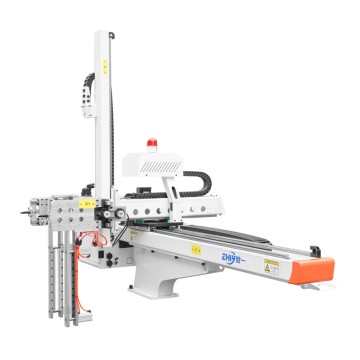
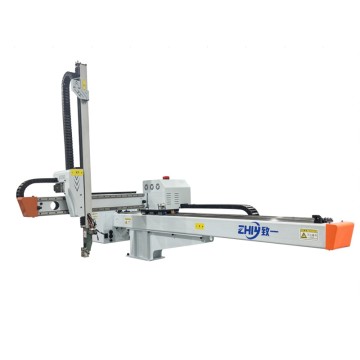
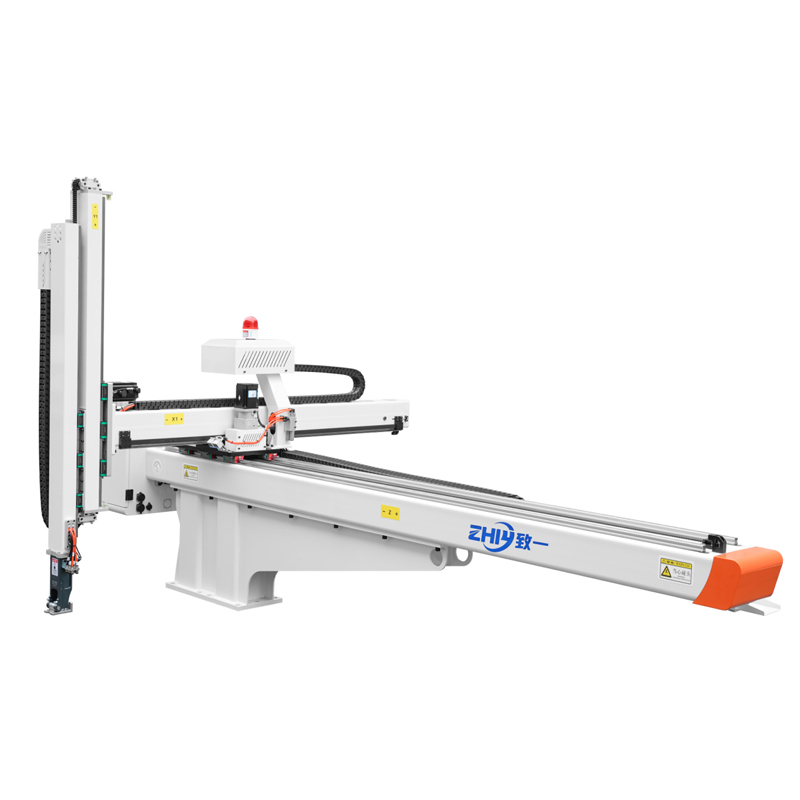
In the global wave of transformation towards automation and precision in the injection molding industry, servo robots, with their precise motion control, flexible process adaptability, and stable operation, have upgraded from auxiliary equipment to core production units. From high-precision molding of automotive parts to clean production of medical consumables, from high-speed manufacturing of 3C products to efficient production of large packaging containers, servo robots are reshaping production logic in various fields, addressing bottlenecks in manual operation and quality control challenges. This article will delve into its four core application scenarios, revealing the deep integration path of technology and industrial needs.
I. Automotive Parts Manufacturing: A Dual Breakthrough in High Precision and High Load Capacity
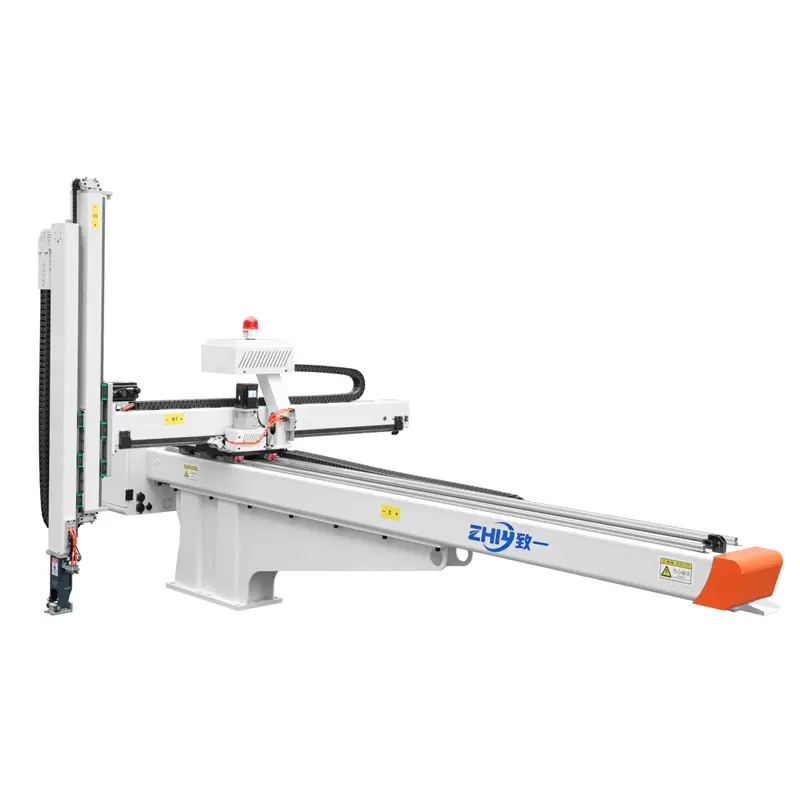
The explosive growth of the global new energy vehicle industry has driven a 40% surge in demand for automotive injection molded parts, while simultaneously imposing stringent requirements on product precision (within ±0.01mm) and production continuity. Servo robots, leveraging the closed-loop control technology of servo motors, have become a key piece of equipment in resolving this contradiction. In the production of small precision parts, such as seat adjustment buttons and battery pack seals, robots equipped with German-imported servo systems can achieve a repeatability accuracy of ±0.005mm, reducing the defect rate from 4%-5% with manual handling to below 1.2%, and increasing the hourly output per injection molding machine from 80 pieces to 120 pieces, perfectly matching the rated capacity of the equipment.
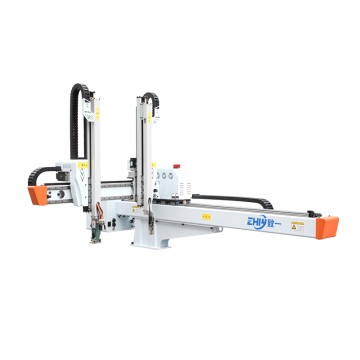
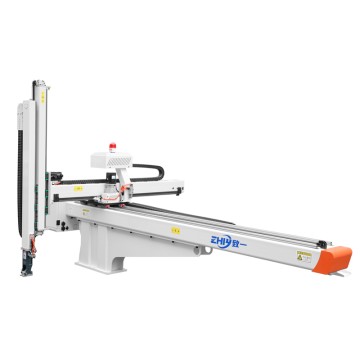
For large injection molded parts such as car bumpers and dashboards, the bull-head type servo robot demonstrates unique advantages. Its shorter arm and 35.5% increased tooling space, combined with a high load capacity of 50-75kg, allow it to be adapted to 800-4000 ton injection molding machines for automatic removal. In in-mold insert molding processes, the robot precisely places metal inserts through pre-set programs, replacing manual assistance, increasing production efficiency by 100%, and avoiding the risk of mold damage caused by insert displacement. After a new energy automotive parts company introduced this type of equipment, its monthly production capacity increased from 240,000 pieces to 360,000 pieces, saving over 700,000 yuan in rework costs annually, fully demonstrating its industrial value.
II. Electronics 3C and Precision Injection Molding: The Perfect Combination of High-Speed Response and Micro-Control
The trend towards lightweight and miniaturized electronic 3C products demands that injection molding production achieve the dual objectives of "high-speed cycles + micro-control." The servo robot's empty cycle time can be as low as 3.3 seconds, and in multi-cavity injection molding scenarios such as 16-cavity wet wipe lids and 24-cavity folding forks, it can precisely cooperate with high-speed injection molding machines to complete synchronous part removal, avoiding product deformation caused by removal delays. For products with stringent appearance requirements, such as mobile phone casings and connectors, the robot's end effector adopts a "quick-change + modular" design, allowing for the switching of gripping mechanisms within 3 minutes. Simultaneously, the smooth operation of the servo system reduces surface scratches on the product, increasing the yield rate to over 99%.
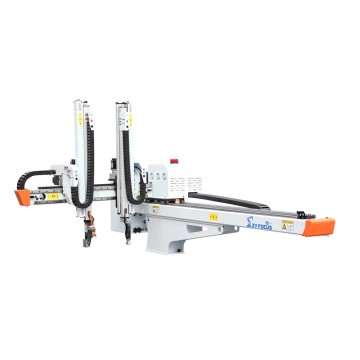
In terms of complex process integration, the single-arm five-axis servo robot, by adding A/C axis servo units, can achieve arbitrary angle rotation of the fixture, completing the integrated operation of removing irregularly shaped electronic components, gate cutting, and inspection. Its communication-type servo control system uses a closed-loop feedback mechanism, avoiding the step loss problem of traditional pulse control, simplifying signal line wiring by 60%, and supporting networking with the entire factory's MES system for real-time production data monitoring and remote debugging. This intelligent feature makes it a core component of flexible production lines in the electronics manufacturing industry.
III. Packaging and Daily Necessities Industry: Core Support for Efficient Integration and Large-Scale Production
The large-scale production of daily necessities such as food packaging and disposable tableware places comprehensive demands on the speed, load capacity, and multi-functionality of robots. High-speed three-axis servo robots perform outstandingly in the production of thin-walled food containers and milk tea cups. For example, the SW7112DS model from Siweike has an empty cycle time of 3.3 seconds and a standard 5kg load capacity. It can not only complete the high-speed removal of 8 milk tea cups at a time but also integrate film covering and stacking functions, achieving full-process automation from injection molding to packaging and warehousing. In the production of large packaging containers such as 5-liter paint buckets and plastic pallets, servo robots with a load capacity of 15-75 kg can be adapted to 500-1300 ton injection molding machines. Through top-loading in-mold labeling technology, precise label application is completed during the removal process, eliminating subsequent processing steps and increasing production efficiency by 30%.
For the high-efficiency demands of stack mold injection molding systems, the side-loading dual-arm five-axis servo robot overcomes the speed limitations of traditional top-loading structures. In KraussMaffei stack mold ice cream container production, its side-loading design shortens the movement path, and combined with the high-speed response of the servo system, the production cycle is shortened to 2.6 seconds, doubling the output per mold cycle. This customized solution provides a flexible path for capacity upgrades in the packaging industry, especially suitable for production environments with limited factory height.
IV. Medical and Optical Fields: Stringent Adaptation for Cleanliness, Safety, and Precise Control
The production of medical consumables (such as syringes and infusion sets) and optical plastic parts (such as lens covers) requires a level of cleanliness, stability, and traceability far exceeding that of ordinary industries. Servo robots adopt a fully enclosed structural design, reducing lubricating oil leakage and dust accumulation, meeting medical-grade cleanroom standards. In the production of medical syringes, its repeatability accuracy reaches ±0.01mm, allowing for precise in-mold insert placement and finished product removal, avoiding contamination risks caused by manual contact, and increasing the sterile product qualification rate to 99.9%.
In optical product manufacturing, the robot uses micro-speed control technology of the servo system to achieve "fast pick and gentle placement" operations, avoiding stress damage to optical surfaces. Its built-in intelligent diagnostic system can monitor motor temperature and Robotic Arm wear in real time, providing 72-hour advance warning of malfunctions, with an average mean time between failures exceeding 1500 hours, ensuring the stability of continuous production. At the same time, the equipment supports parameterized settings and full data recording, allowing for traceability of production parameters for each batch of products, fully complying with the compliance requirements of the medical and optical industries.
Technological Iteration Drives Scenario Expansion, Servo Robots Reshape Production Value
From three-axis to five-axis, from standard models to customized solutions, the application scenarios of servo robots have always expanded in sync with the iteration of servo control technology. Its core value has evolved from simply "replacing manual labor" to a multi-dimensional empowerment encompassing "improving production precision, optimizing process flows, and reducing overall costs." Whether it's the high-precision requirements of the automotive parts industry, the flexible production of the electronics industry, the economies of scale in the packaging industry, or the stringent standards of the medical industry, servo robotic arms can provide tailored solutions through technological adaptation.
In the future, with the deep integration of servo systems with artificial intelligence and the Internet of Things technologies, injection molding servo robotic arms will achieve more precise adaptive control and more efficient multi-device collaboration, further penetrating into high-end manufacturing fields such as aerospace and new energy, becoming a core engine for the global injection molding industry's automation transformation.
Arm Robot#Six Axis Robot#3 Axis Robot#5 Axis Robot Arm
Website:https://www.zhiyirobotics.com/products/
Email:sales@zhiyirobotics.com