Leave Your Message
0102030405
How to Choose Robot Arm for Factory?
2026-05-22
How to Choose Robot Arm for Factory?
For modern manufacturing factories, robot arms have become indispensable equipment to boost production efficiency, cut labor costs and stabilize product quality. More and more factory managers and procurement specialists are faced with the same confusion: how to pick a suitable robot arm that matches actual production demands among countless models and suppliers.
Choosing a factory robot arm is never a random decision. It needs to combine production scenarios, operational parameters, budget planning and long-term operational maintenance. Every detail will affect the later production efficiency and investment return. If you are looking for a clear and practical selection guide, this article will walk you through all key points to help you make a wise decision easily.
Table of Contents
- Clarify Your Factory’s Production Application Scenarios
- Key Technical Parameters to Evaluate Before Selection
- Match Robot Arm Types with Production Needs
- Quality Certification and Operational Stability Check
- Budget Planning and Long-Term Cost Calculation
- After-Sales Service and Technical Support Importance
- Customization Demand for Special Production Lines
- Final Checklist Before Purchasing Factory Robot Arm
1. Clarify Your Factory’s Production Application Scenarios
Understanding your own production scenario is the first step to choose A Robot arm. Different factory workflows require totally different robot arm configurations, and blind selection will lead to equipment idleness or insufficient performance.
Injection molding production lines need robot arms to complete product picking, mold handling and part embedding, which requires high load capacity and stable repetitive positioning. Assembly workshops demand flexible robot arms with high precision for small part installation and matching. Blowing molding, sorting and packaging scenarios focus on running speed and continuous working stability.
You need to sort out core production links first: whether it is heavy-load handling, high-precision assembly, high-speed sorting or customized process operation. Clear application scenarios can narrow down the selection range quickly and avoid choosing overly functional or underperforming models.
2. Key Technical Parameters to Evaluate Before Selection
Technical parameters determine the working performance of the robot arm, and it is the core standard to measure whether the equipment is suitable for the factory. Several parameters must be focused on during selection.
Load capacity is the basic indicator. Confirm the maximum weight of workpieces, molds or products that need to be carried, and reserve a certain margin to avoid long-term overload operation affecting service life. Motion stroke determines the working range of the robot arm, which needs to match the layout size of the factory production line to ensure no dead angle in operation.
Repetitive positioning accuracy directly affects product yield. Precision requirement is higher for electronic parts and precision manufacturing industries, while conventional handling scenarios can appropriately reduce accuracy standards. Running speed should balance efficiency and stability. Excessively pursuing high speed will easily cause operation deviation, and matching the production line rhythm is the best choice.
In addition, working voltage, environmental adaptability (dustproof, high temperature resistance) and continuous working time are also worthy of attention, to ensure the robot arm can adapt to the factory’s long-cycle uninterrupted production mode.
3. Match Robot Arm Types with Production Needs
There are various types of robot arms on the market, and each type has its own applicable scenarios. Matching the type according to production needs can maximize equipment value.
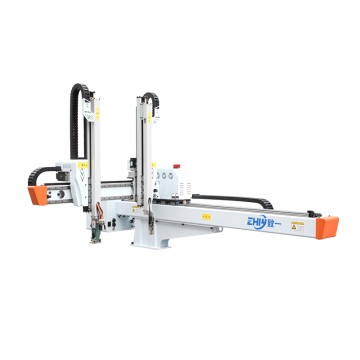
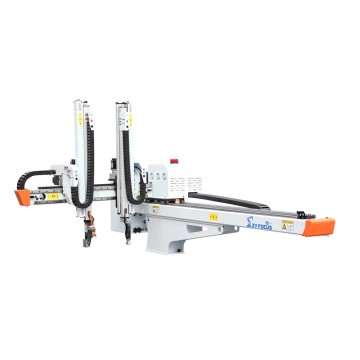
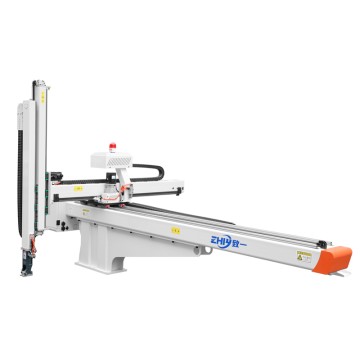
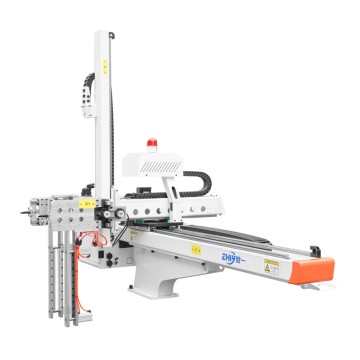
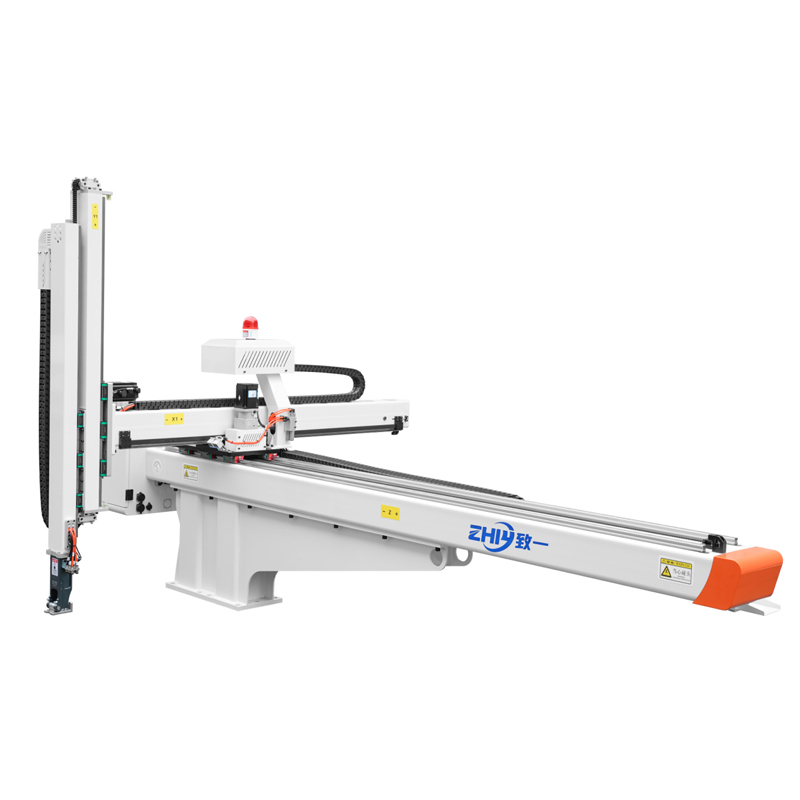
Three-axis servo robot arms feature simple structure, stable operation and cost performance, which are widely used in conventional injection molding picking and general handling tasks, ideal for small and medium-sized factories with basic automation needs. Five-axis double-Arm Robot arms own higher flexibility and multi-angle operation ability, suitable for complex procedures such as multi-station processing and cross-angle assembly.
Custom non-standard robot arms are tailored for special production processes. For some unique mold processing, embedded production and special sorting links, standard models cannot meet demands, and non-standard customized robot arms will be the optimal solution. Factories can select single-arm single-section, double-arm double-section and other structural forms according to production line space and process flow.
4. Quality Certification and Operational Stability Check
Factory robot arms belong to long-term investment equipment, and quality and stability are related to the continuous operation of the entire production line. Never ignore qualification certification and product testing when selecting.
Regular qualified robot arm manufacturers will pass ISO9001 quality management system certification and CE safety certification. These certifications are the basic guarantee of product quality, reflecting that the equipment complies with international production and safety standards.
In addition to certification, we should also pay attention to the actual running stability of the equipment. Understand the manufacturer’s product testing process, service life of core components, and failure rate in actual project cases. Robot arms with stable quality can reduce downtime maintenance frequency, avoid production interruption, and create stable output benefits for the factory.
5. Budget Planning and Long-Term Cost Calculation
Many procurement personnel only focus on the initial purchase price while ignoring the later comprehensive cost, which is a common misunderstanding in robot arm selection.
First, set a reasonable budget range according to production scale and automation demand. Do not blindly pursue low price, as low-cost equipment often has hidden dangers such as unstable performance and short service life; nor overly pursue high-end configuration to cause functional waste.
It is more important to calculate long-term operating costs, including later component replacement cost, daily maintenance cost, energy consumption cost and labor saving income. A high-quality robot arm can help factories reduce labor costs by up to 30% in the long run, and the investment recovery cycle is far shorter than expected. Comprehensive measurement of initial price and long-term benefit is the correct budget selection logic.
6. After-Sales Service and Technical Support Importance
Robot arm is a professional automation device, and later installation, debugging, maintenance and technical training are inseparable from the supplier’s support. Perfect after-sales service is an important reference for selection.
Reliable suppliers can provide 24-hour pre-sales consultation and after-sales technical support, quickly respond to equipment failure problems, and ensure the factory production line runs without interruption. At the same time, professional team can provide on-site installation debugging, operation training, helping factory workers master equipment operation and daily maintenance skills in a short time.
Avoid choosing suppliers with only sales capability but no technical support. Once the equipment fails, it will face the dilemma of no one to repair, resulting in huge production losses.
7. Customization Demand for Special Production Lines
Many factories have unique production line layouts and special process requirements, and standard robot arm models cannot fully adapt to personalized production demands. At this time, the supplier’s customization capability needs to be evaluated.
Professional robot arm suppliers can provide tailored structural transformation, function upgrading and process matching solutions, including welding upgrading, inlay process customization and multi-station system integration. They can also combine the factory’s plant space, production line rhythm to optimize equipment layout, making automation transformation more in line with actual production habits.
For factories with plans to expand production lines and upgrade processes in the future, it is recommended to prefer suppliers with strong customization and R&D capabilities, which can reserve upgrade space for later automation transformation.
8. Final Checklist Before Purchasing Factory Robot Arm
Before finally confirming the purchase, you can check against the following key points to avoid missing any details:
- Confirm whether the load, stroke, accuracy and speed fully match production scenarios
- Verify product international certification and actual operation stability
- Match robot arm type and structure with production line process
- Complete the comprehensive budget calculation of purchase and long-term use cost
- Confirm the supplier’s after-sales response speed and technical training service
- Evaluate whether the supplier can meet future production expansion and customization demands
Conclusion
Choosing a suitable robot arm for the factory is a systematic work that combines scenario demand, parameter performance, quality certification, budget cost and after-sales service. It is not to select the most high-end model, but to find the most matched equipment for your own production line.
By clarifying production scenarios, focusing on core parameters, matching equipment types, controlling comprehensive costs and paying attention to after-sales support, you can easily screen out high-quality robot arm products, help the factory realize intelligent and automated transformation, improve production efficiency, stabilize product quality and gain greater market competitive advantages.
Blog Tags: Factory Robot Arm, Industrial Robot Arm Selection, Robot Arm Procurement Guide, Automation Equipment for Manufacturing