
Leave Your Message
0102030405
How to Choose Injection Molding Machines Robot for Continuous Operation
2026-05-26
How to Choose Injection Molding Machines Robot for Continuous Operation
In modern manufacturing, round-the-clock continuous operation has become the core demand of injection molding production lines. An injection molding robotis no longer just an auxiliary handling device; it is a key component that determines production stability, cycle efficiency, and long-term operating costs. Choosing the right robot for non-stop operation directly affects downtime frequency, product consistency, and overall factory productivity. Many procurement professionals struggle with distinguishing core parameters, matching production scenarios, and verifying long-term reliability when selecting models. This guide breaks down all key selection dimensions to help you pick the most suitable injection Molding Robot for uninterrupted production.
Table of Contents
1 Core Requirements for Continuous Operation Robots 2 Key Technical Parameters to Evaluate 3 Robot Type Selection for Different Production Scenarios 4 Certification & Build Quality for Long-Term Stability 5 Compatibility with Injection Molding Machine Systems 6 Maintenance & Lifecycle Cost Considerations 7 After-Sales Support & Service Reliability 8 Final Selection Checklist for Buyer
1 Core Requirements for Continuous Operation Robots
Robots used for 24/7 continuous operation have completely different standard demands compared to ordinary intermittent production equipment. The first priority is stable runtime performance—the robot must maintain consistent operation for thousands of hours without frequent shutdowns or position deviation.
Durability is another non-negotiable requirement. Long-term continuous operation brings constant mechanical wear, so the robot’s structural materials, transmission parts, and motor components need to withstand high-frequency repeated actions. Meanwhile, anti-interference capability matters greatly; injection molding workshops have dust, high temperature, and oil fume, which require the robot to adapt to harsh environments without signal failure or program crash.
Cost control throughout the lifecycle is also a core demand. Continuous operation means high energy consumption and regular wear parts replacement. A qualified robot should balance initial purchase cost with energy efficiency and low maintenance frequency, avoiding hidden high costs in later operation.
2 Key Technical Parameters to Evaluate
When screening robot models, focusing on core technical parameters can quickly eliminate unqualified products, which is the most efficient way for procurement buyers.
| Parameter | Impact on Continuous Operation | Recommended Standard |
|---|---|---|
| Load Capacity | Determines the ability to grab large molds and heavy workpieces; overloaded operation causes accelerated wear | Match 10%-20% higher load than actual workpiece weight |
| Repeat Positioning Accuracy | Ensures consistent product picking and placement, avoids defective products in mass production | Within ±0.1mm for precision parts; ±0.08mm for high-end electronics |
| Protection Grade | Resists workshop dust, oil and water erosion, protects internal circuits and mechanical structures | IP65 or above for full closed structure |
| Running Speed | Matches injection molding cycle, improves overall line efficiency without jitter | Steady adjustable speed, no vibration at high frequency operation |
| Drive Mode | Decides operation stability and failure rate in long-term use | Full servo drive is preferred for smooth and low-friction operation |
These parameters are directly related to the robot’s continuous operation lifespan. Never compromise on accuracy and protection grade just for lower prices, as it will lead to frequent downtime losses.
3 Robot Type Selection for Different Production Scenarios
Injection molding robots have multiple classifications, and matching the model to production scenarios is the premise of stable continuous operation.
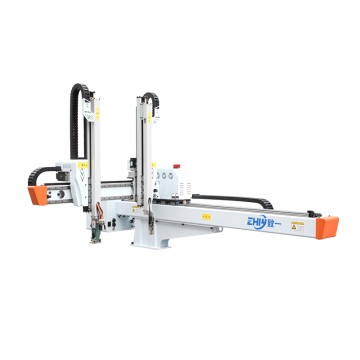
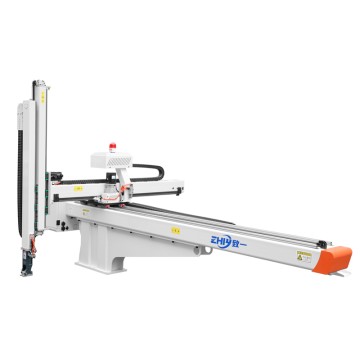
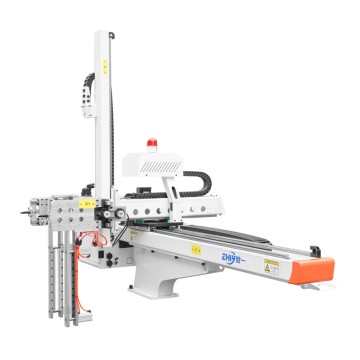
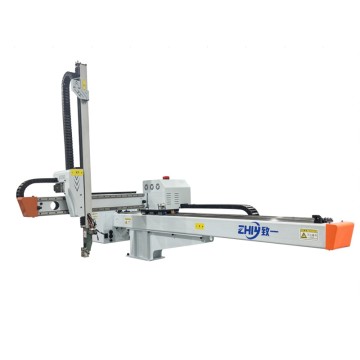
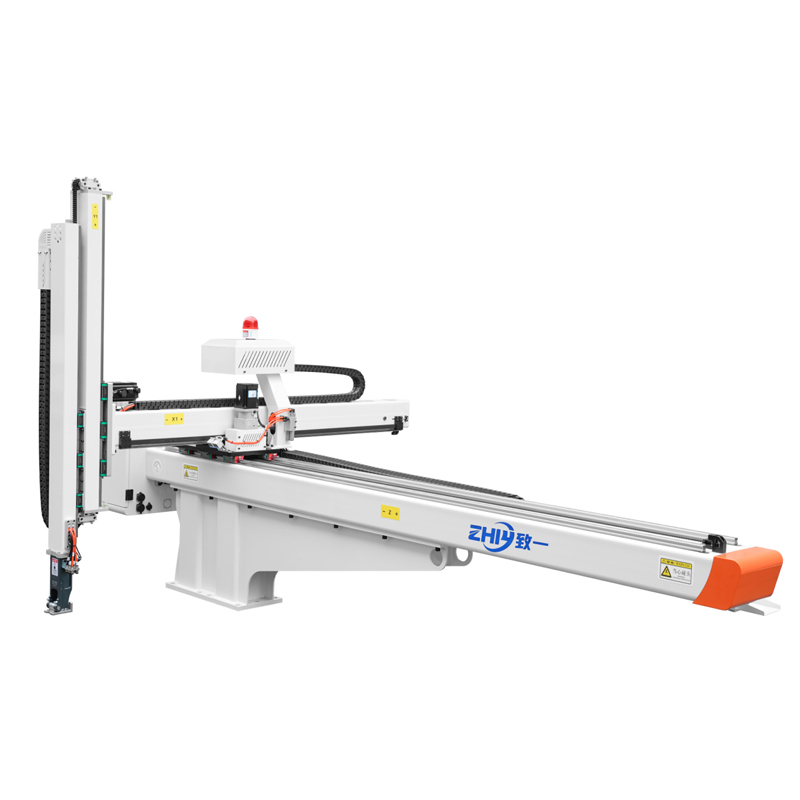
Three-axis servo robotic arm Suitable for standard ordinary injection molding production, with simple structure, low failure rate and easy maintenance. It is the mainstream choice for daily continuous production of plastic parts, featuring large stroke and strong load capacity, meeting the grabbing needs of most conventional molds and products.
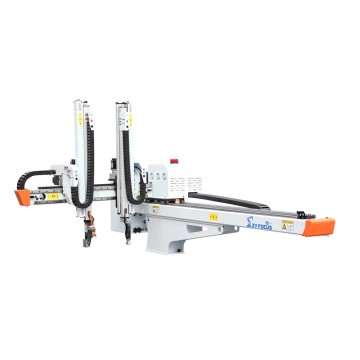
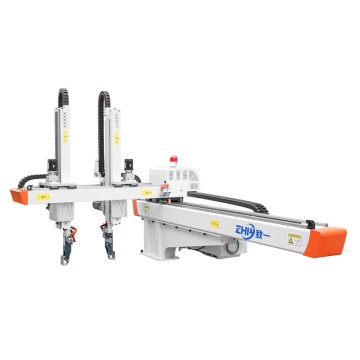
Five-axis double-arm robotic arm Ideal for complex processes such as insert molding, multi-station sorting and high-precision product taking. It has more flexible motion trajectories, adapts to complex production logic, and maintains stable cycle operation in customized automated production lines.
Custom non-standard insertion robot For special processes like embedded injection molding and blow molding sorting, standard models cannot meet demands. Customized robots can be tailored to production line layout and process flow, ensuring seamless connection and uninterrupted operation of special working procedures.
4 Certification & Build Quality for Long-Term Stability
Formal qualification certification is an intuitive proof of robot quality, and it is also an important reference for judging whether it can run continuously for a long time. Prioritize products with ISO9001 quality management certification and CE safety certification. These certifications mean the product has passed strict factory testing in terms of safety, reliability and production standards.
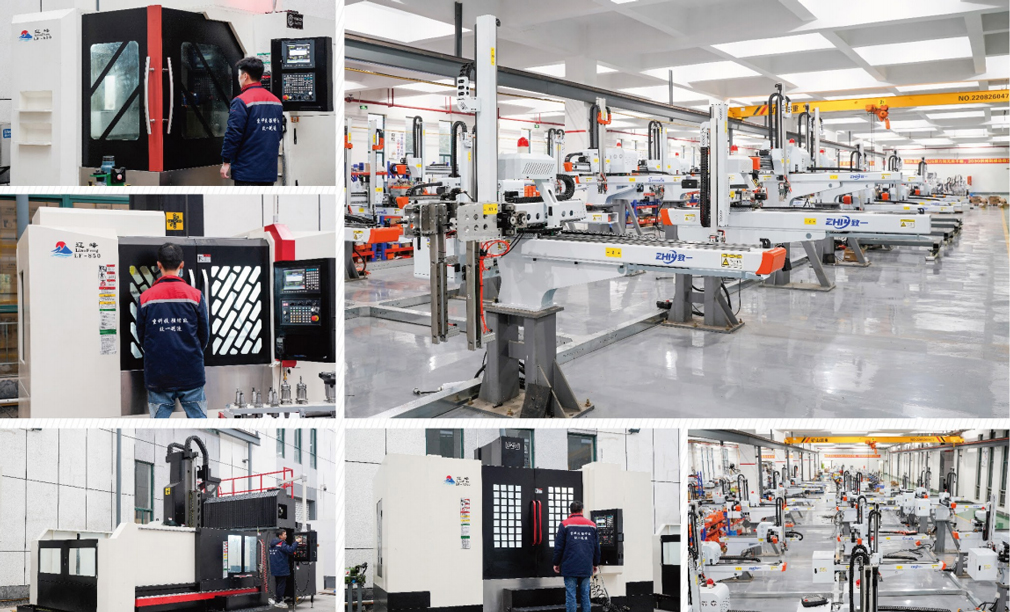
Build quality focuses on structural materials and overall craftsmanship. High-quality continuous operation robots adopt integrated steel structure and high-strength aluminum alloy materials, with anti-rust and wear-resistant surface treatment. The internal transmission components adopt precision customized parts, effectively reducing mechanical loss during long-term reciprocating operation and extending service life.
In addition, factory aging testing is crucial. Qualified suppliers will conduct thousands of hours of continuous simulated operation testing on finished robots to screen out potential hidden faults, ensuring stable performance after customer installation.
5 Compatibility with Injection Molding Machine Systems
A robot with excellent performance cannot exert its value if it is incompatible with existing injection molding equipment. For continuous production, system compatibility must be verified in advance.
First is communication protocol compatibility. The robot needs to seamlessly connect with mainstream injection molding machine brands, supporting common industrial communication protocols to realize synchronous start-stop and linkage operation, avoiding production line stagnation caused by signal mismatch.
Second is installation and layout adaptability. The robot’s stroke, installation size and motion range should match the injection molding machine model and workshop space layout, without additional transformation costs. It can quickly dock with assembly lines, conveyor belts and peripheral automation equipment to form an unmanned continuous production unit.
6 Maintenance & Lifecycle Cost Considerations
Procurement for continuous operation should not only focus on the initial price, but also calculate the 3-5 year full lifecycle cost.
Energy efficiency is the key to daily operation cost. High-quality servo robots adopt energy-saving control design, which can effectively reduce power consumption in long-term operation and help factories cut operating costs significantly.
Wear parts universality and maintenance convenience also matter. Choose robots with standardized common wear parts, which are easy to purchase and replace. The structural design should facilitate daily inspection and maintenance, reducing maintenance time and avoiding long production shutdowns.
It is necessary to avoid models with overly complex internal structures and customized exclusive parts. Once faults occur, it will lead to long waiting times for accessories and seriously affect continuous production arrangements.
7 After-Sales Support & Service Reliability
Round-the-clock production cannot afford long-term downtime due to equipment failure, so the supplier’s after-sales service capability is an indispensable selection factor.
Priority should be given to suppliers with a professional technical support team, providing 24-hour pre-sales consultation and after-sales technical response. Timely remote debugging and on-site maintenance services can quickly solve equipment faults and minimize production downtime.
Meanwhile, refer to the supplier’s industry project cases. Suppliers with hundreds of mature application cases in the injection molding automation field have richer practical experience, can accurately match production needs, and provide targeted operation and maintenance training to ensure operators master daily debugging and simple fault handling skills.
8 Final Selection Checklist for Buyers
Before confirming the purchase, you can check one by one according to the following key points to avoid selection mistakes:
- Confirm load, accuracy, protection grade and other parameters match production demands, with reserved margin for long-term operation
- Select robot type according to product process: three-axis for standard production, five-axis for complex processes, customized models for special scenarios
- Verify complete ISO9001, CE and other formal certifications, confirm factory aging test records
- Test compatibility with existing injection molding machines and peripheral automation equipment
- Evaluate energy-saving performance and later maintenance cost, calculate full lifecycle input-output ratio
- Confirm supplier’s 24-hour after-sales response mechanism and local service support capability
- Review similar industry operation cases to verify actual continuous operation stability
Conclusion
Choosing an injection molding robot for continuous operation is a systematic decision that integrates technical parameters, scenario matching, quality certification, lifecycle cost and after-sales service. It is not advisable to simply pursue low prices or blindly stack high configurations. Procurement buyers should start from actual production demands, focus on long-term stability and operating efficiency, and select robots that adapt to workshop environments, match process flow, and have reliable after-sales support. A suitable injection molding robot can not only realize stable unmanned continuous production, but also reduce labor costs, improve product qualification rate, and create long-term value for manufacturing enterprises.