
Leave Your Message
Electronic Component Pallet Injection Molding: Efficiency Comparison of Three-Axis Robots
Electronic Component Pallet Injection Molding: Efficiency Comparison of Three-Axis Robots
In the electronics manufacturing supply chain, electronic component pallets serve as the core carrier for the storage and transportation of precision components. The efficiency, precision, and stability of their injection molding production directly impact the supply chain rhythm of downstream electronics industries. Three-axis servo robots, as core equipment for injection molding automation, are key to improving the efficiency of electronic component pallet injection molding production lines. Different configurations and technical standards of three-axis robots exhibit significantly different performance in electronic component pallet injection molding scenarios. Selecting the right equipment can not only double production capacity but also fundamentally reduce production losses and improve product yield.
Core Performance Requirements of Three-Axis Robots for Injection Molding of Electronic Component Trays
Electronic component trays are mostly thin-walled, precision-structured designs, some with dense slots and positioning pins. Injection molding production places stringent requirements on pick-up speed, positioning accuracy, and operational stability. This dictates that three-axis robots suitable for this scenario must meet three core standards: First, high-speed pick-up, matching the rapid prototyping cycle of the Injection Molding Machine to reduce in-mold waiting time and avoid machine idleness; second, micron-level positioning, with deviations during pick-up and placement controlled to a minimum to prevent scratching the tray's precision structure and affecting subsequent component loading; third, high load stability, as some electronic component trays are produced using multi-cavity molds with high single-pickup weights, requiring the robot to maintain stability at high speeds without shaking or deviation.
Meanwhile, electronic component tray injection molding is mostly a high-volume, continuous production process. Robots need to be capable of 24/7 uninterrupted operation and adaptable to multi-cavity molds and rapid mold changes. This makes the robot's structural design, servo system configuration, and durability crucial dimensions for efficiency competition.
Efficiency Comparison of Different Types of Three-Axis Robots in Electronic Component Tray Injection Molding
I. By Structure: Bull-Head Three-Axis Robot vs. Ordinary Horizontal-Roaming Three-Axis Robot
Bull-head three-axis robots and ordinary horizontal-roaming three-axis robots are the two most commonly used structural types in electronic component tray injection molding. The main differences in their operating efficiency lie in their running speed, space utilization, and load capacity.
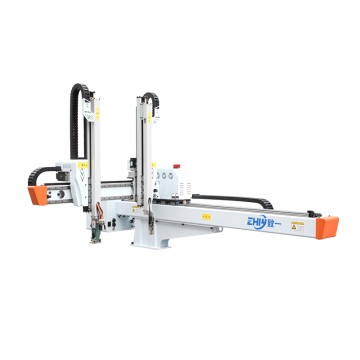
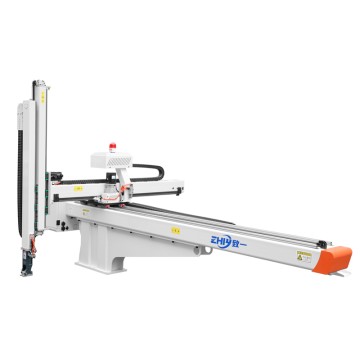
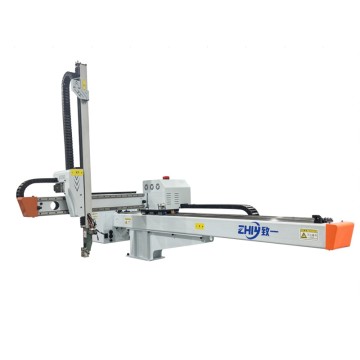
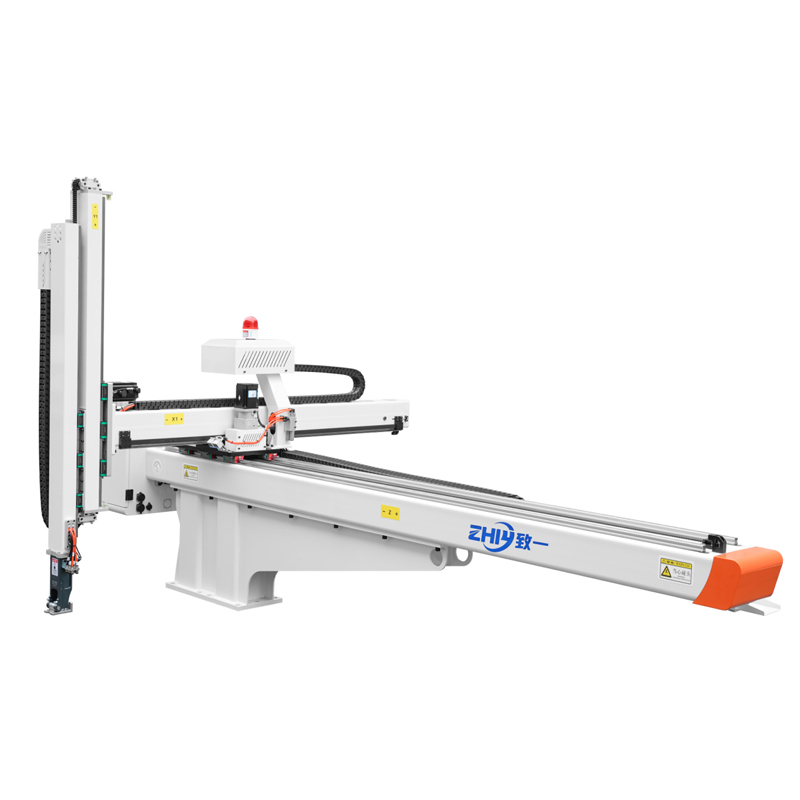
Bull-Head Three-Axis Robot: Utilizing a unique bull-head layout, it has a shorter lever arm, stronger structural rigidity, and lower inertia during operation. Its empty cycle time can be as low as 3.3 seconds, and its in-mold part removal time can reach as fast as 0.65 seconds, significantly reducing single-cycle production time. In terms of load capacity, the high-quality bull-head type three-axis Robot Can handle a maximum load of 50kg, perfectly suited for the single-cycle component retrieval requirements of multi-cavity molds for electronic component trays. Its fully linear guide rail configuration ensures smooth operation even under heavy loads, preventing tray deformation or scratches due to vibration. Furthermore, the bull-head structure increases fixture space by over 35%, adapting to electronic component tray molds of different sizes and cavities, making mold changes and adjustments more convenient.
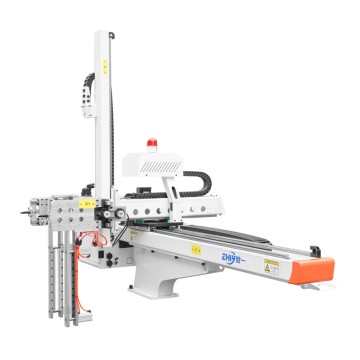
Ordinary horizontal-travel three-axis robots: Their structural design is relatively traditional, with idle cycle times typically around 4-5 seconds and in-mold component retrieval time around 1-2 seconds. Single-cycle production time is approximately 30% longer than the bull-head type. Their load capacity is mostly concentrated between 3-15kg, suitable only for small-cavity molds and lightweight electronic component tray production. When handling heavy-load component retrieval from multi-cavity molds, issues such as running jams and positioning deviations are prone to occur. Additionally, the horizontal-travel structure has lower space utilization, requiring additional adjustments to the production line layout when adapting to large-size molds, and mold change efficiency is relatively low.
In mass injection molding of electronic component trays, the overall production efficiency of a bull-head type three-axis robot is 40%-50% higher than that of a regular horizontal-track robot, and the product yield can be consistently above 99.5%, while the yield of a regular horizontal-track robot is mostly between 95%-98%, and it is prone to defects due to positioning deviations.
II. Classification by Drive and Configuration: Full Servo Three-Axis Robot vs. Semi-Servo Three-Axis Robot
The servo system is the "power core" of a three-axis robot. The difference in configuration between full-servo and semi-servo robots directly determines the robot's operational accuracy and efficiency stability in electronic component tray injection molding.
Full Servo Three-Axis Robot: All three axes are driven by high-precision AC servo motors, paired with precision planetary reducers and imported ball screws. The repeatability can reach ±0.01mm, perfectly matching the precision production requirements of electronic component trays. Its operating speed can be flexibly adjusted according to the injection molding cycle, enabling seamless synchronization with the injection molding machine. After the injection molding machine completes the molding, the robot arm can instantly respond and pick up the part without any time lag. Simultaneously, the full servo system has lower energy consumption and features automatic fault detection and alarm recording functions, effectively reducing equipment downtime and ensuring continuous production line operation.
Semi-servo three-axis robot: Only the horizontal axis uses servo drive, while the vertical and pull-out axes are pneumatically driven. Positioning accuracy is only ±0.1mm, which can easily lead to problems such as misalignment of slots and surface scratches when handling trays of precision electronic components. The pneumatic drive has a slower response speed, and its operating speed is affected by air pressure, making it difficult to achieve precise synchronization with the injection molding machine. In-mold waiting time increases by 0.5-1 second, significantly reducing single-cycle production efficiency. Furthermore, pneumatic components wear out faster, requiring more frequent maintenance and easily causing frequent production line downtime, affecting the continuity of mass production.
Under the same mold conditions, the overall equipment utilization (OEE) of a full-servo three-axis robot can reach over 90%, while the OEE of a semi-servo three-axis robot is only 60%-70%. Furthermore, the product scrap rate of a semi-servo robot is 3-5 times that of a full-servo robot, resulting in higher long-term production costs.
III. Classification by Arm Type: Double-Arm Three-Axis Robot vs. Single-Arm Three-Axis Robot
The design differences between single-arm and double-arm robots primarily affect the operating radius and applicable scenarios of the three-axis robot, thus indirectly affecting production efficiency.
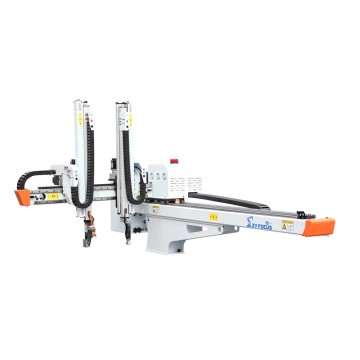
Double-Arm Three-Axis Robot: Utilizing a telescopic double-arm design, it has a larger operating radius, adaptable to large injection molding machines and large-size electronic component tray molds. After picking up parts, it can quickly transport products to more distant sorting and stacking stations without the need for additional conveying equipment, simplifying production line layout. The double-arm's running trajectory is more optimized, reducing ineffective movement and further compressing single-cycle time, making it suitable for injection molding production of large, multi-cavity electronic component trays.
Single-arm three-axis robots have a small operating radius, suitable only for small injection molding machines and small-sized electronic component tray molds. For large molds, the injection molding machine needs to be closely integrated with subsequent workstations, resulting in poor production line layout flexibility. The limited extension stroke of a single arm leads to a short product transport distance after picking up parts, requiring additional conveyor belts and other equipment, increasing production line costs and causing time losses due to multiple interconnected steps.
In large-sized electronic component tray injection molding scenarios, double-arm three-axis robots offer 25%-30% higher overall production line efficiency than single-arm robots. However, in small-sized tray production, the difference in single-cycle efficiency is smaller, with single-arm robots offering better cost-effectiveness due to their simpler structure and lower cost.
Key Factors Influencing the Efficiency Improvement of Three-Axis Robots
As the above comparison shows, the efficiency of three-axis robots in electronic component tray injection molding is not a simple matter of speed, but rather determined by multiple factors including structural design, servo configuration, arm type selection, and mold compatibility. Furthermore, the durability, ease of maintenance, and level of intelligence of the equipment also affect long-term production efficiency.
Servo System and Transmission Components: Imported high-precision servo motors, planetary reducers, and ball screws are fundamental to ensuring high-speed and precise operation. Inferior components can lead to operational jamming and positioning deviations, directly reducing efficiency and yield.
Structural Rigidity and Materials: The robotic arm, constructed with high-rigidity aluminum alloy profiles and robust steel, effectively reduces noise and vibration during operation, improves equipment stability, extends service life, and minimizes downtime.
Intelligent Control: Equipped with mold data memory, rapid programming and debugging, and remote monitoring, the robotic arm significantly improves mold changeover efficiency, adapting to the needs of multi-variety, small-batch electronic component tray production, and reducing line changeover downtime.
Supporting Services and Debugging: On-site surveys, customized debugging, and professional training from the equipment supplier ensure optimal matching between the robotic arm and the electronic component tray injection molding production line, fully leveraging the equipment's performance advantages and avoiding efficiency losses due to improper debugging.
Selection Recommendations for Three-Axis Robots in Electronic Component Pallet Injection Molding
Considering the characteristics of electronic component pallet injection molding production and the efficiency performance of different three-axis robots, companies should adhere to the principles of "adaptability first, cost-effectiveness considered, and long-term stability paramount" when selecting a robot. Specifically, the following points can be considered:
Selection based on production scale and mold specifications: For large-volume, multi-cavity mold, and large-size electronic component pallet production, prioritize a bull-head type full-servo double-arm three-axis robot to maximize single-cycle efficiency and production line continuity. For small-volume, small-cavity mold, and small-size pallet production, a standard horizontal-travel type full-servo single-arm three-axis robot can be selected to control equipment costs while ensuring accuracy.
Key performance parameters to consider: Focus on the four core parameters of the robot: repeatability, idle cycle time, maximum load, and protection level. Ensure accuracy ≤ ±0.05mm, idle cycle time ≤ 4 seconds, load matching the multi-cavity mold part handling requirements, and protection level suitable for the high-temperature, dusty environment of the injection molding workshop.
Prioritize suppliers with customization capabilities: Electronic component trays have diverse structures, and some special-sized trays require customized fixtures and work trajectories. A supplier's customized design and on-site debugging capabilities ensure a high degree of match between the robot and production needs, avoiding the problems of "overkill" or "insufficient performance."
Focus on the total lifecycle cost of the equipment: In addition to equipment purchase costs, energy consumption, maintenance costs, and downtime losses must also be considered. Choose a three-axis robot with low energy consumption, easy maintenance, and sufficient spare parts supply to reduce the overall long-term production cost.
Conclusion: Against the backdrop of the electronics manufacturing industry's transformation towards high efficiency, precision, and intelligence, the automation upgrade of electronic component tray injection molding has become an inevitable trend. As a core piece of equipment, the efficiency performance of the three-axis robot directly determines the core competitiveness of the production line. From the structural differences between bull-head and side-walking types, to the configuration differences between full-servo and semi-servo types, and to the scenario adaptation between single-arm and double-arm types, every choice is closely related to production efficiency, product yield, and overall cost.
For injection molding companies, there is no "best" three-axis robot, only the "most suitable" equipment. Only by accurately selecting a three-axis robot with a matching structure, configuration, and arm type, based on the company's specific production specifications, capacity requirements, and production line layout for electronic component trays, can both efficiency and profitability be improved. High-quality equipment suppliers not only provide high-performance three-axis robots but also offer professional technical support and customized solutions to create injection molding automated production lines tailored to the company's actual needs, helping them gain a market advantage in the electronic component tray processing field.
#ElectronicComponentPatternInjectionMolding #ThreeAxisRobot #InjectionMoldingMachineServoRobot #ThreeAxisRobotEfficiency#BullHeadThreeAxisRobotElectronicComponentPattern #FullServoThreeAxisRobot #InjectionMoldingEfficiency #ElectronicComponentPatternInjectionMolding #RobotSelection #ThreeAxisRobotEfficiencyComparisonInjectionMoldingProduction