Leave Your Message
Automation in Thermos Cup Factories: Three-Axis or Five-Axis Servo Robots for Injection Molding Machines?
Automation in Thermos Cup Factories: Three-Axis or Five-Axis Servo Robots for Injection Molding Machines?
In today's increasingly competitive global thermos cup manufacturing industry, automation upgrades have become a core path for companies to overcome production capacity bottlenecks, ensure product consistency, and address labor shortages. As a critical process in thermos cup production, the selection of servo robots in the injection molding stage directly determines the success or failure of automation transformation—and "three-axis or five-axis" is a core issue frequently faced by European and American buyers when making decisions.
This article will combine the technological characteristics of thermos cup injection molding production, providing scientific selection references for global thermos cup factories from the dimensions of practicality, cost-effectiveness, and production capacity requirements. It will also share ZHIYI Intelligent Robots' practical experience in this field, helping companies achieve precise investment and efficient automation transformation.
I. Core Pain Points: The Core Demands of Thermos Cup Injection Molding Production for Robots
The injection molding process for thermos cups has distinct characteristics: thin-walled molding requires high-precision control; the assembly and compatibility of the cup body and lid depends on stable part handling; and some high-end products require complex processes such as integrated inlay (e.g., stainless steel inner liner inlay, logo injection molding inlay). Meanwhile, the demands of the European and American markets for product quality consistency (ISO standards), production efficiency, and cost control have further amplified the importance of Robot Selection.
Whether it's the "cost reduction and efficiency improvement" needs of small and medium-sized thermos cup factories or the "high capacity and high flexibility" upgrade goals of large enterprises, the choice of the number of axes for A Robot is essentially a balance between "process adaptability" and "return on investment"—the core difference between three-axis and five-axis servo robots lies in their adaptability to different production scenarios.
II. Three-Axis Servo Robots: A Cost-Effective Choice for Small and Medium-Sized Thermos Cup Factories
Core Advantages: Controllable Cost, Efficient Adaptation to Basic Processes
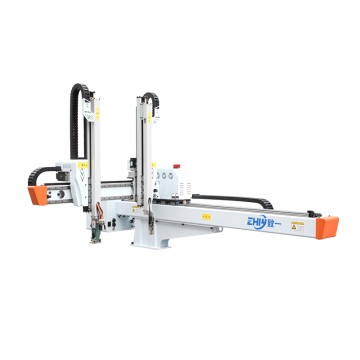
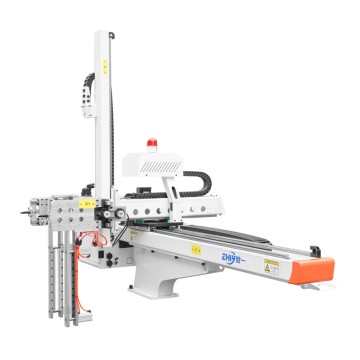
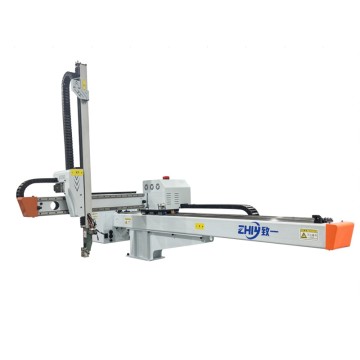
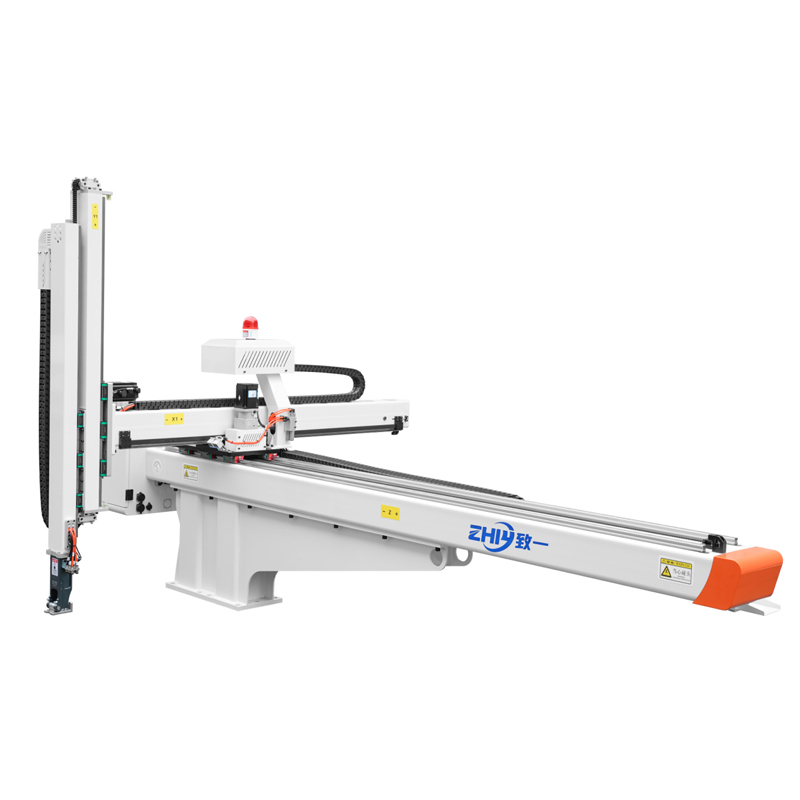
ZHIYI three-axis servo robots (such as the WKG-1000 model) are specifically designed for injection molding machine automation, and their "high cost-effectiveness and stable reliability" have made them the mainstream choice for small and medium-sized thermos cup factories in Europe and America. Its core advantages perfectly match the needs of basic injection molding processes:
Precise and efficient single-process execution:Focusing on the core process of "injection molding - part retrieval - sorting," with a repeatability accuracy of ±0.1mm, it can quickly complete the retrieval and placement of single components such as insulated cup shells and lids, meeting the production needs of low to medium capacity (5000-15000 pieces per day).
Significant cost-effectiveness:Compared to five-axis equipment, procurement costs are reduced by 30%-40%, maintenance is simple (high degree of parts standardization), and combined with ZHIYI automation solutions, it can help companies reduce overall operating costs by 30%, especially suitable for SMEs (small and medium-sized enterprises) with limited budgets.
ISO/CE certification guarantee:The product has passed ISO9001 quality system certification and CE safety certification, fully complying with the compliance requirements of European and American factories, requiring no additional investment in compliance modifications.
Applicable Scenarios (Thermos Cup Production): Injection molding of single components (e.g., cup body, lid, sealing ring); Standardized thermos cup production without complex inlay processes; Small to medium batch production with fixed workflows; Factory space limited, requiring compact automated production line layout.
The ZHIYI three-axis servo robot has a maximum load capacity of 50kg, is compatible with injection molding machines of different tonnages, and supports customized part-removing fixtures. It has been deployed in over 200 small and medium-sized thermos cup factories worldwide, improving production efficiency by an average of 40%.
III. Five-Axis Servo Robot: A Flexible Solution for High-End/Large-Scale Thermos Cup Production
Core Advantages: Multi-Dimensional Motion, Complex Process Integration, High Flexibility
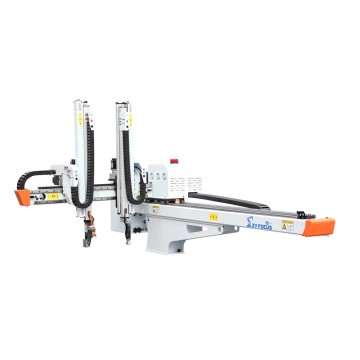
For thermos cup factories pursuing "high capacity, high added value, and complex processes," the ZHIYI five-axis dual-station dual-arm servo robot system achieves "multi-purpose functionality," perfectly solving the pain points of multi-process collaboration:
Multi-directional Precision Operation:The five-axis linkage supports X/Y/Z axis translation and dual-rotation axis motion, enabling complex actions such as tilting pick-up, multi-station transfer, and precise embedding. It is suitable for the production of thin-walled thermos cups and thermos cups with embedded parts (such as metal nameplates and silicone anti-slip rings).
Double Production Efficiency:The dual-station dual-arm design can simultaneously handle the entire process of "injection molding - pick-up - embedding - sorting," requiring no additional auxiliary equipment. Daily capacity can reach 20,000-50,000 pieces, suitable for large-scale mass production.
Flexible and adaptable to multiple products: The programmable control system supports rapid switching between product models (such as insulated cups of different capacities and shapes), meeting the "small batch, multiple shipments" order requirements of the European and American markets and reducing product changeover costs.
Applicable scenarios (insulated cup production):
High-end thin-walled insulated cups (accuracy requirement within ±0.05mm); Complex processes requiring integrated inlay, assembly, and multi-directional component handling; Large-scale mass production (daily capacity of over 20,000 pieces); High-value-added insulated cup production (such as medical-grade, customized gift cups); Factories planning future capacity expansion and multi-product production lines.
ZHIYI's five-axis servo robot boasts 13 utility model patents. Through an intelligent programming system, it achieves automated process optimization and has served over 100 high-end insulated cup brand factories worldwide, helping clients shorten production cycles by 50% and increase product qualification rates to 99.8%.
IV. Selection Decision: 3 Key Dimensions to Avoid Wasted Investment
When choosing between three-axis and five-axis servo robots, European and American buyers don't need to blindly pursue "high configurations." They can make precise decisions based on the following three core dimensions:
1. Process Complexity: How many processes are required for your thermos cup production?
If only three basic processes are needed—"injection molding - part removal - sorting"—a three-axis robot can meet the requirements and offers better cost-effectiveness.
If complex processes such as inlaying, multi-directional assembly, and thin-walled high-precision molding are involved, a five-axis robot is the inevitable choice, reducing equipment redundancy and improving process continuity.
2. Capacity and Budget: Short-Term Costs vs. Long-Term Returns
For small and medium-sized factories (daily capacity < 15,000 units) with limited budgets, prioritize three-axis robotic arms for a quick return on investment (average payback period 8-12 months).
For large factories (daily capacity > 20,000 units) producing high-value-added products, choose five-axis robotic arms for higher long-term returns through efficiency improvements and reduced labor costs (average payback period 12-18 months).
3. Future Scalability: Does Your Factory Plan Upgrades?
If there are no plans for large-scale expansion or product upgrades in the next 3-5 years, three-axis robotic arms are sufficient.
If you plan to expand to multiple product lines and increase capacity, it is recommended to choose five-axis robotic arms directly to avoid the time and financial costs of secondary modifications.
V. ZHIYI: A Global Trusted Partner for Automation in Thermos Cup Factories
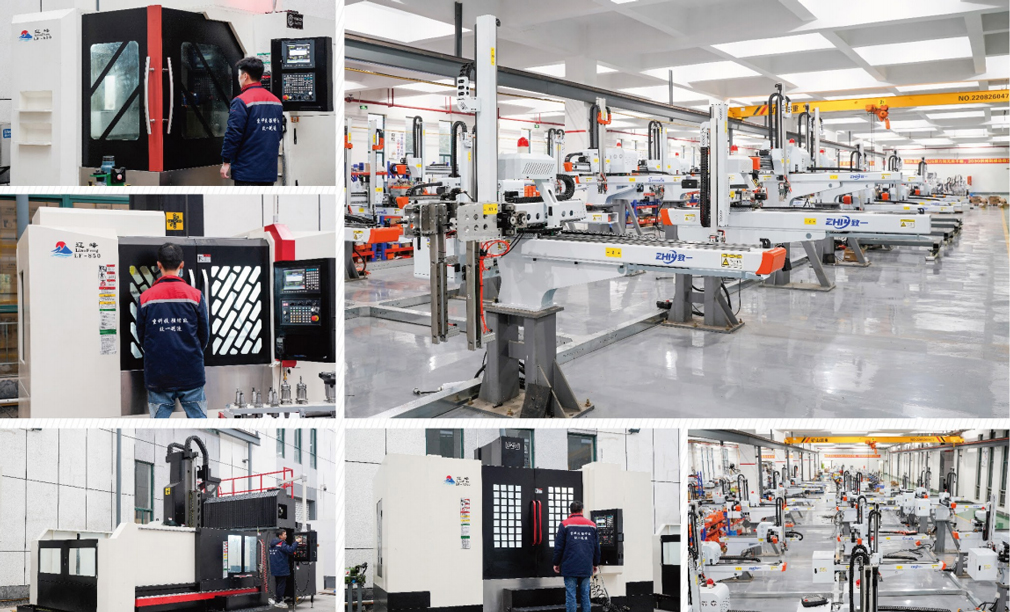
As a leading brand in industrial automation, ZHIYI Intelligent Robots, with 7 years of industry experience (established in 2017), 500+ global project cases, and ISO9001 and CE dual certifications, provides customized servo robotic solutions for thermos cup factories:
Customized Adaptation: Tailor-made three-axis/five-axis automation solutions based on your production processes, capacity requirements, and workshop layout, supporting upgrades for special processes such as welding and inlay;
Global Service Guarantee: A 24/7 global technical support team provides comprehensive services including pre-sales consultation, on-site installation and commissioning, operation training, and after-sales maintenance, ensuring uninterrupted production line operation;
Cost and Efficiency Balance: By optimizing automation processes, helping customers reduce operating costs by 30% and increase production efficiency by 40%-60%, with an annual delivery capacity of up to 2500 units;
High Precision and Stability: Products undergo rigorous testing, achieving high repeatability accuracy. ±0.05mm (5-axis) / ±0.1mm (3-axis), adaptable to the high precision requirements of thermos cup production.
Whether you are a small to medium-sized thermos cup factory seeking cost-effective automation upgrades, or a large enterprise requiring highly flexible and high-capacity solutions, ZHIYI can provide 3-axis/5-axis servo robots to meet your needs, helping you gain a competitive edge in the global market.
VI. Conclusion: Choosing the Right Number of Axes Makes Automation Investment More Valuable
The core of thermos cup factory automation is "adaptability"—3-axis servo robots are a pragmatic choice for small and medium-sized factories to "reduce costs and increase efficiency," while 5-axis servo robots are the core driving force for "flexible upgrades" in high-end/large-scale production. There's no need to blindly pursue high configurations; combining your own processes, production capacity, budget, and future plans is key to maximizing the return on your automation investment.
Website:https://www.zhiyirobotics.com/
Email:sales@zhiyirobotics.com
#ThermosCupFactoryAutomation #InjectionMoldingMachineServoRobot #3-AxisServoRobot #5-AxisServoRobot #ThermosCupInjectionMoldingAutomationSolution