
Leave Your Message
Automation in the food and beverage industry: application innovation trends of three-axis servo robots
A Revolution in Precision and a Breakthrough in Flexibility: Three-Axis Servo Robots Reshape the New Paradigm for Food and Beverage Automation
The global food automation market is experiencing unprecedented growth. According to QYResearch, the market size reached $23.61 billion in 2024 and is projected to soar to $36.96 billion by 2031, maintaining a high compound annual growth rate of 6.7%. Against this backdrop, food and beverage companies face the triple challenges of rising labor costs, evolving food safety standards, and diversifying consumer demand. As core equipment for automation upgrades, three-axis servo robots are reshaping the production paradigm through technological innovation. From high-speed plastic handle collection to precise bottle sorting, from efficient fast food container stacking to micron-level control of the filling process, their applications are continuously expanding, becoming a critical link between large-scale production and the demands of flexibility.
Flexible Solutions for Rigid Demands: The Core Value of Three-Axis Servo Technology
The unique characteristics of the food and beverage industry place extremely stringent demands on automation equipment—it must meet stringent hygiene standards such as those of the FDA and EU 10/2011, cope with the demands of high-mix, low-batch production changeovers, and maintain millisecond-level motion accuracy. The three-axis servo robot, with its unique technical architecture, perfectly meets these core requirements. Its structural design utilizes food-grade stainless steel with a smooth surface finish, and all track systems are certified for European food industry hygiene standards. For example, the SC 130 track system customized by the Rollon Group for Coca-Cola's production line not only withstands frequent cleaning and disinfection but also maintains long-term stable operation in humid environments.
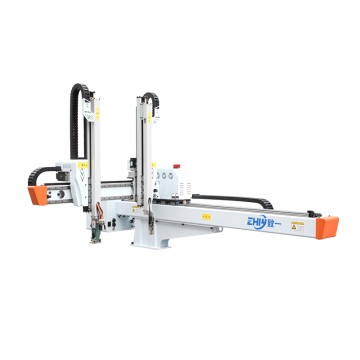
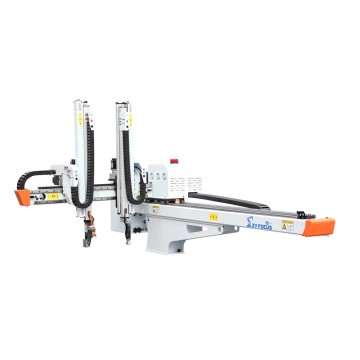
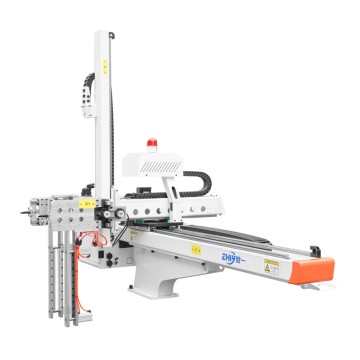
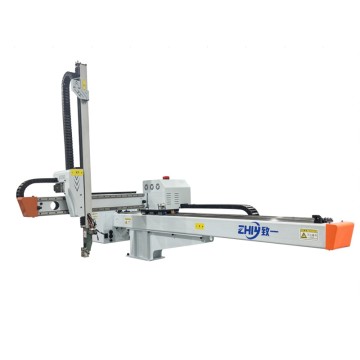
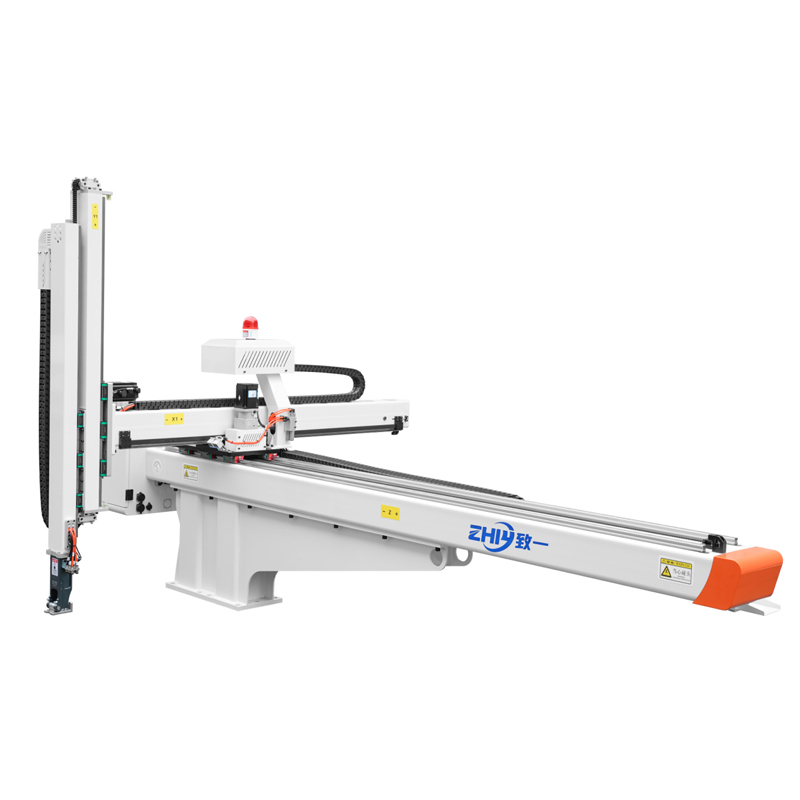
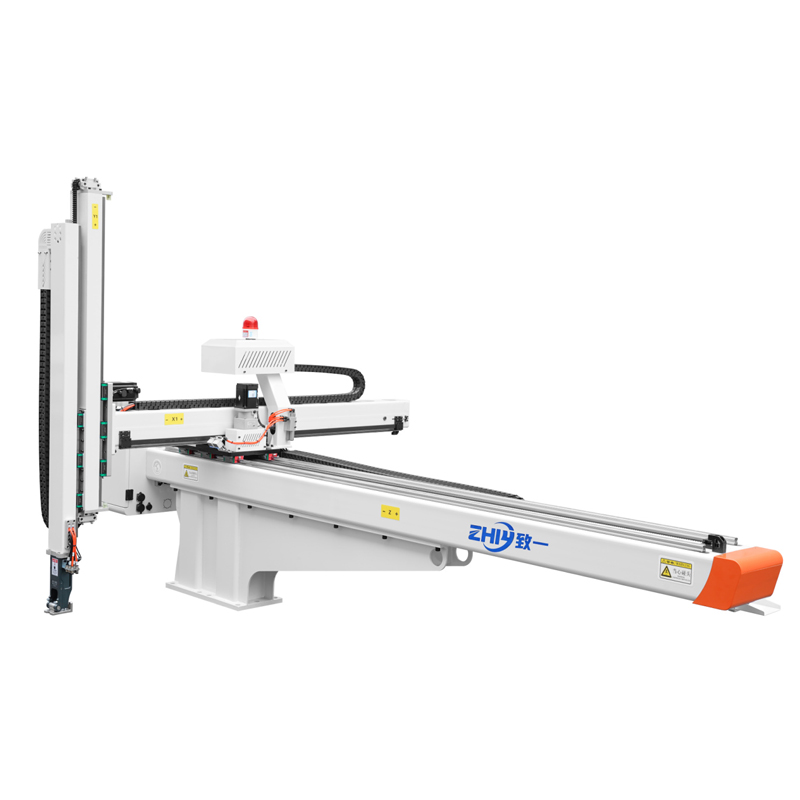
Efficiency improvement is the most significant value proposition of the three-axis servo robot. The SW66 series three-axis servo robot developed by SWEIKE is designed for thin-walled products like fast food containers. Its dual-arm structure enables the complete injection molding, removal, and stacking process of four-cavity fast food containers in 2.8-3.5 seconds, improving efficiency by over 300% compared to traditional manual operations. Even more impressive is its "1-out, 32-handle fully automated solution." Utilizing a dual-tray, 32-cavity handle collection system, this solution enables unmanned, continuous plastic handle production from injection molding to packaging, completely eliminating efficiency bottlenecks in the production of packaging accessories for edible oil drums and beverage bottles. This efficiency is particularly critical in the beverage filling process. The YAMAHA three-axis Robot Can precisely handle dozens of bottles per minute, and the dynamic response speed of its servo drive system ensures high-speed operation of the production line.
This precise control capability redefines the standard of accuracy in food processing. In the beverage canning line, a three-axis servo system controlled by a Mitsubishi FX5U PLC can coordinate X-axis horizontal movement, Y-axis elevation, and Z-axis angle adjustment within 2 seconds, with positioning errors strictly controlled within ±0.1mm. This submillimeter control accuracy offers unique advantages in food sorting. Equipped with visual recognition technology, Yamaha Robotic Arms can precisely classify food based on characteristics such as shape, color, and size, placing products of varying specifications along pre-set paths, enabling new possibilities for refined processing.
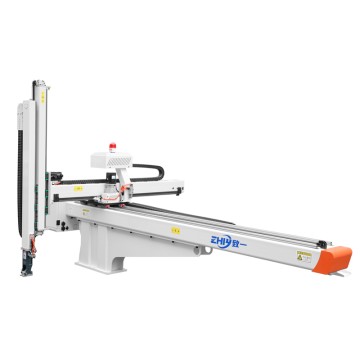
Flexible adaptability is the core competitive advantage of three-axis servo robots in responding to market changes. Unlike the fixed processes of traditional automated equipment, modern three-axis servo systems utilize a modular design that allows for rapid switching of production parameters, meeting the production needs of a wide range of products, from milk tea cups to fast food boxes, and from beverage bottles to food packaging. Dongguan Guangwei Digital Technology Co., Ltd. offers hundreds of robot models, successfully enabling flexible production in diverse scenarios for major clients such as Yibao and Yihe International. Specialized models, such as the Bullhead servo robot and the ultra-low-profile specialized robot, address space constraints in food production workshops.
Innovation Spectrum of Technological Convergence: The Cutting-Edge Evolution of Three-Axis Servo Robotics
When machine vision algorithms meet precision servo control, food and beverage automation is undergoing a paradigm shift. Three-axis servo robots are no longer simple actuators, but have evolved into intelligent units integrating perception, decision-making, and manipulation. The Vision-Robotics Experimental Platform launched by Hefei Zhongke Shengu Technology exemplifies this trend. By leveraging the OpenCV algorithm library for color recognition, shape feature extraction, and FAST corner detection, combined with YOLOv5 object detection technology, the three-axis robotic arm can autonomously identify food materials in various packaging formats and accurately convert pixel coordinates to world coordinates. This "eye + hand" collaborative model has demonstrated its power in practice. Leveraging this technology, a Yamaha robotic arm has achieved intelligent upgrades in food sorting, reducing the missed detection rate compared to manual inspection from 3% to below 0.1%.
Breakthroughs in multi-axis collaborative control technology make it possible to standardize complex processes. In the beverage filling production line, the PLC precisely controls the motion parameters of each axis by combining DRVA absolute positioning instructions with DRVI relative positioning instructions. The X-axis achieves 300mm displacement at a 5kHz frequency, the Y-axis achieves 100mm lift and lowering at a 2kHz frequency, and the Z-axis achieves 90° rotation using pulse width modulation. The timing error for these three motions is kept within 10ms. By optimizing S-curve acceleration and deceleration settings and interpolation instructions, commissioning engineers not only eliminated material splashing caused by mechanical impact but also reduced single-cycle time to 60% of that of conventional equipment. This high-precision coordination is particularly important in fast food container production. The SW66 series of SWECO robots, through optimized motion parameters for their dual-section arms, successfully addresses the industry's pain point of thin-walled products prone to deformation.
Hygienic design innovation has become a new focus of technological competition. To meet the specific requirements of the food industry, the new generation of three-axis servo robots has undergone comprehensive upgrades in material selection and structural design. Yamaha's robotic arms utilize food-grade materials with a surface roughness controlled to below Ra0.8μm. Their streamlined design, with no blind spots, allows them to withstand 85°C hot water washdowns and CIP cleaning-in-place (CIP) procedures. The E-SMART 100 track system customized by ROLLON for Coca-Cola features a fully enclosed design, minimizing the risk of lubricant leakage. Its unique sealing structure ensures long-term reliability despite three daily disinfection cycles. These innovations enable the robotic arms to fully comply with stringent standards such as FDA 21 CFR Part 177 and EU 10/2011, providing a technical barrier to food safety.
Open source and modularization trends are lowering the barrier to entry for technology adoption. Zhongke Shengu's open-source three-axis collaborative robot platform provides comprehensive development tools, from kinematic simulation to actual control. Its independently developed joint drivers and controllers support advanced development, allowing developers to quickly build visual grasping applications using the ROS system. This open ecosystem accelerates technological iteration. Siweike, leveraging its modular architecture, has rapidly deployed various handle collection solutions on 400-650 ton injection molding machines. For food companies, modularization not only reduces equipment replacement costs but also means production lines can transition from milk tea cups to fast food boxes in under an hour. This flexibility is key to addressing consumer diversification.
The Implementation Path of the Future Factory: From Technological Innovation to Value Reconstruction
Automation upgrades in the food and beverage industry are not simply equipment replacements, but a complete restructuring of the production paradigm. Three-axis servo robots, the core engine of this transformation, are being increasingly applied along the path of "single-machine automation - production line collaboration - factory intelligence." Initially, companies are achieving efficiency gains through single-point breakthroughs. For example, replacing manual assembly with Siweike's automated handle collection system can reduce labor costs by 80% and increase production efficiency to 30,000 pieces per hour. When production lines reach the collaborative stage, multiple three-axis servo robots are linked through PLCs and MES systems to form a coherent process from raw material processing to finished product packaging. This collaboration has helped Coca-Cola's production lines increase their overall equipment efficiency (OEE) from 65% to 89%.
Data-driven predictive maintenance is becoming a new competitive advantage. With the penetration of IoT technology, modern three-axis servo systems now possess comprehensive condition awareness capabilities—real-time assessment of equipment health through encoder pulse monitoring, motor current analysis, and vibration spectrum acquisition. In beverage filling lines, engineers monitor X-axis pulse value changes using the D8340 register, enabling prediction of potential mechanical wear issues three days in advance. This predictive maintenance model transforms traditional "breakdown maintenance" into "planned preventive maintenance," reducing unplanned downtime on production lines by over 70%. Yamaha has extended this concept to energy management. Its servo systems use dynamic power regulation to reduce energy consumption per unit by 15-20%, providing technical support for food companies' carbon neutrality goals.
Human-robot collaboration is redefining the production organization model on the shop floor. Unlike the isolated operations of traditional industrial robots, the new generation of three-axis collaborative robots utilize force feedback and safety monitoring technology to enable close collaboration with human operators. In food sorting stations, robotic arms handle repetitive handling tasks, while workers focus on quality inspections and exception handling. This combination increases per capita output by 50% while reducing labor intensity. The experimental platform at Hefei Zhongke Shengu has demonstrated the feasibility of this model. Its hand-eye calibration technology ensures robot positioning accuracy in mixed human-robot environments, while open-source control algorithms allow companies to optimize the human-robot division of labor based on actual needs. For food companies, this flexible collaborative model is particularly suitable for production scenarios with significant seasonal fluctuations.
Looking forward, sustainable design will become the core competitive advantage of three-axis servo robotic arms. As ESG concepts become more prevalent in the manufacturing industry, equipment must not only meet production needs but also comply with environmental standards. Leading companies are innovating in material selection, energy consumption, and lifecycle management. These include using recycled stainless steel for mechanical structures, reusing braking energy through servo motor energy recovery technology, and designing modular, easily disassembled structures for later recycling. These innovations have reduced the equipment's carbon footprint by over 30% over its entire lifecycle. A QYResearch report indicates that sustainable automation equipment is gaining increasing favor among food companies, with its market growth rate 2-3 percentage points higher than that of traditional equipment.
Conclusion: The Art of Balancing Precision and Flexibility
Amid the wave of automation in the food and beverage industry, three-axis servo robots are reshaping the production value chain with their unique technological advantages. From the efficient operation of Siweike's 32-hole handle automation system, to the precise identification of Yamaha's visual sorting, to the collaborative operation of Coca-Cola's production lines, these innovative practices reveal a core principle: the ultimate goal of food automation is not to replace humans with machines, but to achieve a balanced balance of efficiency, safety, and flexibility through technological empowerment.