
Leave Your Message
A Detailed Guide on Robot Arm Types for Injection Molding
A Detailed Guide on Robot Arm Types for Injection Molding
Introduction
Injection molding is a widely used manufacturing process that involves injecting molten material, typically plastic, into a mold to produce precise components in large volumes. Integrating robot arms into injection molding production lines can significantly enhance efficiency, precision, and overall productivity. This detailed guide aims to provide comprehensive insights into the various types of robot arms used in injection molding, their characteristics, applications, and benefits, to help global wholesale buyers and professional procurement specialists make informed decisions.
Types of Robot Arms for Injection Molding
Cartesian Robot Arm
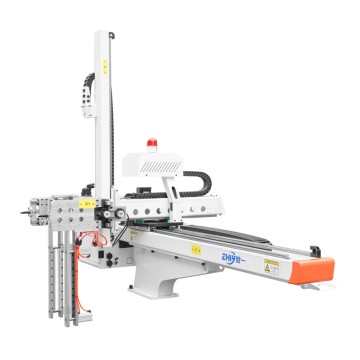
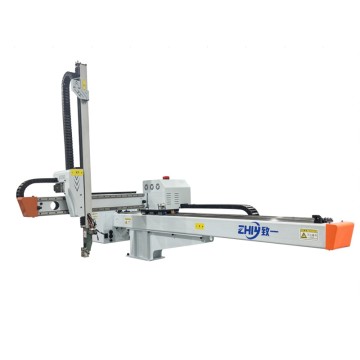
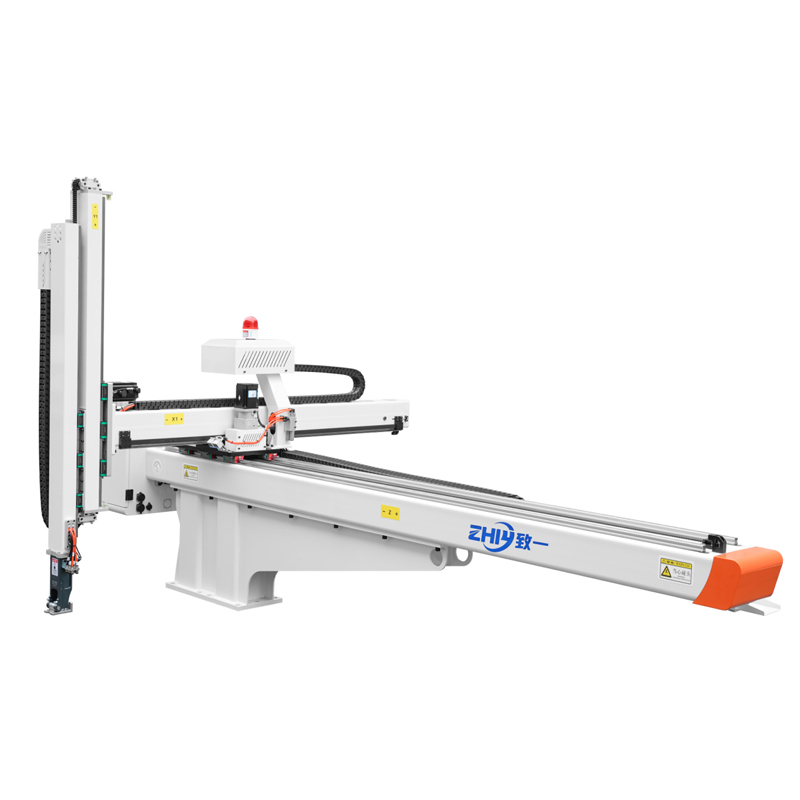
The Cartesian robot arm is one of the most common types used in injection molding. It operates on three linear axes (X, Y, and Z) and moves in a straight-line motion. This type of robot arm is highly appreciated for its simplicity, accuracy, and ability to handle heavy loads. Cartesian Robots are ideal for applications where precision in part placement and movement is crucial, such as in pick-and-place operations, material handling, and machining. They are commonly placed in production lines due to their efficiency and versatility. However, their reach is limited to positions within their defined range of motion.
Six-Axis Robot Arm
The six-axis robot arm, also known as an articulated robot, is a versatile option in the range of robot arm types. It features six rotational axes, providing a high degree of freedom and flexibility in movement. This type of robot arm is excellent for more complex tasks that require multi-directional motion, such as reaching into confined spaces or performing intricate assembly tasks. Articulated robots are ideal for handling large, irregularly shaped parts or performing complex, post-processing assembly tasks. Depending on the model, their payload capacities can range from a few kilograms to over a thousand kilograms. However, they require more floor space than their counterparts and have a higher initial cost.
SCARA Robot Arm
SCARA (Selective Compliance Articulated Robot Arm) is another popular robot arm type used in injection molding. It offers fast, accurate movements in a horizontal plane, making it suitable for tasks like pick-and-place, assembly, and packaging. SCARA robots are known for their speed and compact design, which can be particularly beneficial in space-constrained manufacturing environments. They have two parallel rotary joints to provide motion in a horizontal plane. SCARA robots are popular for high-speed pick-and-place, sorting, and post-processing assembly applications. They work very well in environments where precision is the top priority. For high-volume production, a fast robot is essential; slower robots may bottleneck the process.
Delta Robot Arm
Delta robots, also known as parallel robots, are among the fastest robot arm types available. Their lightweight design and high-speed capabilities make them ideal for high-speed pick-and-place applications in injection molding processes. Delta robots excel in environments where precision and speed are critical, such as in the packaging or sorting of molded products. They are designed to perform tasks quickly and accurately, making them suitable for applications that require high throughput.
Collaborative Robot (Cobot) Arm
Collaborative robots, or cobots, are designed to work alongside humans, making them a unique option among robot arm types. Cobots are equipped with advanced sensors and safety features that allow them to operate safely in close proximity to human workers. In injection molding, cobots can assist with tasks like quality inspection, part handling, and light assembly, enhancing both efficiency and safety. Unlike traditional industrial robots that are usually placed within protective cages or barriers to ensure human safety, cobots are built with features that allow them to safely interact with humans without posing a significant risk of injury. The concept behind cobots is to facilitate cooperation and collaboration between humans and robots to enhance productivity and efficiency in various industries.
Gantry Robot Arm
A gantry robot arm is another variation of the robot arm types used in injection molding. It operates on a linear motion system similar to Cartesian robots but can cover a larger area due to its overhead structure. Gantry robots are particularly useful in applications requiring the movement of large or heavy objects over a vast workspace. They are commonly used in production lines for material handling and other tasks that require precise positioning and movement over a large area.
Servo Injection Robot Arm
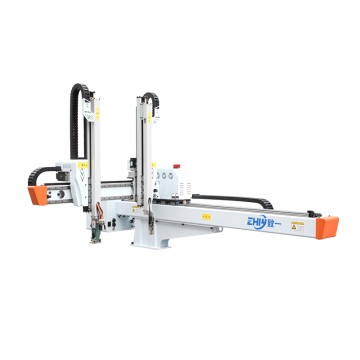
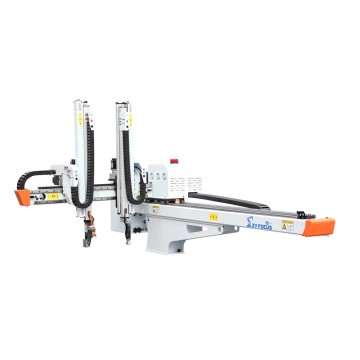
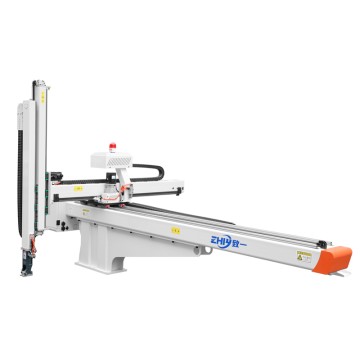
Servo injection robot arms are extensively applied to plastic injection molding machines. These robot arms can rapidly take out the injection runners, sprues, and finished products from the mold of plastic injection molding machines. They are equipped with servo motors that provide high-speed and precise positioning capabilities. The repeat position location of servo motors can reach 0.02mm, ensuring high accuracy in part placement and movement. Servo injection robot arms can be embedded, stacked, and used for various auxiliary processes, making them highly versatile.
Redstone Series CNC AC Servo Traverse Beam Robots
The Redstone series of robotic arms are used for various types of horizontal plastic injection molding machines of 50-800 tons. These robots feature 3-axis and 5-axis AC servo drives and are designed for high-precision, high-speed removal and embedding/insert applications. The Redstone series robots offer fast response and high positioning accuracy for quick removal of single cavity and multiple cavities and embedding/insert applications. They are available in different models with varying traverse strokes, crosswise strokes, vertical strokes, and maximum loading capacities to meet different production requirements.
Swing Arm Sprue Picker Robot
Swing-arm robots are applicable to all types of horizontal injection machines and vertical injection molding machines of 30-150T for products and sprues take-out. These robots are designed to clamp products and sprues, ensuring accurate output and reducing waste. They offer increased productivity, reduced defective rates, enhanced operator safety, and reduced manpower requirements. Swing-arm robots are available in single-stage and telescopic-stage models to suit different machine types and production needs.