
Leave Your Message
200T Injection Molding Machine: 3-Axis vs 5-Axis Servo Robot Selection Guide – Boost Efficiency & Precision
200T Injection Molding Machine: 3-Axis vs 5-Axis Servo Robot Selection Guide – Boost Efficiency & Precision
In the European and American mid-range injection molding market, the 200T injection molding machine is a workhorse—widely used in producing household appliance parts (e.g., plastic control panels), automotive small components (e.g., sensor housings), and consumer electronics enclosures. However, many manufacturers face a critical dilemma: which servo robot—3-axis or 5-axis—best matches their 200T line? Choosing incorrectly can lead to wasted investment, reduced production efficiency, or even compromised product quality.
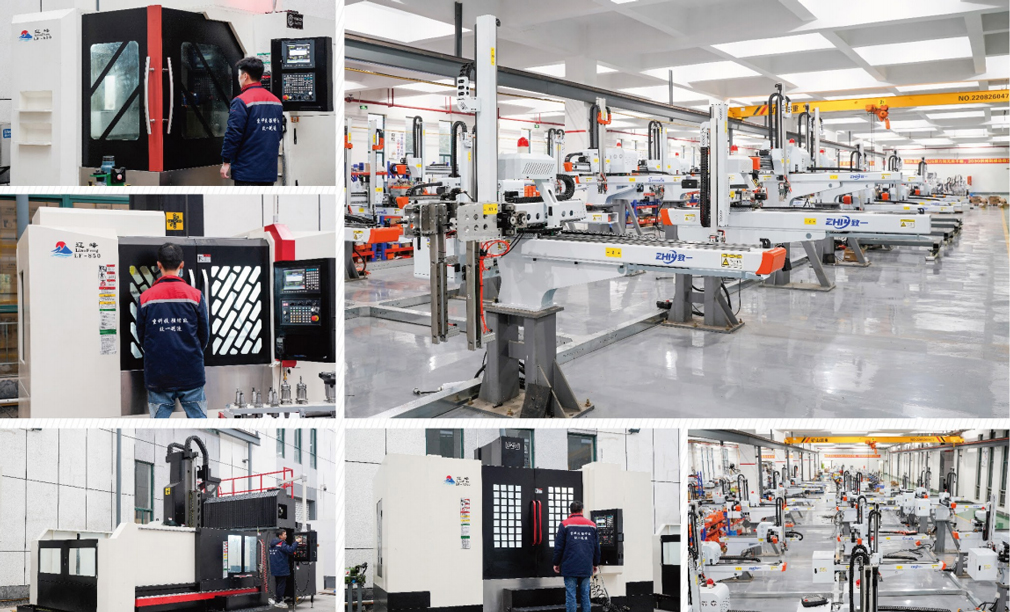
As a leading global provider of automated intelligent equipment, ZHIYI (Zhejiang Zhiyi Intelligent Robot Co., Ltd.) has supported over 500 injection molding projects worldwide. Drawing on our experience with 200T machine matching, this guide breaks down the differences between3-axis and 5-axis servo robots, helping you make data-driven decisions aligned with your production goals.
1. First: Understand Your 200T Injection Molding Machine’s Core Application Scenarios
Before selecting a robot, clarify your production needs—this is the foundation of accurate. For 200T machines, typical applications in European and American markets include:
Simple part production: Single-material plastic parts (e.g., food-grade tableware, TV remote casings) requiring only basic pickup and unloading.
Mid-complexity production: Parts with minor post-processing (e.g., water gap cutting) or simple inserts (e.g., metal nuts in plastic brackets).
High-precision production: Complex components (e.g., medical device connectors, automotive lighting housings) needing attitude adjustment, multi-station transfer, or dual-color molding.
Your scenario directly determines whether a 3-axis or 5-axis robot is optimal. Below, we analyze both options for 200T machines.
2. 3-Axis Servo Robots for 200T Injection Molding Machines: Simple, Cost-Effective, and Efficient
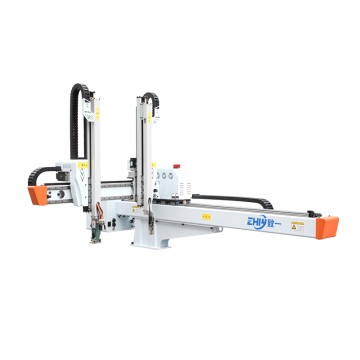
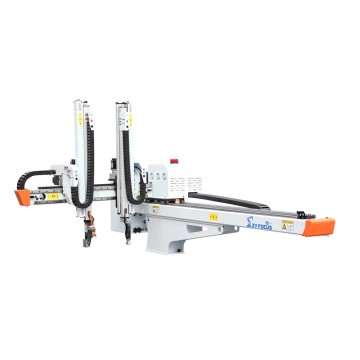
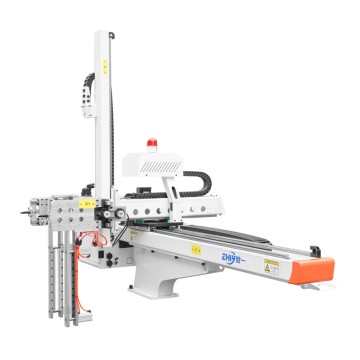
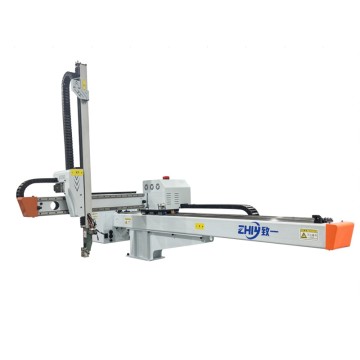
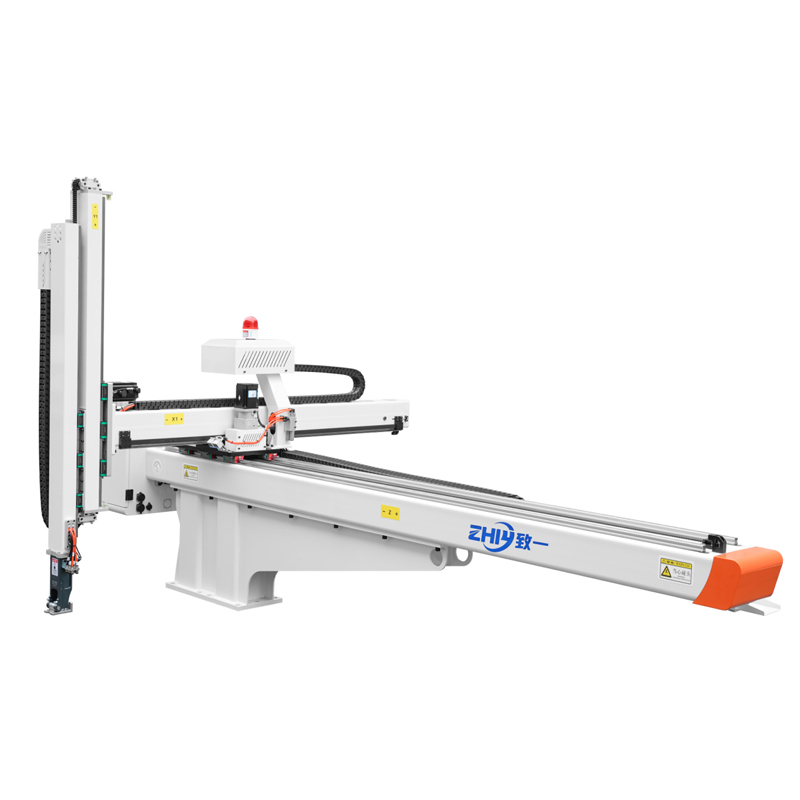
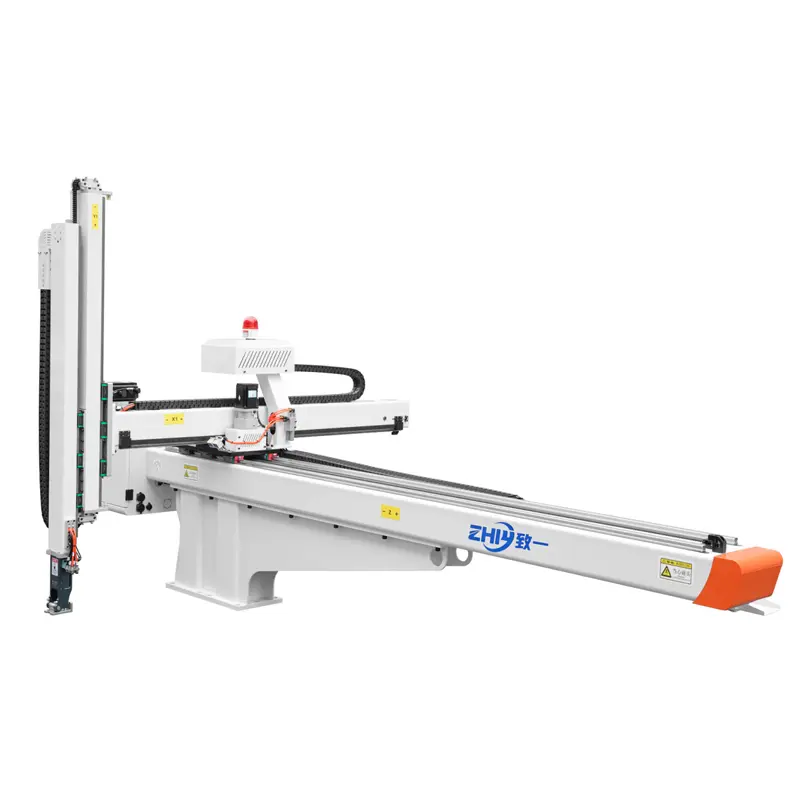
ZHIYI’s 3-axis servo robot series (e.g., Bull Head 3-Axis Servo Robotic Arm and Model WKG-1000) is engineered for 200T machines, focusing on "reliable basic automation"—ideal for manufacturers prioritizing cost control and simple processes.
Core Advantages for 200T Lines
Straightforward functionality, fast deployment: With 3 linear axes (X: traversal, Y: forward/backward, Z: lifting), it excels at basic tasks like part pickup, water gap separation, and single-station unloading. No complex programming is needed—parameters for linear paths can be set in 1–2 hours, and trial runs stabilize in 3–5 cycles.
Cost efficiency, quick ROI: Compared to 5-axis models, 3-axis robots reduce initial investment by 30–40%. For 200T machines running 24/7, they cut labor costs by up to 30% (per ZHIYI’s project data) and typically recoup investment in 6–8 months.
Easy installation, space-saving: Designed for 200T machine dimensions, it can be mounted on the fixed mold plate, top, or workbench of the 200T machine. The horizontal error tolerance is ≤0.5mm/m, and no extra space is required for rotation—perfect for compact European and American workshops.
Proven reliability: All ZHIYI 3-axis robots are ISO9001 and CE certified, undergoing 1,000+ hours of durability testing. The maximum load of the Bull Head series reaches 50kg, easily handling large parts from 200T machines (e.g., 10kg plastic buckets).
Best For 200T Machine Applications
Simple single-material parts (e.g., plastic bowls, washing machine knobs).
Low-mix, high-volume production (e.g., 10,000+ units/day of the same part).
Manufacturers new to automation (easy to operate, minimal training required for workers).
3. 5-Axis Servo Robots for 200T Injection Molding Machines: Flexible, Precise, and Future-Ready
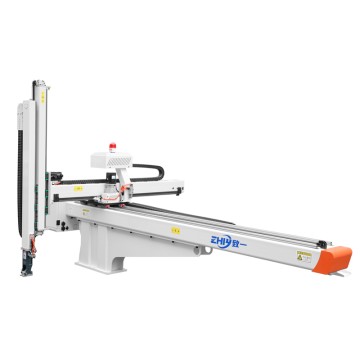
For 200T machines handling complex processes, ZHIYI’s 5-Axis Double-Arm Double-Section Robotic System is a game-changer. By adding 2 rotation axes (A: rotation around Z-axis, B: rotation around X-axis) to the basic 3 linear axes, it enables "human-like flexible operations"—critical for high-value production in European and American markets.
Core Advantages for 200T Lines
Complex process compatibility: It can complete multi-step tasks in one cycle, such as "pick up part → rotate 90° to remove flash → insert metal pins → place in inspection station"—a process that would require 2–3 workers or a 3-axis robot plus additional equipment.
Superior precision for high-quality parts: With a repeat positioning accuracy of ±0.05–0.1mm (vs. ±0.1–0.2mm for 3-axis), it meets the strict tolerances of European and American automotive/medical industries. For example, when producing 200T-molded automotive sensor housings, it ensures consistent insert alignment, reducing defect rates by over 25%.
Adaptability to advanced molding: Compatible with dual-color 200T machines and multi-cavity molds. ZHIYI’s 5-axis dual-arm system can simultaneously pick parts from 2 cavities and sort them by color—boosting 200T line efficiency by 40% compared to manual operation.
ZHIYI’s tailored support: We provide custom mounting solutions for 200T machines (e.g., shock-absorbing pads to reduce rotation vibration) and 7×24 technical support in English/German. Our team also offers on-site training to ensure smooth integration with your existing MES system.
Best For 200T Machine Applications
Complex parts with inserts (e.g., metal-reinforced plastic brackets for electric vehicles).
Dual-color/multi-material molding (e.g., soft-touch plastic handles for household appliances).
High-value products (e.g., medical plastic connectors) where precision directly impacts safety compliance.
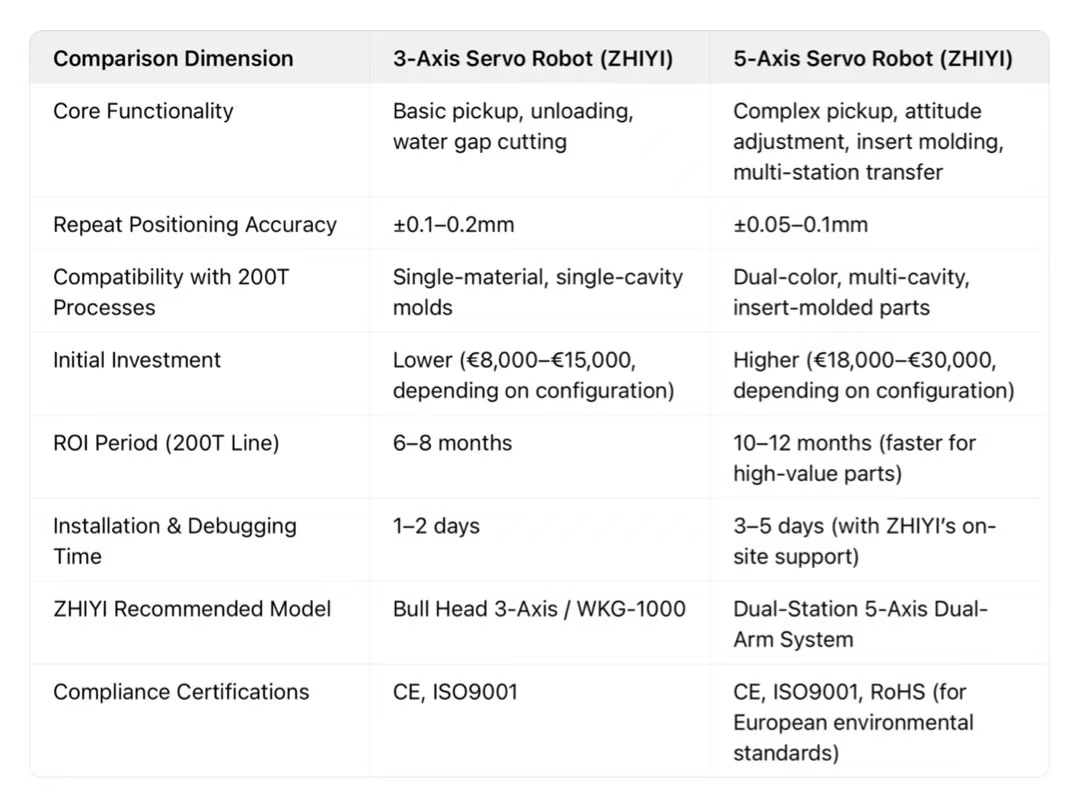
4. 3-Axis vs. 5-Axis Servo Robots: Key Comparison for 200T Injection Molding Machines
To simplify your decision, we’ve summarized the critical differences in a side-by-side table—focused on factors European and American manufacturers care about most:
5. Step-by-Step Selection Checklist for Your 200T Injection Molding Line
Follow these 5 steps to confirm whether a 3-axis or 5-axis robot is right for you:
Step 1: Map Your Production Process
If your 200T machine only needs "mold opening → part pickup → unloading" (no extra steps), a 3-axis robot is sufficient.
If you require insert placement, attitude adjustment, or integration with downstream testing equipment, choose a 5-axis robot.
Step 2: Evaluate Part Complexity
Measure your part’s tolerance requirements: ≤±0.1mm → 5-axis; >±0.1mm → 3-axis.
Check for inserts: 0 inserts → 3-axis; 1+ inserts → 5-axis (to avoid manual handling errors).
Step 3: Calculate Long-Term ROI
For low-value parts (e.g., €0.5/unit), a 3-axis robot’s lower cost delivers better ROI.
For high-value parts (e.g., €10+/unit), a 5-axis robot’s defect reduction and efficiency gains will outweigh the higher initial cost.
Step 4: Verify Workshop Compatibility
Measure your workshop space: If the 200T machine is in a narrow area (no room for rotation), 3-axis is better.
Check power/air supply: 5-axis robots need extra wiring for rotation axes—ZHIYI can provide a pre-installation checklist to avoid delays.
Step 5: Test with ZHIYI’s Demo Service
ZHIYI offers free on-site demos for 200T machine owners in Europe and America. We’ll bring a 3-axis (WKG-1000) or 5-axis robot to your factory, run your actual parts, and provide a detailed efficiency report—so you can see results before investing.