
Leave Your Message
How to Choose Robot for Injection Machine
How to Choose the Right Robot for Injection Molding Machines
In today’s competitive manufacturing environment, automation is no longer an optional upgrade for injection molding factories. Rising labor costs, increasing quality requirements, shorter production cycles, and the demand for stable output are driving more manufacturers to integrate robotic automation into their molding lines.
Among all automation solutions, Injection Molding Robots have become one of the most effective ways to improve production efficiency, reduce defects, and achieve consistent product handling. However, many factory owners and purchasing managers face the same challenge:How do you choose the right robot for your injection molding machine?
Selecting the wrong robot can result in unstable production, slower cycle times, excessive maintenance costs, and poor return on investment. On the other hand, choosing the correct robot can significantly improve productivity, reduce labor dependency, and support long-term smart manufacturing goals.
This guide explains the most important factors to consider when selecting a robot for injection molding applications, including robot types, payload, reach, cycle time, EOAT selection, and integration requirements.
Why Injection Molding Factories Use Robots
Injection molding robots are mainly used for:
- Part removal from molds
- Sprue picking
- Insert loading
- Product stacking
- Packaging and palletizing
- In-mold labeling
- Secondary processing
- Quality inspection assistance
Modern robotic systems can operate continuously with high precision, helping factories achieve stable production 24/7.
The main benefits include:
1. Faster Production Cycles
Robots can remove products from molds quickly and consistently, reducing overall cycle time and increasing machine utilization.
2. Improved Product Quality
Manual handling often causes scratches, contamination, or inconsistent placement. Robots provide repeatable motion and stable handling accuracy.
3. Reduced Labor Costs
Automation minimizes dependence on manual operators, especially for repetitive take-out operations.
4. Increased Workplace Safety
Robots reduce operator exposure to hot molds, moving machine parts, and hazardous environments.
5. Better Production Consistency
Robots maintain stable operation without fatigue, helping factories achieve more predictable output.
Understand the Main Types of Injection Molding Robots
Before choosing a robot, it is important to understand the common robot categories used in injection molding automation.
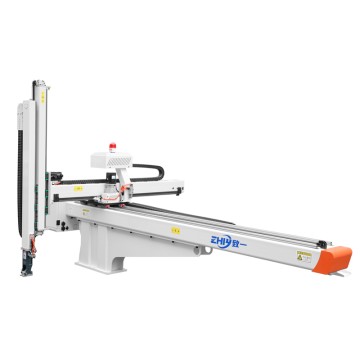
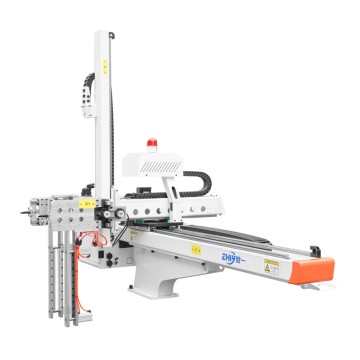
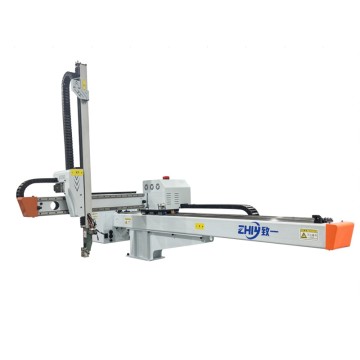
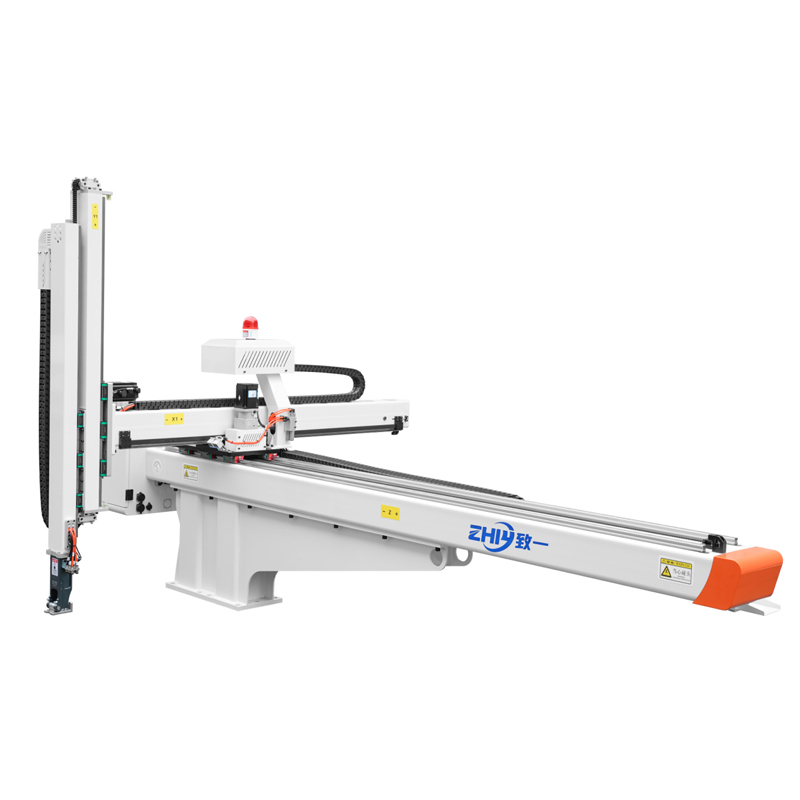
1. Cartesian Robots (Linear Robots)
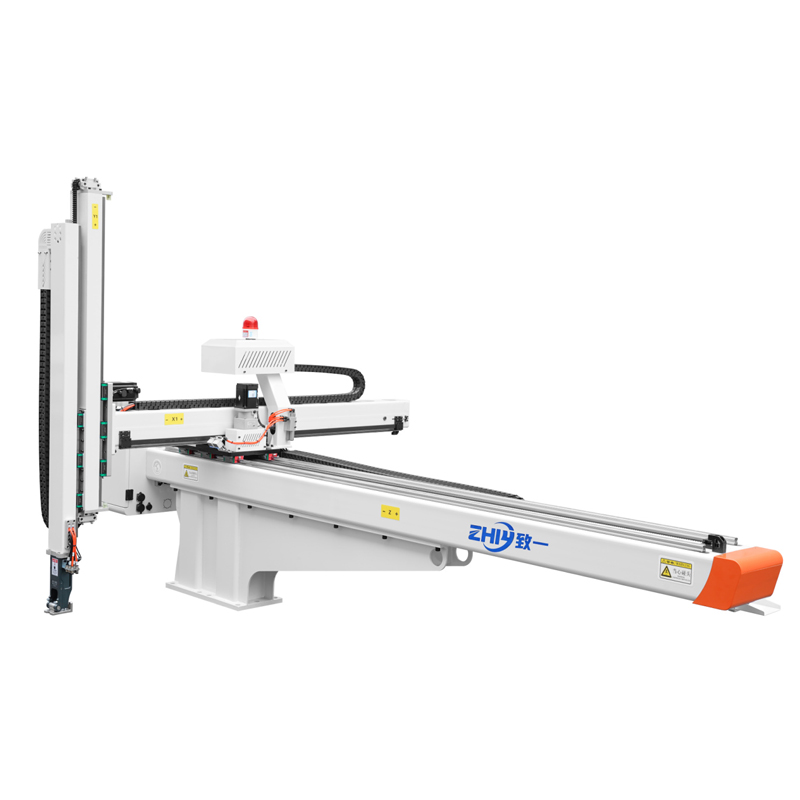
Cartesian robots are the most widely used robots in injection molding applications.
They move along X, Y, and Z axes using linear motion systems and are commonly installed above injection molding machines.
Advantages
- High speed for take-out applications
- Excellent repeatability
- Simple programming
- Cost-effective
- Easy integration with molding machines
- Ideal for standard pick-and-place operations
Best Applications
- Product take-out
- Sprue removal
- Simple stacking
- Conveyor placement
Cartesian robots are particularly suitable for high-speed molding environments where cycle time is critical. They are commonly used in packaging, household products, automotive components, and consumer goods manufacturing.
2. 5-Axis Servo Robots
5-axis robots provide more flexible movement than standard linear robots.
These robots can rotate and manipulate parts at different angles, making them suitable for more complex operations.
Advantages
- Greater flexibility
- Multi-angle handling
- Improved positioning capability
- Suitable for insert molding
Best Applications
- Complex product handling
- Insert placement
- Product orientation
- Multi-step automation
Factories producing precision parts often choose 5-axis robots for their improved motion control.
3. 6-Axis Articulated Robots
Articulated robots offer the highest flexibility and freedom of movement. They are commonly used in advanced automation systems.
Advantages
- Flexible movement
- Suitable for complex paths
- Multi-function integration
- Ideal for downstream automation
Best Applications
- Secondary processing
- Assembly operations
- Packaging
- Vision inspection
- Insert molding
- Multi-machine automation
Although articulated robots provide excellent flexibility, they usually require higher investment and more advanced programming capability.
Key Factors to Consider When Choosing an Injection Molding Robot
1. Injection Molding Machine Size
The first step is understanding your injection molding machine specifications.
Important machine parameters include:
- Clamping force
- Tie-bar spacing
- Mold opening stroke
- Machine layout
- Injection unit position
The robot must physically fit the machine and reach the mold safely.
Larger injection molding machines usually require robots with longer vertical and horizontal reach.
2. Payload Capacity
Payload refers to the maximum weight the robot can safely carry, including:
- Product weight
- Sprue weight
- End-of-arm tooling (EOAT)
- Vacuum cups or grippers
- Additional accessories
Many engineers underestimate EOAT weight during robot selection. Industry recommendations suggest selecting a robot with 20–30% additional payload margin to ensure stable operation and reduce wear.
For example:
| Item | Weight |
|---|---|
| Plastic product | 2 kg |
| Sprue | 1 kg |
| EOAT | 1.5 kg |
| Total | 4.5 kg |
In this situation, choosing a robot with at least 6 kg payload capacity is recommended.
Oversized payload selection, however, can also increase costs and reduce efficiency. Larger payload robots often move slower and consume more energy.
Payload Sizing Formula
A commonly used payload estimation method is:
This provides a practical safety margin for long-term operation.
3. Robot Reach and Working Envelope
Robot reach determines whether the robot can:
- Enter the mold safely
- Remove products efficiently
- Place products onto conveyors
- Reach downstream stations
A robot with insufficient reach may cause collision risks or unstable movement.
Manufacturers should evaluate:
- Vertical stroke
- Crosswise stroke
- Traverse stroke
- Overall working envelope
For large molds or deep cavities, additional reach may be necessary.
It is also important to avoid selecting excessively long reach robots if unnecessary, since larger reach often increases equipment cost and reduces rigidity.
4. Cycle Time Requirements
Cycle time directly affects production output.
In high-speed injection molding applications, the robot must complete:
- Mold entry
- Product gripping
- Mold exit
- Product placement
- Return movement
within the molding cycle window.
Some applications require ultra-fast take-out times below 3 seconds.
When evaluating robot speed, manufacturers should focus on:
- Dry cycle time
- Actual production cycle
- Acceleration and deceleration performance
- Motion stability
High-speed packaging and medical molding applications often prioritize speed over flexibility.
5. Product Characteristics
Different products require different handling methods.
Consider:
- Product size
- Product shape
- Surface sensitivity
- Temperature after molding
- Material type
- Wall thickness
Fragile or glossy products may require soft vacuum handling systems, while heavier parts may require mechanical grippers.
Complex products sometimes need rotational positioning before downstream processing.
6. End-of-Arm Tooling (EOAT)
EOAT is one of the most critical parts of the robotic system.
The robot itself only provides movement. The EOAT performs the actual gripping and handling function.
Common EOAT types include:
- Vacuum suction cups
- Pneumatic grippers
- Servo grippers
- Magnetic grippers
- Custom fixture systems
Choosing the correct EOAT improves:
- Stability
- Product protection
- Cycle time
- Handling precision
Poor EOAT design can cause:
- Product dropping
- Vacuum leakage
- Mold collisions
- Excessive robot load
Lightweight EOAT is generally preferred because it improves robot acceleration and reduces payload burden.
Common EOAT Selection Guide
Vacuum EOAT
Best for:
- Thin-wall products
- Smooth surfaces
- Lightweight plastic parts
Advantages:
- Fast gripping
- Simple design
- Lower cost
Mechanical Grippers
Best for:
- Heavy products
- Irregular shapes
- High-temperature parts
Advantages:
- Strong holding force
- Better stability
Hybrid EOAT
Combines vacuum and gripper systems.
Best for:
- Complex parts
- Multi-cavity molds
- Unstable products
7. Accuracy and Repeatability
Repeatability refers to the robot’s ability to return to the same position repeatedly.
High repeatability is essential for:
- Precision molding
- Insert molding
- Automated assembly
- Quality inspection
Many industrial injection molding robots provide repeatability between ±0.02 mm and ±0.5 mm depending on robot type and size.
Applications involving electronics, medical parts, or precision automotive components often require extremely high positioning accuracy.
8. Robot Installation Position
Robot mounting configuration significantly affects usable reach and factory layout.
Common installation methods include:
- Top-mounted
- Side-entry
- Floor-mounted
- Beam-mounted
Top-Mounted Robots
Most common for injection molding.
Advantages:
- Space saving
- Easy integration
- Fast vertical take-out
Side-Entry Robots
Suitable for:
- Thin-wall packaging
- High-speed production
Advantages:
- Faster extraction
- Reduced mold open time
9. Automation Integration Requirements
Modern factories increasingly require robots to integrate with:
- Conveyors
- Vision systems
- Packaging systems
- MES systems
- Quality inspection equipment
- AGV systems
Before purchasing a robot, manufacturers should evaluate future automation expansion plans.
Questions to ask include:
- Does the robot support communication protocols?
- Can it integrate with PLC systems?
- Is remote monitoring available?
- Does it support Industry 4.0 requirements?
A scalable automation platform can reduce future upgrade costs.
10. Ease of Programming and Operation
Some factories prioritize simple operation because operators may have limited robotics experience.
Important considerations include:
- User-friendly interface
- Touchscreen controllers
- Pre-installed molding programs
- Fast mold changeover capability
- Error diagnostics
Ease of maintenance and service support are also major concerns for long-term operation. Many manufacturers consider after-sales service and spare part availability equally important as robot performance itself.
How to Match Robot Type with Production Needs
| Production Requirement | Recommended Robot Type |
|---|---|
| High-speed take-out | Cartesian robot |
| Heavy products | Large servo robot |
| Insert molding | 5-axis or 6-axis robot |
| Complex movement | 6-axis articulated robot |
| Packaging integration | 6-axis robot |
| Cost-sensitive projects | 3-axis servo robot |
| Precision positioning | Full servo robot |
Common Mistakes When Choosing Injection Molding Robots
Choosing Based Only on Price
Low-cost robots may have:
- Lower stability
- Poor repeatability
- Limited support
- Shorter lifespan
Long-term operating cost is more important than initial purchase price.
Ignoring Future Expansion
Some factories only consider current projects.
However, future product changes may require:
- Larger payload
- Additional axes
- Vision integration
- More flexible EOAT
A scalable system reduces future replacement costs.
Over-Specifying the Robot
Bigger robots are not always better.
Excessive payload or oversized reach can result in:
- Higher investment
- Slower movement
- Increased energy consumption
Proper matching is the key to efficiency.
Underestimating EOAT Importance
Many automation failures come from poor EOAT design rather than the robot itself.
Factories should involve EOAT engineers early during project planning.
Questions to Ask Your Robot Supplier
Before placing an order, buyers should ask suppliers:
- What injection molding machine sizes are compatible?
- What payload margin is recommended?
- Can the robot support future automation upgrades?
- What EOAT solutions are available?
- Is on-site installation included?
- What training services are provided?
- How quickly are spare parts supplied?
- What communication protocols are supported?
- What is the average maintenance interval?
- Can the robot integrate with vision systems?
Professional suppliers should provide complete technical evaluation rather than only product quotations.
Future Trends in Injection Molding Robotics
The injection molding industry is rapidly moving toward intelligent automation.
Future trends include:
- AI-assisted robot programming
- Vision-guided picking
- Smart predictive maintenance
- Digital twin simulation
- Collaborative robots (cobots)
- Fully automated molding cells
- Remote monitoring systems
Factories investing in automation today should consider long-term smart manufacturing compatibility.
Final Thoughts
Choosing the right robot for an injection molding machine is not simply about selecting the fastest or most expensive model. The ideal solution depends on a careful balance of:
- Payload
- Reach
- Cycle time
- Product characteristics
- EOAT design
- Machine compatibility
- Future automation requirements
A properly selected robotic system can significantly improve production efficiency, reduce labor dependency, enhance product quality, and deliver long-term return on investment.
For injection molding manufacturers aiming to remain competitive in global markets, robotic automation is becoming an essential part of modern production strategy rather than an optional upgrade.
When evaluating robotic solutions, manufacturers should focus on practical production needs, long-term reliability, and integration capability instead of relying solely on catalog specifications or initial purchase price. Proper planning today creates a more efficient and scalable factory for the future.