
Leave Your Message
0102030405
How to Choose Robot for Electronics Industry
2026-05-25
How to Choose Robot for Electronics Industry
The electronics industry stands out for its compact components, high precision demands, mass production demands and strict clean environment requirements. From circuit board assembly and component picking to packaging and testing, every production link relies heavily on automated robotic solutions. Choosing the right robot for electronic manufacturing is never a one-size-fits-all decision. It directly impacts production efficiency, product yield, long-term operation costs and production line stability.
Many factory procurement managers and production leaders often face confusion: What robot type fits electronic workshops best? What core parameters should be prioritized? How to balance performance, budget and after-sales support? This guide breaks down all key factors step by step, helping you make a targeted, cost-effective Robot Selection for electronics manufacturing.
Table of Contents
1 Unique Requirements of Electronics Industry for Robots 2 Common Robot Types for Electronics Manufacturing 3 Core Parameters to Evaluate When Selecting Robots 4 Environmental Compatibility & Safety Standards 5 Total Cost of Ownership Beyond Initial Budget 6 System Integration & Operation Friendliness 7 After-sales Service & Global Supply Support 8 Final Checklist for Electronics Robot Selection
Unique Requirements of Electronics Industry for Robots
Electronics manufacturing has distinct characteristics that set it apart from other industrial sectors, and these features define the basic criteria for robot selection.
First, ultra-high precision. Electronic parts such as chips, resistors, connectors and micro-components are tiny, requiring robots to maintain stable repeated positioning accuracy to avoid component damage or assembly deviation. Even minor position errors can lead to mass product defects.
Second, high-speed continuous operation. The electronics industry features large-batch, streamlined production. Robots need to support 24-hour uninterrupted operation without performance decay, matching the fast pace of assembly lines.
Third, dust-free and anti-static performance. Electronic components are extremely sensitive to static electricity and dust. Workshop environments require low-dust design, and robots must have anti-static structure to prevent static damage to precision electronic parts.
Fourth, compact footprint & flexible layout. Most electronic factories have limited workshop space with dense production lines. Robots need a compact structure, flexible motion range, and easy integration into narrow workstation layouts.
Lastly, low vibration & low noise. Excessive vibration may displace tiny components during operation, while low noise ensures a comfortable and compliant workshop working environment.
Common Robot Types for Electronics Manufacturing
Different application scenarios in electronics production correspond to Different Robot types. Matching the robot form to actual workflow is the first step to correct selection.
| Robot Type | Core Application Scenarios | Key Advantages | Suitability for Electronics |
|---|---|---|---|
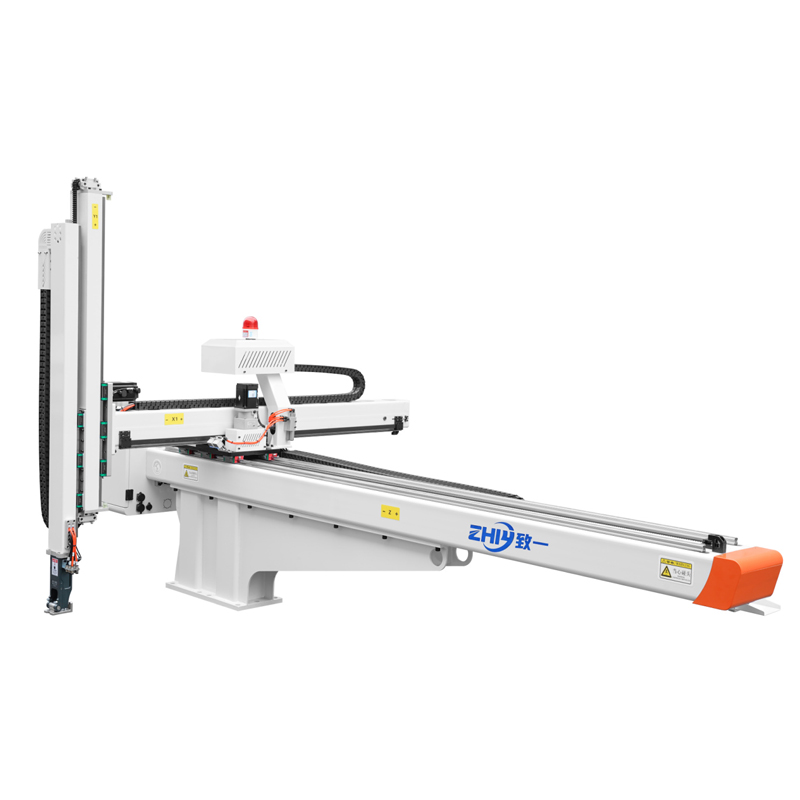
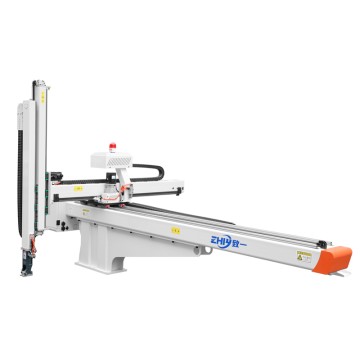
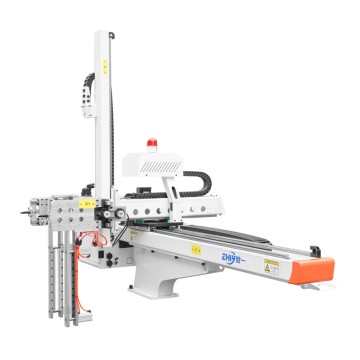
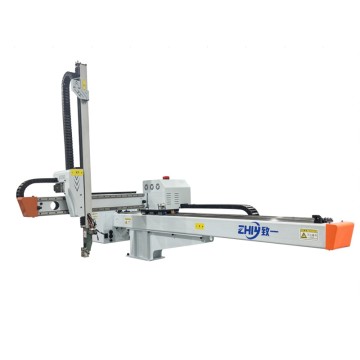
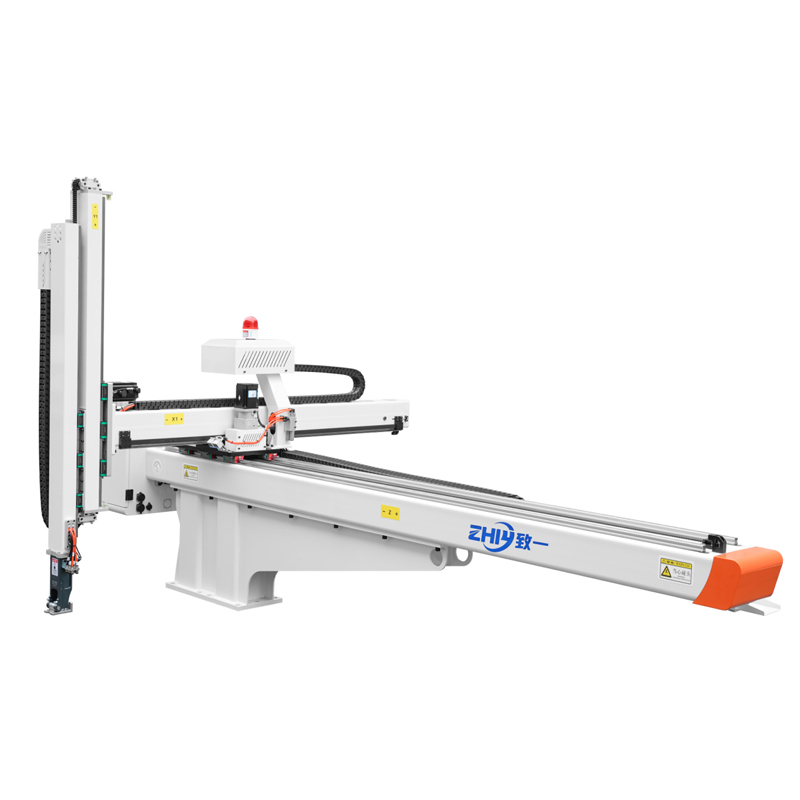
| Three-Axis Servo Robot | Material picking, placement, simple packaging, injection molding electronic parts take-out | Fast speed, stable operation, cost-effective, easy installation | High suitability for basic assembly and handling tasks |
| Five-Axis Robotic Arm | Precision assembly, multi-angle testing, complex component handling | Flexible multi-dimensional movement, high positioning accuracy, adaptive to complex processes | Ideal for mid-to-high precision electronic production |
| Cartesian Robot | PCB board handling, precise dispensing, fixed-point assembly | Simple control, ultra-high repeat accuracy, linear stable movement | Perfect for straight-line precision operation links |
| Collaborative Robot | Man-machine hybrid assembly, small-batch customized production | No need for isolation protection, flexible programming, safe interaction with workers | Suitable for small workshops and flexible production lines |
| High-Speed Sorting Robot | Electronic parts sorting, finished product grouping, automated packaging | Ultra-fast cycle speed, high load stability, batch sorting efficiency | Excellent for post-production sorting and packaging processes |
For large-scale electronic component mass production, three-axis and five-axis servo robots are the most mainstream choices. For customized small-batch production and man-machine collaboration scenarios, collaborative robots become the preferred option.
Core Parameters to Evaluate When Selecting Robots
Parameters determine the actual working performance of the robot. When selecting models, focus on these key indicators instead of blindly pursuing high configuration.
Repeat Positioning Accuracy This is the most critical indicator for electronics industry. For common electronic assembly, accuracy within ±0.02mm is basic; for chip and micro-component processing, it requires higher precision up to ±0.01mm. Stable repeated accuracy ensures long-term consistent product yield.
Load Capacity Electronic parts are mostly lightweight, so there is no need to over-configure heavy-load robots. Most electronic handling and assembly scenarios adapt to 3kg-20kg load; only for large electronic finished products or mold handling, medium load models are required. Excessive load will increase procurement and operating costs unnecessarily.
Motion Stroke & Working Range Select the stroke according to the size of production line workstations. The working range needs to cover the entire picking, handling and assembly path without redundant space waste. A reasonable stroke matches the production line layout and improves space utilization.
Cycle Speed Production efficiency depends directly on cycle speed. Robots for electronic assembly lines need to maintain fast and stable cycle speed, avoiding jitter or accuracy decline caused by excessive speed. Balance speed and stability to ensure both efficiency and yield.
Durability & Continuous Operation Ability Check the robot's designed service life and continuous running time. Excellent industrial robots can support long-term uninterrupted operation with low failure rate, reducing production line downtime losses.
Environmental Compatibility & Safety Standards
Electronics workshops have strict environmental and safety thresholds, and robots must meet industry certification and environmental adaptation requirements.
First, certification compliance. Prioritize robots with ISO9001 quality certification, CE safety certification and other international mainstream certifications. These certifications prove that the product meets global industrial manufacturing standards and is suitable for cross-border factory layout and international production standards.
Second, anti-static and dust-free design. The robot body should adopt anti-static materials and sealed structure to prevent dust accumulation and static conduction, protecting sensitive electronic components from damage. It adapts to dust-free workshop standards of electronic manufacturing.
Third, temperature and humidity adaptability. Electronic workshops have constant temperature and humidity requirements. Robots need to operate stably in the conventional temperature and humidity range of electronic factories without performance drift caused by environmental changes.
Fourth, safety protection mechanism. For workshops with man-machine operation, robots need to have collision sensing, emergency stop and safety limit functions to avoid accidental injury to workers and damage to precision equipment.
Total Cost of Ownership Beyond Initial Budget
Many procurement teams only focus on the initial purchase price, ignoring the full life cycle cost, which easily leads to later cost overrun.
The total cost includes equipment procurement fee, installation and debugging fee, staff programming training fee, daily maintenance fee, spare parts replacement cost and later upgrade cost. A robot with a low initial price may have high maintenance costs and short service life, resulting in higher long-term investment.
It is recommended to calculate the 3-year or 5-year total ownership cost before selection. Choose robots with simple maintenance, universal spare parts and low failure rate. Such models can help electronic factories reduce comprehensive operating costs by up to 30% in long-term use.
System Integration & Operation Friendliness
Electronic production lines are mostly automated integrated systems, and robot compatibility and ease of use are crucial.
System Compatibility The robot control system needs to be compatible with mainstream production line equipment such as injection molding machines, assembly machines and testing equipment. It supports seamless docking with existing workshop MES and production management systems, realizing intelligent unified scheduling.
Programming & Operation Difficulty Electronic production lines often face product model updates and process adjustments. Robots with simple programming interface, visual programming function and quick parameter adjustment can reduce technical threshold for operators and shorten process switching time. Complex programming will increase training cost and production line adjustment cycle.
Customization Ability Many electronic production scenarios have non-standard process requirements. Suppliers need to provide customized structural optimization, function upgrading and process scheme matching services to meet personalized production demands of different electronic products.
After-sales Service & Global Supply Support
For multinational electronics manufacturers and cross-border procurement buyers, after-sales service and global support are indispensable selection factors.
First, 24-hour technical support. Stable pre-sales consultation and after-sales technical support ensure timely troubleshooting once the robot fails, avoiding long-term production line shutdown.
Second, global spare parts supply. Choose brands with complete global spare parts inventory, which can quickly deliver replacement parts to reduce maintenance waiting time.
Third, on-site training and demonstration services. Professional suppliers can provide factory on-site operation training, process demonstration and production line optimization guidance, helping the team quickly master robot operation and maintenance skills.
Fourth, long-term technical iteration. The electronics industry updates rapidly, and robots need to support later software upgrading and function iteration to adapt to new production processes and product demands, extending equipment service life.
Final Checklist for Electronics Robot Selection
Before finalizing the purchase, check these key points one by one to avoid selection mistakes:
- Match robot type with actual electronic production scenario
- Confirm positioning accuracy, load and stroke meet component processing demands
- Verify international certifications like CE and ISO9001 and dust-free anti-static design
- Evaluate 5-year total ownership cost instead of only initial price
- Confirm compatibility with existing production line equipment and management systems
- Check programming simplicity and customization service capability
- Confirm global after-sales support, spare parts supply and technical training services
- Refer to mature application cases in the electronics industry for performance verification
Conclusion
Choosing a suitable robot for the electronics industry is a systematic project that combines scenario demand, performance parameters, environmental standards, comprehensive cost and service support. It is not about selecting the most high-end model, but the most matched one for production needs.
By clarifying electronic production characteristics, screening robot types, focusing on core parameters, paying attention to environmental safety and full life cycle cost, and verifying after-sales support, procurement managers can efficiently select stable, high-efficiency and cost-effective robotic solutions. This not only improves automated production level, but also creates long-term value for factory cost reduction and efficiency improvement.