
Leave Your Message
SMED and Flexible Production: How Servo Robots Enable Fast Mold Change in High-Mix Injection Molding
SMED and Flexible Production: How Servo Robots Enable Fast Mold Change in High-Mix Injection Molding
Over the last five years, a quiet but decisive shift has reshaped the injection molding floor. Where a typical molding cell once ran a single 50,000-piece order over two weeks, more plastics processors now face batches of 2,000 to 8,000 pieces that change every one to three days. Automotive trim suppliers, medical packaging plants, and appliance-component makers report that more than 40% of their active jobs are now short runs below 10,000 shots, a share that was below 15% a decade ago. This high-mix, low-volume reality is exactly where traditional fixed automation breaks down and where the discipline of SMED (Single-Minute Exchange of Die) becomes a board-level concern rather than a maintenance curiosity.
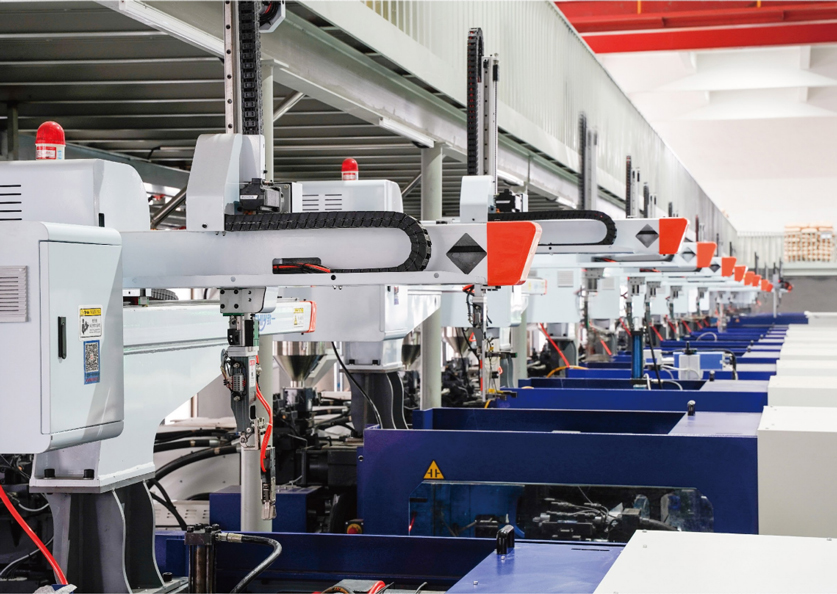
SMED is not a machine; it is a method for collapsing the time between the last good part of one job and the first good part of the next. In molding, the "die" is the mold, and the supporting automation—the servo robot, its end-of-arm tooling, and its program—is half of every changeover. A plant that invests in magnetic platens but leaves the robot on manual jog-and-teach mode during changeover has solved only half the problem. This article walks through how modern servo robots coordinate with quick mold change (QMC) hardware, how recipe management removes manual reprogramming, and how plant owners should actually measure the payback of flexibility.
The High-Mix, Low-Volume Shift on the Molding Floor
The economics that pushed processors toward flexibility are straightforward. OEMs are carrying less finished-goods inventory, demanding shorter lead times, and ordering more SKUs with smaller quantities. For a custom molder, this means the molding machine is increasingly a shared resource juggling dozens of tool numbers per month. The cost structure changes in two ways that matter to automation buying:
- Setup and changeover time becomes a larger fraction of total available machine hours, often 18% to 30% on mixed-line cells versus 4% to 8% on dedicated lines.
- Per-piece margins thin out because fixed costs—tooling, robot amortization, operator labor—must be spread over fewer parts per campaign.
- Quality risk rises because every restart is a fresh opportunity for short shots, flash, or robot pick collisions.
For production managers, the conclusion is uncomfortable: the robot that simply "takes the part out faster" is no longer the main lever. The lever is how fast the entire cell can switch contexts without scrap, without a technician on standby, and without a 30-minute teach session.
What SMED Really Demands from the Robot Cell
SMED methodology splits setup into two buckets: internal operations (machine must be stopped) and external operations (can be done while running). The goal is to convert as much as possible to external and then shrink the remainder. Applied to A Robot-equipped cell, this yields a concrete checklist.
Separate the Robot's Internal and External Work
Internal robot work includes lowering the platen guard, switching the EOAT physically, and re-homing. External work includes pre-loading the next program, pre-staging the EOAT, and verifying the pick coordinates against the offline job card. A well-designed cell moves 60% to 80% of robot-related setup to the external bucket.
Standardize the Robot Interface, Not the Product
You cannot standardize a thousand part geometries, but you can standardize how the robot receives a job. That means a fixed electrical and pneumatic quick-connect for EOAT, a fixed robot-base datum, and a fixed naming convention for recipes. Standardization is what lets a changeover drop from 25 minutes to under 5.
Minimize Adjustments Through Pre-Positioning
Every manual jog to "nudge the pick point 3 mm" is an internal operation. Pre-positioning via stored offsets or a vision-assisted first-article check converts that adjustment into a one-touch confirmation instead of a re-teach.
Quick Mold Change Hardware and Robot Coordination
QMC hardware sets the floor for how fast a mold physically moves in and out. Three technologies dominate the mid-market today:
- Magnetic platens: clamp a steel-backed mold in 10 to 30 seconds with no bolting; suitable for molds from roughly 200 kg up to several tons depending on platen size.
- Hydraulic or pneumatic mold clamps: 20 to 60 seconds per clamp set, lower upfront cost, but require plumbed hydraulic power and periodic seal maintenance.
- Mold change carts and shuttles: roll the next tool into alignment so the press never waits on a crane; typical cart swap adds only 30 to 90 seconds of travel time.
The robot's job during a physical mold swap is mostly to stay clear and then re-sync. After the new mold locks, the Robot Must re-acquire its pick and place coordinates. Plants that treat the robot and the mold as separate islands lose 3 to 8 minutes here because the robot has no record of where the new cavity sits. The fix is to bind the robot recipe to the mold identity, covered in the next section.
Tip: Always size the magnetic platen and the robot reach for the largest mold in your mixed portfolio, not the current high-runner, or you will bottleneck exactly the jobs you most want to win.
Robot Recipe and Program Switching
A recipe (sometimes called a job or program set) is the complete digital description of how the robot behaves for one part: stroke profiles, pick and place coordinates, vacuum or gripper sequence, conveyor timing, and reject handling. In a flexible cell, switching jobs should be a selection, not a rewrite.
- A modern servo controller typically stores 200 to 2,000 recipes on board, with USB or network backup for more.
- Switching between stored recipes takes 2 to 8 seconds once the operator selects the job number or scans the mold QR code.
- Moving profiles (acceleration, deceleration, mid-stroke dwell) should be part of the recipe, because a thin-wall part and a heavy structural component need different motion laws.
- Air and vacuum consumption setpoints per job prevent both part damage and wasted utility cost.
The procurement implication is direct: when evaluating a servo robot, ask whether recipe switching is a native function or a workaround built on macro scripts. Native recipe management with a protected "edit-lock" mode prevents an operator from accidentally overwriting parameters that took an engineer two hours to tune. For plants running more than 20 active job numbers per month, native recipe handling stops being a convenience and becomes a requirement.
Linking Robot and Machine Mold Data
A recipe is only as good as its trigger. The most reliable trigger is the injection molding machine itself, which already knows which mold is mounted through its own tool management. Two integration paths are standard:
- EUROMAP 67 / 77 signals: the press tells the robot the mold ID and cure-complete signal; the robot then auto-loads the matching recipe.
- PLC or MES handoff: a higher-level controller broadcasts the scheduled job, and both press and robot load in lockstep.
When the link works, a mold swap becomes a closed loop: press recognizes mold 4471, robot loads recipe 4471, guard interlock confirms, and production resumes. The win is not just speed—it is traceability. Every changeover is logged with timestamp, operator, and first-article result, which quality managers in medical and automotive supply chains increasingly demand. The cost of a one-way or manual handshake is paid in misloads: industry feedback suggests manual recipe selection contributes to 1 in 30 changeovers where the wrong program runs for a partial batch.
Measuring Cycle Time, Takt and Changeover Loss in Mixed Lines
Flexible production makes naive cycle-time comparisons misleading. A plant should track three numbers, not one:
- Machine cycle time: the press molding window, typically 12 to 90 seconds depending on part size.
- Robot handling time: the portion of the open-time the robot occupies, usually 3 to 9 seconds for a 3-axis take-out and 5 to 14 seconds for a 5-axis demold-and-place.
- Changeover loss: total minutes from last good part of job A to first good part of job B, including mold swap, robot re-sync, and warm-up rejects.
Takt time on a mixed line is the available time divided by the sum of demand across all jobs, not per-job. A common planning error is to set robot speed for the fastest runner and then watch slower jobs fall behind. Better practice: define a cell takt that includes a changeover allowance of 6% to 12% of scheduled time, so the line plan survives the reality of switching. For EOQ-style batch sizing, plants often find that grouping same-material, same-color jobs cuts changeovers by 25% to 40% with no new capital.
EOAT Generalization for Flexible Production
End-of-arm tooling is where flexibility is won or lost. A dedicated vacuum cup fixture is fast for one part and useless for the next. Generalization strategies that work on mixed lines include:
- Modular EOAT frames with quick-change adapter plates, so a base plate stays on the robot and only the tip section swaps in 20 to 60 seconds.
- Multi-zone vacuum grids that cover a family of part footprints without re-machining.
- Magnetic or pneumatic quick-release for grippers, reducing the physical swap to a click rather than a bolt pattern.
- Compliant and soft-touch surfaces to handle minor part variation within a family without re-tuning.
The trade-off is speed: a generalized EOAT is rarely as fast as a purpose-built one, typically 5% to 15% slower on peak jobs. The offset is recovered many times over by eliminating the 10-to-20-minute hard swap. The right question for a buyer is not "which EOAT is fastest" but "how many jobs can one EOAT family cover." A realistic target is covering 60% to 80% of a plant's volume with two or three EOAT families rather than one fixture per mold.
Spreading Changeover Cost Across Small Batches
The financial case for SMED is a cost-per-piece equation. If a changeover costs 18 minutes of stopped machine time plus 12 minutes of lost operator time, at a machine hour rate of USD 45 to 90 and labor at USD 25 to 40 per hour, a single changeover can cost USD 25 to 70. Spread over a 3,000-piece batch, that is USD 0.008 to 0.023 added per part—often larger than the robot energy cost. The levers to dilute this:
- Cut changeover time: magnetic platens plus recipe auto-load can pull a changeover from 30 minutes to under 5, dropping the per-piece penalty by 70% to 85%.
- Raise batch grouping: scheduling same-tooling families back-to-back reduces total changeover count across the month.
- Recover the internal minutes: every minute removed from the stopped window is recovered at the full machine hour rate, the highest-leverage saving available.
- Qualify first-article faster: a robot vision or fixture gauge that confirms the first pick in 10 seconds versus a 3-minute manual check reduces warm-up scrap.
For a plant running 400 changeovers per year, a 20-minute reduction per event at USD 60 blended cost returns roughly USD 8,000 annually in recovered capacity before any quality or labor savings—enough to justify QMC hardware on a single busy cell.
Procurement Checklist for a Flexible, SMED-Ready Robot Cell
When specifying a servo robot for high-mix production, plant owners should put the following on the purchase order rather than the sales brochure:
- Native recipe capacity of at least 500 jobs with edit-lock protection.
- Auto recipe call via EUROMAP 67/77 or PLC handshake, demonstrated at FAT.
- EOAT quick-change interface to a documented standard (pneumatic or magnetic).
- Stored motion profiles per recipe, not a single global speed setting.
- Changeover logging to USB or MES for traceability audits.
- Re-home time under 30 seconds after a mold swap.
These are the features that convert a fast take-out robot into a flexible production asset. Without them, the robot remains the slowest step in every changeover.
Frequently Asked Questions
How fast can a full mold changeover be with magnetic platens and a servo robot?
With magnetic platens, a mold swap itself is often 10 to 30 seconds. Adding robot re-sync via auto recipe load and EOAT quick-change, a complete changeover from last good part to first good part commonly lands between 4 and 9 minutes, versus 20 to 45 minutes with manual bolting and re-teaching.
Do I need a 5-axis robot to support SMED and flexible production?
Not necessarily. A 3-axis take-out robot handles most high-mix jobs where parts drop to a conveyor or secondary fixture. A 5-axis or double-arm unit earns its cost when parts need in-mold labeling, complex demold motion, or placing into oriented nest trays. Choose axis count by part handling complexity, not by the changeover goal.
How many recipes can a servo robot controller realistically store?
Mid-range controllers store 200 to 2,000 recipes on board, with external backup for more. For plants with fewer than 50 active job numbers per month, even the lower end is ample; above 200 active jobs, confirm export and version-control workflows before purchase.
What is the typical payback on quick mold change and recipe automation?
On a cell running 300 to 600 changeovers per year, recovered machine hours plus reduced labor and scrap typically pay back QMC hardware and recipe-enabled robotics in 12 to 30 months. Busy mixed-line cells at the high end of that range often see payback under 18 months.
Can an older hydraulic press support SMED and robot integration?
Often yes. Magnetic platens and mold carts are press-agnostic, and EUROMAP 67 retrofit kits exist for many legacy machines. The limiting factor is usually the press controller's ability to broadcast mold ID; if it cannot, a small PLC bridge can still trigger the robot recipe and preserve most of the benefit.