
Leave Your Message
Servo Robot and Injection Molding Machine Integration: Communication Protocols and Signal Handshake for B2B Buyers
Servo Robot and Injection Molding Machine Integration: Communication Protocols and Signal Handshake for B2B Buyers
Most injection molding plants evaluate a servo robot on payload, reach, and price. Those numbers matter, but they are not what determines whether the cell runs on day one. The variable that actually gates a successful startup is integration: how cleanly the Robotic Arm exchanges signals with the injection molding machine (IMM), how the timing is tuned, and whether the supplier can deliver a tested, documented interface before the equipment reaches your floor. A robot with perfect axis specifications is useless if it never receives a reliable "mold open" signal or if the IMM refuses to eject until the arm confirms a safe take-out. This article is written for plant managers, automation engineers, and equipment dealers who need a working, repeatable interface—not a sales pitch.
Why Integration Is the Real Bottleneck, Not the Arm
When an automation project slips its schedule, the root cause is rarely the robot hardware. It is the handshake between two independently engineered systems: the IMM controller and the robot controller. Each machine speaks its own logic, runs its own safety circuit, and defines "ready" in its own way. If those definitions are not reconciled, the cell either refuses to start or, worse, starts unsafely. For overseas buyers sourcing from a Chinese manufacturer such as Zhejiang Zhiyi Intelligent Robotics Co., Ltd. (Zhiyi Robotics), the integration question is doubly important because the robot and the IMM often come from different continents, different support teams, and different documentation standards. A practical buying decision therefore weighs integration maturity as heavily as mechanical specs.
The Two Integration Layers: Mechanical and Electrical
Mechanical Mounting and Take-Out Geometry
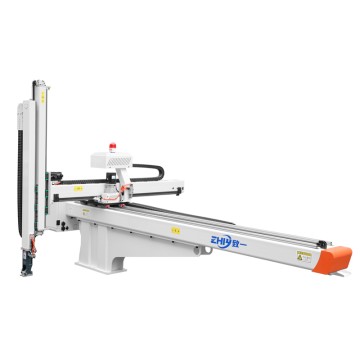
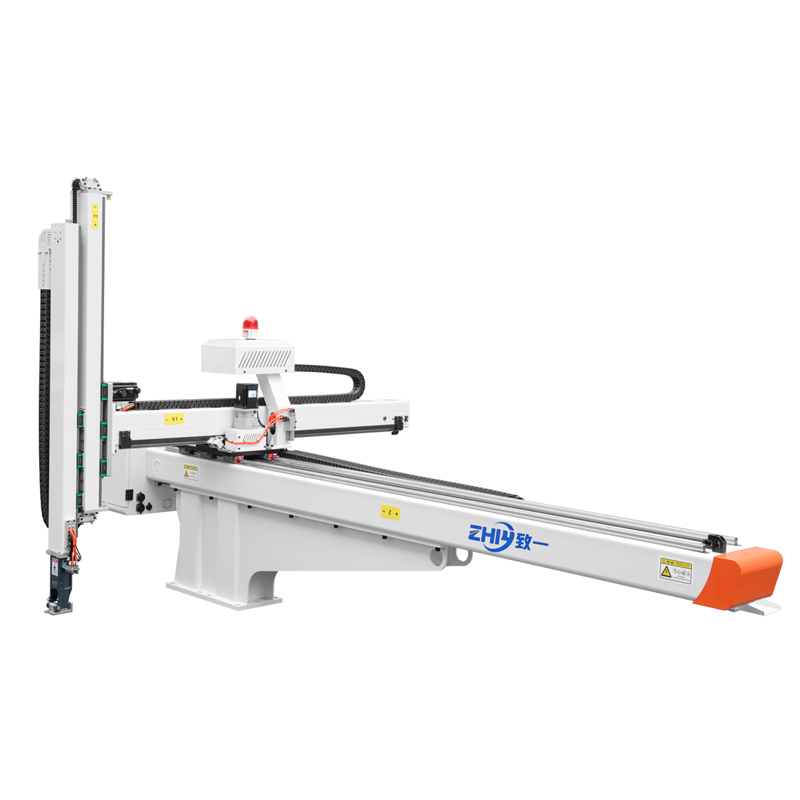
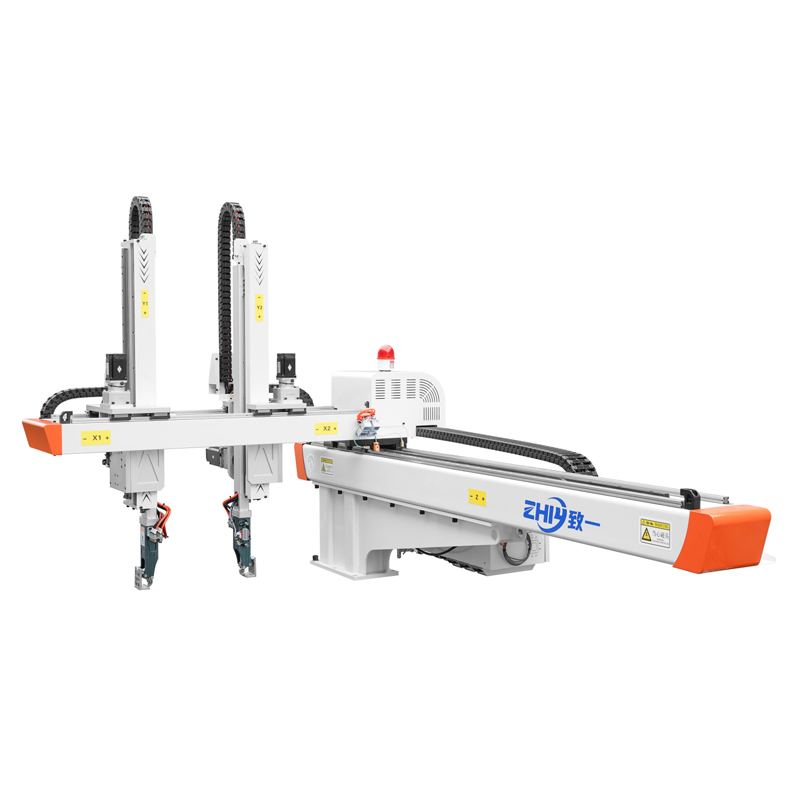
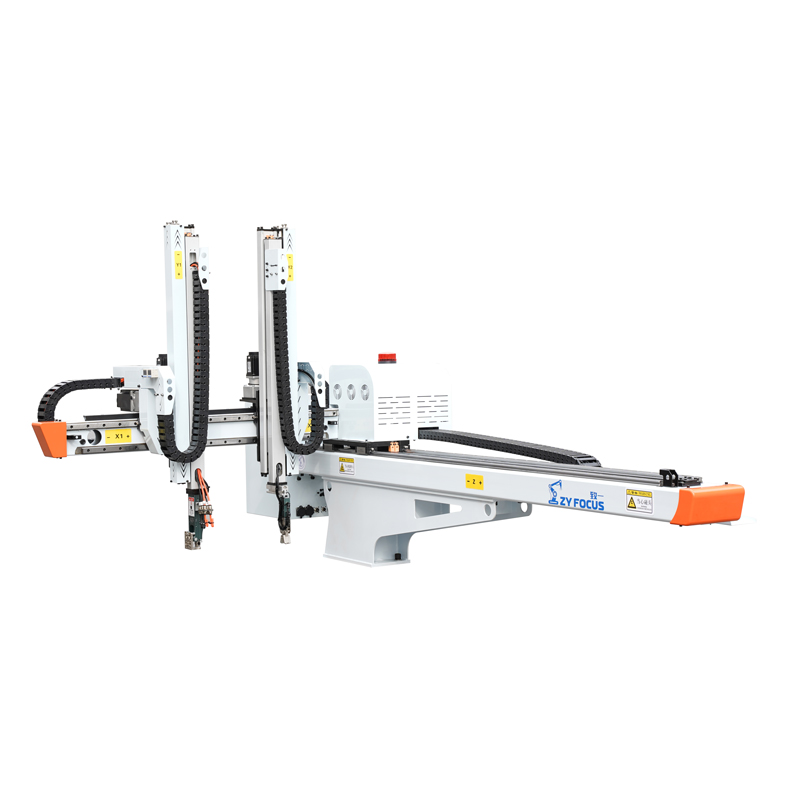
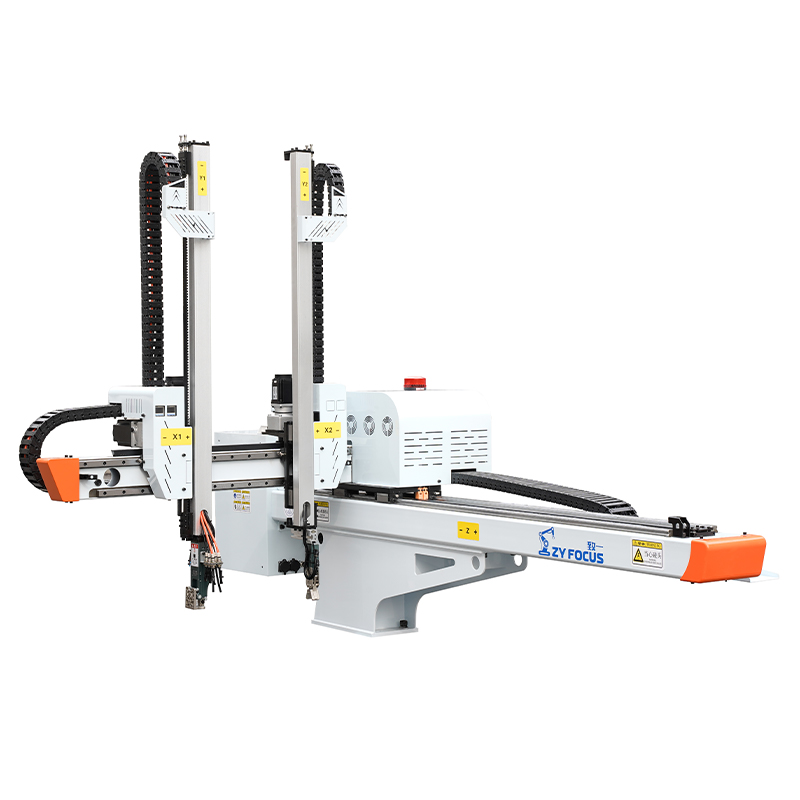
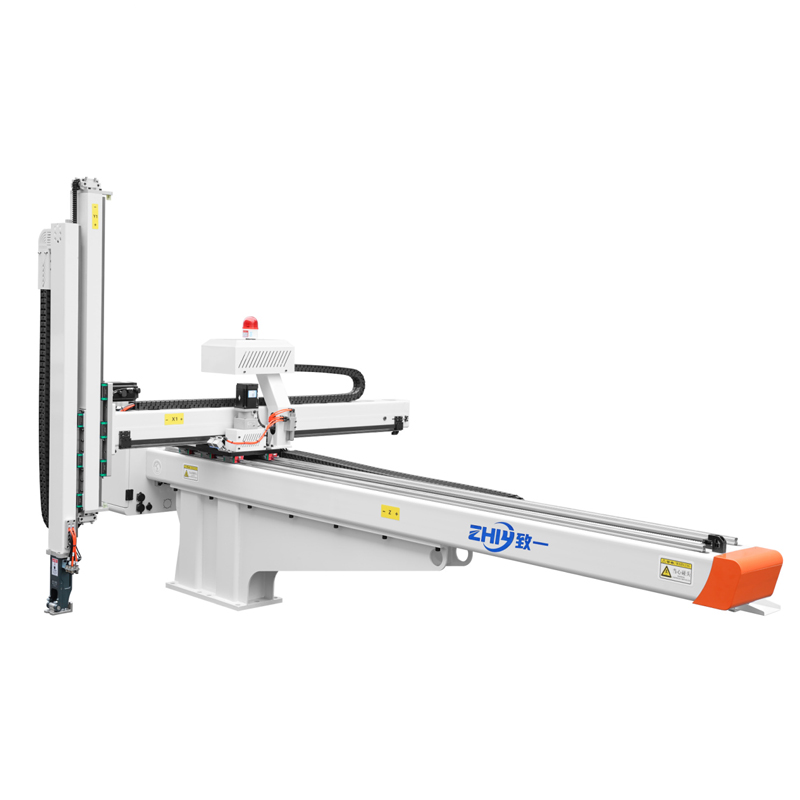
Mechanical integration is the part most buyers already understand: the robot is mounted on a platen-side bracket or a top-entry frame, and its stroke must clear the mold area with enough margin for the end-of-arm tooling (EOAT) and the part being removed. Where plants get surprised is in the take-out geometry relative to the tie bars and the ejector plane. A 3-axis top-entry servo robot for a 300-ton press needs a defined vertical stroke and a horizontal traverse timed to the mold-open gap. A 5-axis or double-arm configuration for large industrial equipment housings needs a different kinematic envelope entirely. These are mechanical facts, but they feed directly into the electrical timing discussion below.
Electrical and Signal Integration
Electrical integration is where most startup hours are lost. At minimum, the robot and IMM must share a set of discrete I/O points: the IMM tells the robot that the mold is open and the platen is safe; the robot tells the IMM that it has cleared the mold area and that take-out is complete. This exchange is the core signal handshake of the cell. If even one input is inverted, debounced incorrectly, or mislabeled in the wiring diagram, the cell will fault on every cycle or, in a dangerous failure mode, eject while the arm is still inside the mold space. The supplier's job is to deliver a verified I/O map, not a generic one.
Communication Protocols: From Hard-Wired I/O to Euromap
The SPI / Euromap 67 Interface (The Workhorse)
For the vast majority of retrofits and new cells, the interface is not a fieldbus at all—it is hard-wired discrete I/O converging on a standardized connector. In North America this is often called the SPI interface; in Europe and increasingly worldwide it is the Euromap 67 pinout. Euromap 67 defines a 24-pin connector and a signal assignment that lets a robot and an IMM from different makers interoperate without custom electronics. The robot receives "mold open," "ejector forward," and "safety gate" states; it returns "robot in home," "take-out complete," and "fault" states. For a B2B buyer, the single most useful question to a robot supplier is simply: "Do you ship a wired, tested Euromap 67 harness, or do we build it on site?" The answer predicts weeks of schedule.
Euromap 17, Euromap 67, and Euromap 77
It helps to separate the standards by generation. Euromap 17 is the older serial link used mainly on legacy machines. Euromap 67 is the parallel I/O standard described above and remains the default for most servo take-out robots. Euromap 77 is the newer Ethernet-based interface that carries richer data—cycle counts, fault codes, part-quality flags—over a network connection rather than discrete wires. For a standard 3-axis or 5-axis take-out cell, Euromap 67 is usually sufficient and far simpler to commission. Choose Euromap 77 only when you plan to feed cycle data into a plant MES or when the IMM brand already mandates it.
- Euromap 17: legacy serial interface, rare on new equipment.
- Euromap 67: parallel discrete I/O, the practical default for servo take-out robots.
- Euromap 77: Ethernet data interface for MES integration and richer diagnostics.
- SPI: the North American equivalent pinout convention for the same discrete signals.
Brand-Specific Considerations: Haitian, Engel, Boy, Fanuc, KraussMaffei
Even with a standard connector, brand behavior varies. A Haitian or Borch machine may expose the mold-open signal on a particular auxiliary board; an Engel uses its own CC300/CC700 controller logic where the robot interface is configured in the machine menu; a Boy or Fanuc may require a specific option card. None of this is hard, but it is specific, and it must be resolved before shipment. When you read application notes such as Automotive Parts Molding with 3-Axis Servo Robotic Arm, the mechanical result is visible; what is invisible is the weeks of integration testing that the supplier performed against a given IMM brand. Ask which IMM brands the robot has been physically commissioned against, not just which ones are "compatible in theory."
The Signal Handshake: What Must Be Exchanged
A safe, productive cell exchanges a small but non-negotiable set of signals. Missing any one of them forces the plant to bridge the gap with operator intervention, which destroys the labor savings the robot was bought to deliver. The minimum set is:
- Mold open / platen safe: IMM to robot, permits the arm to enter.
- Ejector forward / part ejected: IMM to robot, triggers the grip sequence.
- Robot in home position: robot to IMM, permits mold close.
- Take-out complete / part clear: robot to IMM, releases the next cycle.
- Robot fault / emergency stop: robot to IMM, halts the machine.
- Safety gate interlock: shared, blocks motion when the guard is open.
The timing of these signals is the difference between a 28-second cycle and a 31-second cycle. The phrase mold-open-to-take-out describes the critical window: from the instant the platen stops moving to the instant the arm has the part clear of the mold parting line. Every millisecond the robot is late extends the cooling-dependent portion of the cycle or forces the IMM to wait, both of which cost throughput across millions of shots per year.
Mold-Open, Eject, and Take-Out Timing
Cycle-Time Loss and How to Measure It
Cycle-time loss from poor integration is rarely obvious on a stopwatch during a demo. It shows up as a small, persistent gap between the IMM's optimized dry cycle and the integrated cell's actual cycle. To measure it, run the IMM in automatic mode with the robot disabled and record the native cycle, then run the full cell and record the integrated cycle. The delta is your integration tax. A well-integrated brand-specific I/O mapping keeps that delta under a few hundred milliseconds; a poor one can add two or three seconds per shot. On a 24/7 molding operation producing consumer or automotive components, that gap is the difference between meeting and missing delivery commitments.
Buyers evaluating silicone applications will find that material behavior compounds the timing problem. Food-contact and kitchenware parts demold at different temperatures and stickiness than rigid technical plastics, so the take-out window shifts. Notes like 3-Axis Servo Robots for Food-Grade Silicone Molding exist precisely because the safe take-out timing, and therefore the handshake timing, is material-dependent. The robot program and the IMM ejector timing must be tuned together, not separately.
Commissioning and Acceptance Before Shipment
The most expensive place to discover an integration gap is on your factory floor with a production line down. The practical alternative is a factory acceptance test (FAT) that includes a live handshake against a representative IMM or a validated simulator. For overseas buyers, this is non-negotiable. A dry-run acceptance test in the supplier's plant, with the actual Euromap 67 harness and the actual I/O map your machine uses, catches 90% of startup failures before the container ships.
What to Ask Your Supplier About Integration Support
Before issuing a purchase order, require written answers to a short, specific checklist. Treat vague answers as a risk flag. The checklist should cover:
- Which IMM brands have you physically commissioned this robot model against?
- Do you supply a wired, tested Euromap 67 (or SPI) harness matched to my machine?
- Can you run a dry-run handshake test and provide a video and the I/O log?
- What does the integration documentation package include—wiring diagram, signal list, fault matrix?
- Who performs on-site commissioning, and do you have a local partner or dealer?
- What is the defined escalation path if the handshake faults after installation?
Tip: Request the as-built I/O map and a recorded FAT handshake video as contract deliverables, not as optional extras, because they are the cheapest insurance against a multi-week startup delay.
Choosing a Robot That Integrates Cleanly
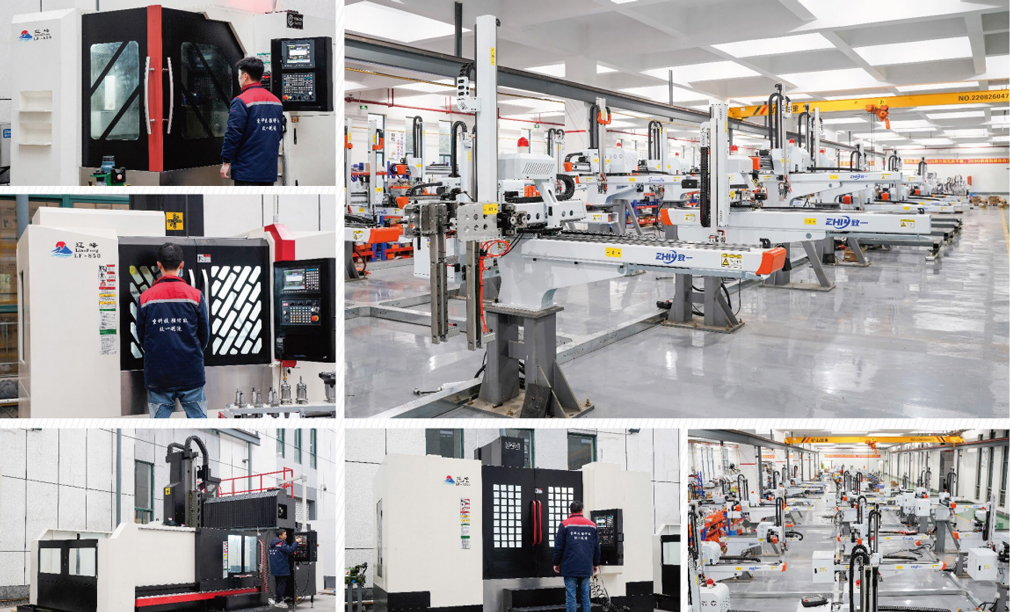
A robot that integrates cleanly is not the one with the most features; it is the one whose supplier treats integration as a documented engineering deliverable. For a B2B buyer, this translates into a few concrete selection rules. Prefer a supplier that publishes its standard interface pinout and can map it to your specific IMM brand without custom engineering fees. Prefer a model line—whether 3-axis top-entry, 5-axis, or single/double-arm—that has a track record on the same press brand you run. And prefer a partner with a dealer or service presence in your region, because the last 5% of integration always needs a human on site. Zhiyi Robotics builds servo robots and robotic arms for injection molding machines across 3-axis, 5-axis, and single/double-arm configurations, and for overseas buyers the deciding factor should be the completeness of the integration package shipped with the machine, not just the axis count.
FAQ
What is the difference between Euromap 67 and Euromap 77 for a servo robot?
Euromap 67 is a parallel discrete I/O interface using a 24-pin connector to exchange basic signals like mold-open and robot-home; it is the practical default for most take-out robots. Euromap 77 is an Ethernet-based interface that carries richer data such as cycle counts and fault codes into a plant network, and is worth adopting only when you need MES-level data or your IMM brand mandates it.
Do I need a custom interface card to connect a Chinese robot to a European IMM?
In most cases no. If both the robot and the IMM support the Euromap 67 (or SPI) pinout, a standard pre-wired harness is sufficient. A custom interface card is only needed for proprietary legacy protocols or for Euromap 77 network integration, and that requirement should be confirmed against your specific IMM brand and controller generation before ordering.
How much cycle time can poor integration cost on a molding cell?
Poor integration typically adds anywhere from a few hundred milliseconds to two or three seconds per shot. Across millions of annual cycles, even half a second compounds into meaningful lost throughput and missed delivery windows, which is why a dry-run acceptance test is worth the upfront effort.
Can the robot be commissioned against my IMM brand before it ships from China?
Yes, provided the supplier supports a factory acceptance test. A competent supplier can run a live or simulated handshake using your IMM's signal definitions and deliver a recorded test plus the as-built I/O map. This is the single most effective way to avoid on-site startup delays for overseas buyers.
What documents should the supplier provide for integration?
At minimum, expect a wiring diagram, a complete signal list mapping each I/O point to its function, the connector pinout, a fault matrix explaining each alarm, and the integration procedure. These documents are what allow your local technician or dealer to commission the cell without calling the factory for every error.
Is safety fencing part of the robot-to-IMM integration?
It is adjacent rather than core. The signal handshake includes a safety gate interlock shared between the robot and IMM, but the physical guarding, light curtains, and CE machinery directive compliance are a separate scope that should still be planned together so the cell passes audit as one system.
Related Pages
- 3-Axis Servo Robots for Food-Grade Silicone Molding
- Five-Axis Servo Double Arm for Industrial Equipment Housings
- Automotive Parts Molding with 3-Axis Servo Robotic Arm
- 3-Axis Silicone Servo Robot for Kitchenware Manufacturing
Ready to source servo robots and robotic arms for injection molding machines from zhiyirobotics.com?