
Leave Your Message
0102030405
OEM Servo Robot Arm Factory China
2026-06-03
How to Choose Injection Molding Machines Robot for Continuous Operation
Running non-stop round-the-clock injection molding production remains one of the top priorities for modern plastic manufacturers aiming to cut labor costs, stabilize output and eliminate human error during overnight or multi-shift production runs. A poorly matched robotic extractor often leads to unexpected downtime, frequent part drop-offs, inconsistent cycle times and inflated long-term maintenance expenses—pain points most factory procurement leaders encounter when upgrading automation equipment.
This buyer-focused guide breaks down actionable, field-verified criteria to pick A Robot built for long-hour continuous operation, organized around core parameters, structural classification, auxiliary configuration and post-purchase service benchmarks. Whether you manage small-batch daily goods molding or high-volume automotive component production, these selection rules help you avoid overspending on redundant specs or underspecifying critical performance for nonstop factory shifts.
Table of Contents
- Confirm Core Production Baseline Before Robot Selection
- Match Robot Specs With Molding Machine Tonnage & Product Parameters
- Pick Appropriate Robot Structure Based On Continuous Operation Scenarios
- Compare Drive & Control Systems For Long-Hour Runtime Stability
- End-of-Arm Tooling (EOAT): The Hidden Factor Of Nonstop Running Reliability
- Environmental Protection & Durability For Harsh Molding Workshop Conditions
- ROI & Aftersales Support Checklist For Long-Term Continuous Production
- Common Selection Mistakes To Avoid For 24/7 Operating Robots
- Final Quick Reference Selection Chart
- Closing & Practical Next Steps
1. Confirm Core Production Baseline Before Robot Selection
Before browsing robot model catalogs, formalize three core operational data points to eliminate blind selection, a standard pre-purchase step recommended by global plastic processing procurement teams:
- Target continuous runtime: Clarify daily working hours (8h single shift / 16h double shift / 24h nonstop three-shift). 24h continuous lines demand higher mechanical fatigue resistance vs intermittent daily operation.
- Cycle time benchmark: Record existing molding machine’s full mold-open to mold-close cycle length. Robots designed for nonstop use must finish part extraction 10%~20% faster than machine’s base cycle to prevent production bottlenecks during long shifts.
- Future production expansion plan: Note planned mold switching frequency and upcoming new product lines; flexible programmable robots cut secondary procurement cost within 2~3 years of equipment deployment.
2. Match Robot Specs With Molding Machine Tonnage & Product Parameters
Machine tonnage directly defines mold dimension, part weight and required robot working stroke—the most critical matching index for uninterrupted production. Mismatched payload or arm span is the top cause of premature robot breakdown under continuous loading.
2.1 Payload Matching Rule
Calculate total load including finished plastic part + sprue scrap + full EOAT weight, then select robot with 20%~30% load surplus margin for long-hour fatigue resistance:
- 160T~470T molding machines (3C shell, small home appliance spare parts, daily disposable plastic goods): 3kg~25kg rated payload robots, cross stroke between 920mm~1550mm.
- 500T~1600T molding machines (automotive interior trim, large storage crate): 25kg~100kg payload, vertical stroke from 1000mm~2200mm.
- 1200T+ heavy-duty press (automotive bumper, large industrial container): Heavy-duty robot above 50kg payload with over 1800mm transverse stroke.
2.2 Precision Spec For Continuous Mass Production
- General daily plastic products: ±0.1mm repeat positioning accuracy meets stable long-run pick-and-place demand.
- Medical parts, precision electronic inserts, in-mold labeling (IML) production: Require ±0.02~±0.05mm high-precision servo robots to avoid scrap accumulation after thousands of continuous cycles.
3. Pick Appropriate Robot Structure Based On Continuous Operation Scenarios
Three mainstream robot types dominate global injection molding automation, each with unique strengths for different nonstop production workflows:
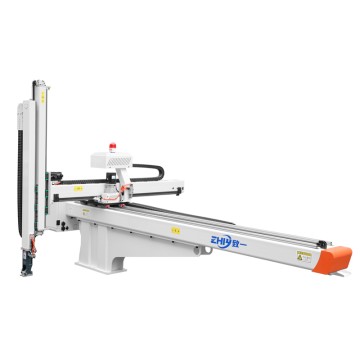
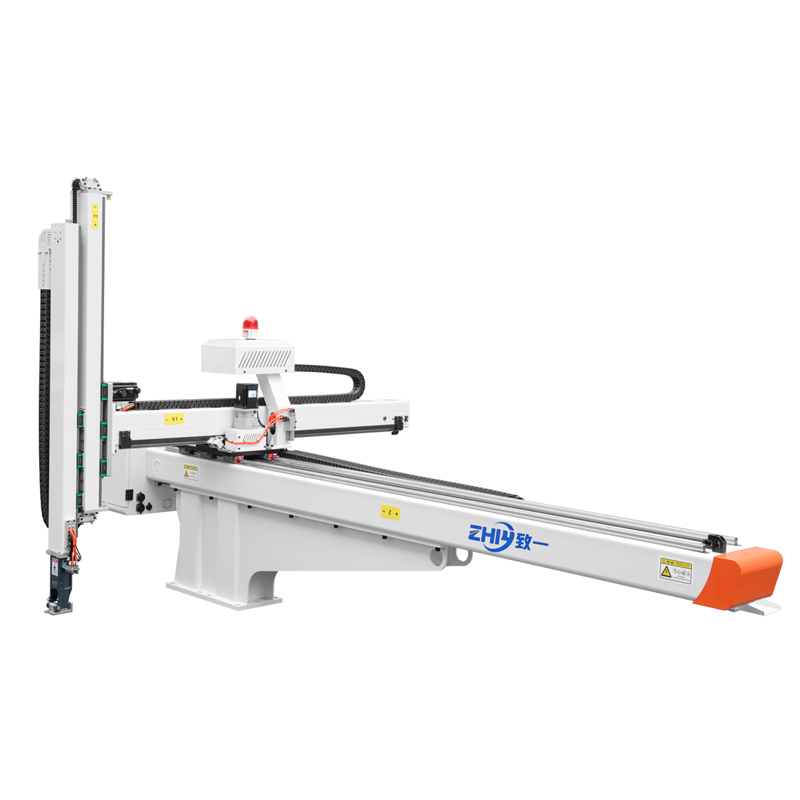
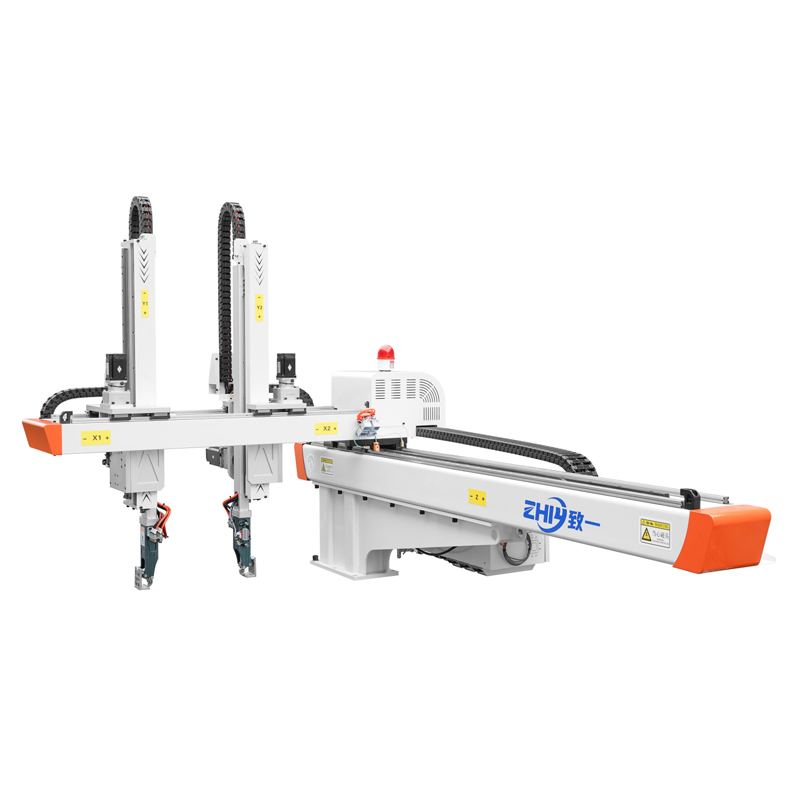
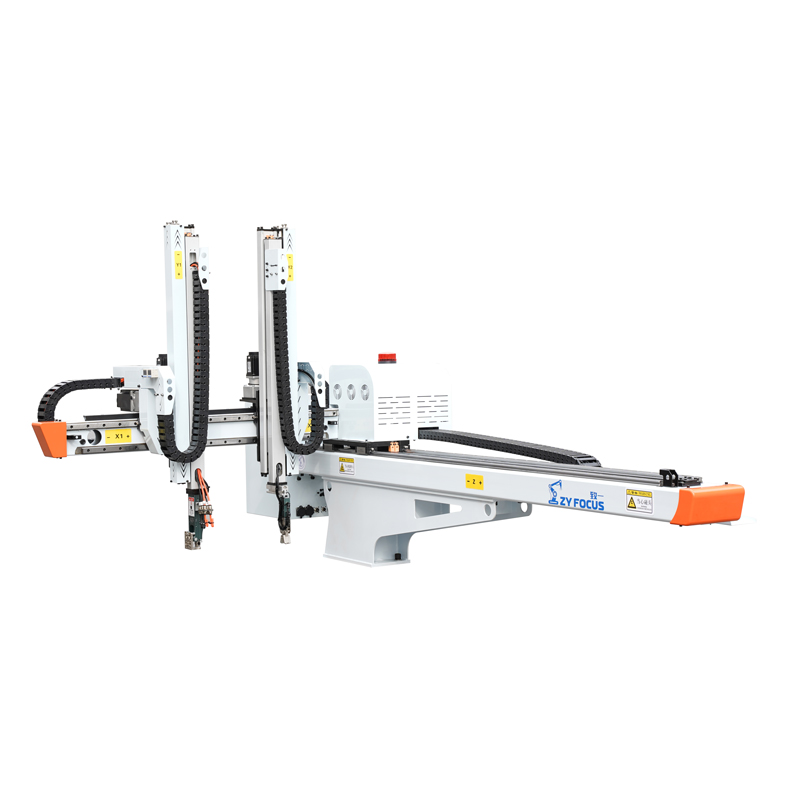
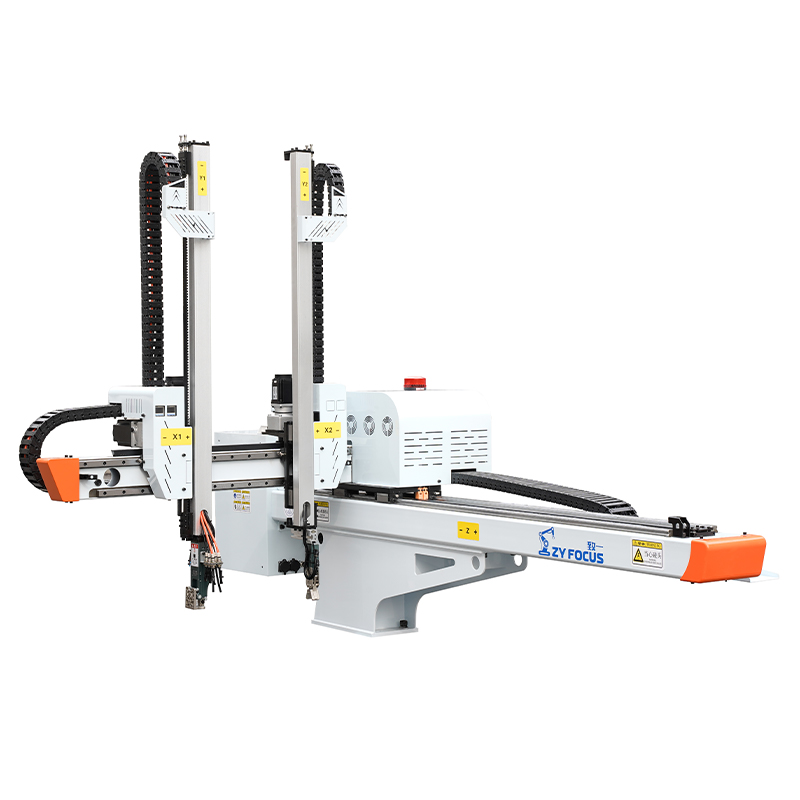
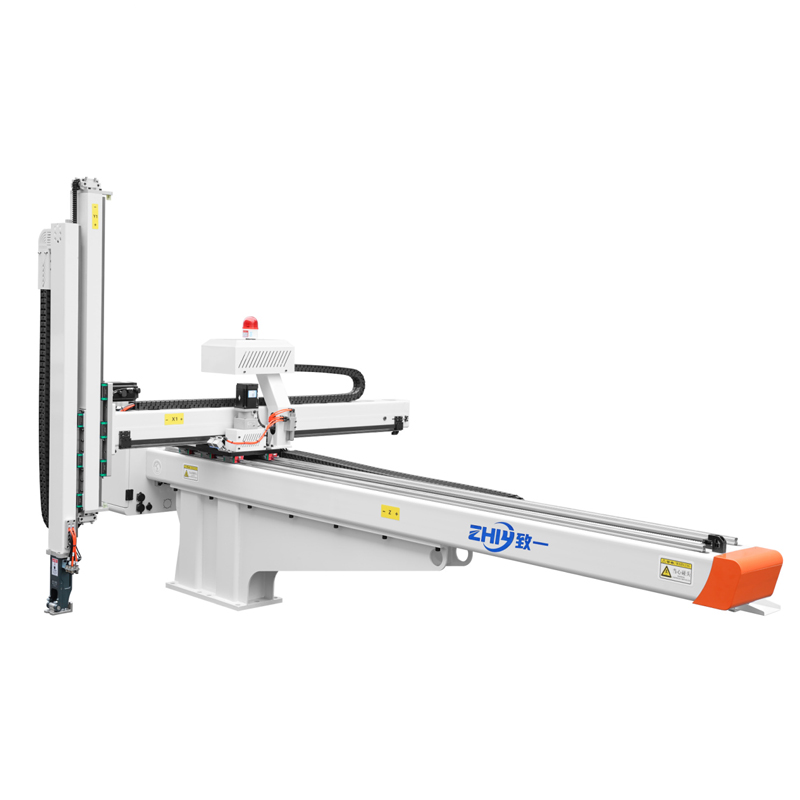
3.1 Top-entry Cartesian 3/5 Axis Servo Robot (Most Popular For Standard Continuous Molding)
Top-mounted crosswise servo robots occupy minimal floor space, optimized for high-volume standardized mass production like disposable tableware, toy shells running 24h daily. Stable linear movement reduces vibration-induced breakdown during repetitive cycles, ideal for single-product long-run production with rare mold changes.
3.2 Side-entry 6-Axis Articulated Robot (Complex Multi-step Continuous Processing)
Perfect for production lines needing inline post-processing: insert overmolding, post-mold trimming, automatic labeling and part stacking after extraction. Flexible multi-angle movement enables one robot to serve multiple molding machines under continuous shift scheduling, widely adopted in automotive component workshops.
3.3 Pneumatic Swing Sprue Picker (Low-cost Intermittent/Short Continuous Runs)
Low upfront investment, suitable only for simple sprue removal on small tonnage machines running under 12h daily continuous operation. Not recommended for 24h nonstop mass production: higher mechanical wear rate leads to frequent air leak and stop failures over long runtime.
4. Compare Drive & Control Systems For Long-Hour Runtime Stability
Drive configuration determines robot’s heat generation, component wear and downtime frequency during weeks of nonstop running:
- Full AC Servo Drive (Top pick for continuous 24/7 production) Servo-controlled axes deliver 30%~62% faster extraction speed vs pneumatic options, with real-time torque adjustment to lower motor overheating risk after thousands of repeated cycles. Integrated closed-loop control synchronizes robot action with molding machine PLC signal to eliminate mold collision during overnight unattended operation. Premium continuous-operation models equip high-resolution encoders and adaptive motion algorithm to auto-adjust acceleration/deceleration to reduce mechanical fatigue.
- Pure Pneumatic Drive (Limited short-run usage only) Lower initial purchase cost but unstable speed consistency with air pressure fluctuation; rising component wear after 8+ continuous running hours increases unplanned maintenance stops, only cost-effective for low-cycle, small-batch workshops.
Control System Additional Checkpoint For Procurement
Prioritize controllers supporting standard industrial communication protocols to seamlessly connect with existing workshop MES or production monitoring systems, enabling real-time runtime data tracking for predictive maintenance during long shifts. User-friendly HMI panel cuts on-site operator error during midnight unattended continuous production.
5. End-of-Arm Tooling (EOAT): The Hidden Factor Of Nonstop Running Reliability
Many factories select high-quality robots yet face frequent part dropping failures under continuous operation due to poorly designed end gripper/ suction tooling:
- Vacuum cup EOAT: Best for flat, smooth-surface plastic casings; select oil-resistant silicone suction cups to withstand high-temperature molding workshop environment and avoid aging failure after long-hour use.
- Mechanical servo gripper: Ideal for irregular thick-wall parts and insert overmolding; adjustable clamping force prevents part crush or slippage after millions of repetitive pick cycles.
- Custom combined EOAT: Mixed vacuum + mechanical finger design for multi-cavity molds producing mixed-size parts, the mainstream choice for continuous multi-spec molding production lines.
Procurement tip: Request supplier to design customized EOAT based on your actual sample parts before order confirmation, instead of using universal off-the-shelf tooling.
6. Environmental Protection & Durability For Harsh Molding Workshop Conditions
Injection molding workshops feature high ambient temperature, oil mist, plastic dust and occasional cooling water splash—core environmental risks shortening continuous-running robot service life:
- Select robot body with IP54~IP65 protection rating for all moving joints and motor housings; IP65 certified units resist dust and coolant intrusion to cut sudden shutdown caused by short circuit during long shifts.
- Guide rail and transmission parts with anti-rust coating and centralized automatic grease lubrication system: auto-lubrication reduces manual maintenance frequency during nonstop weekly production runs, a must-have feature for unattended overnight workshops.
7. ROI & Aftersales Support Checklist For Long-Term Continuous Production
Total ownership cost matters more than initial equipment price for buyers targeting years of continuous automation operation:
- Maintenance cost benchmark: Confirm annual spare part replacement cost and local stocking availability of core components (servo motor, encoder, control board). Suppliers with regional spare part warehouse drastically cut downtime during emergency breakdown on round-the-clock lines.
- Warranty policy: Prioritize models with minimum 12-month full mechanical warranty plus extended optional service package for 24h running equipment.
- Technical response speed: Clarify after-sales engineer arrival timeline for on-site troubleshooting; fast-response local support avoids multi-day production halt for continuous factories.
Most well-matched continuous-operation robot projects deliver full ROI within 10~18 months via cutting manual staffing and scrap loss, a key financial indicator for procurement department budget approval.
8. Common Selection Mistakes To Avoid For 24/7 Operating Robots
- Under-sizing payload without adding safety margin: Running robots at maximum rated load daily accelerates bearing damage and sudden breakdown after 3~6 months continuous production.
- Over-specifying unnecessary multi-axis functions: Pay extra for unused flexible features raises initial cost without improving continuous runtime stability.
- Ignoring workshop layout limitation: Inadequate overhead/side mounting space leads to forced modified installation, triggering abnormal vibration during long-hour repetitive movement.
- Choosing low-grade EOAT to save upfront budget: Cheap gripper aging in weeks creates frequent unplanned downtime offsetting initial cost savings.
9. Final Quick Reference Selection Chart
| Molding Machine Tonnage | Typical Product | Recommended Robot Type | Key Spec For Continuous Run |
|---|---|---|---|
| 160T~470T | Phone shell, daily plastic items | 3/5 Axis Top-entry Servo | 3~25kg payload, ±0.1mm precision |
| 500T~1600T | Auto interior parts, storage boxes | 5 Axis Servo / Basic 6 Axis | 25~80kg payload, IP54+ protection |
| ≥1200T | Bumper, large heavy containers | Heavy-duty Cross Servo Robot | ≥50kg payload, oversize vertical stroke |
| Multi-machine inline assembly | Insert molding + post trimming | Side Mount 6 Axis Robot | Flexible programmable multi-path control |
10. Closing & Practical Next Steps
Choosing injection molding robots for uninterrupted continuous production balances mechanical durability, parameter matching, onsite environment adaption and long-term service security instead of simply comparing sticker prices.
For procurement teams preparing upcoming automation upgrade:
- Collect actual part weight, mold dimension and daily runtime schedule to finalize core spec sheet first;
- Request qualified suppliers to conduct on-site workshop measurement and provide customized robot proposal with EOAT drawing;
- Ask for reference site visits to existing local factories running same robot model under 24h continuous shifts for real production performance verification.
Frequently Asked Questions
Q1: Can a single robot serve multiple injection molding machines for nonstop production?
A: 6-axis articulated robots mounted on linear traveling rails can cover 2~4 mid-size molding presses under stable continuous shift, suitable for scattered layout workshop with similar production cycle parameters. Standard top-entry Cartesian robots are mostly dedicated for single machine installation for stable round-the-clock extraction.
A: 6-axis articulated robots mounted on linear traveling rails can cover 2~4 mid-size molding presses under stable continuous shift, suitable for scattered layout workshop with similar production cycle parameters. Standard top-entry Cartesian robots are mostly dedicated for single machine installation for stable round-the-clock extraction.
Q2: Is high-speed robot always better for continuous operation?
A: No. Excessively high acceleration without reinforced mechanical frame brings heavy vibration and part falling issues after long runtime. Optimal setting balances cycle efficiency and structural stability per your actual molding cycle data.
A: No. Excessively high acceleration without reinforced mechanical frame brings heavy vibration and part falling issues after long runtime. Optimal setting balances cycle efficiency and structural stability per your actual molding cycle data.
Q3: How long is the average service life of a properly selected continuous-use injection robot?
A: With routine scheduled maintenance and correct payload matching, full servo models designed for nonstop operation normally maintain stable performance for 7~10 years under daily multi-shift production
A: With routine scheduled maintenance and correct payload matching, full servo models designed for nonstop operation normally maintain stable performance for 7~10 years under daily multi-shift production