
Leave Your Message
0102030405
How to Choose Servo Robot Arm for Heavy Load
2026-07-28
How to Choose Servo Robot Arm for Heavy Load
Table of Contents
- Understanding Core Heavy-Load Servo Robot Basics
- Step 1: Calculate Actual Total Payload & Safety Margin
- Step 2: Match Axis Configuration to Heavy-Duty Production Tasks
- Step 3: Verify Working Stroke, Stiffness & Dynamic Performance
- Step 4: Check Precision, Servo Drive & Mechanical Structural Durability
- Step 5: Match Robot Specifications to Factory Operating Environment
- Step 6: Evaluate Cycle Time & Production Efficiency Targets
- Step 7: Compare After-Sales Support, Certification & Long-Term Operation Cost
- Real-World Heavy Load Application Matching Table
- Common Buyer Mistakes to Avoid When Selecting Heavy-Duty Robot Arms
- Frequently Asked Questions
- Conclusion
Understanding Core Heavy-Load Servo Robot Basics
Manufacturers handling large plastic moldings, automotive components, thick metal parts, and bulk palletizing goods all rely on heavy-load servo robot arms to replace manual labor, cut operational costs and eliminate workplace safety risks. Unlike light-duty manipulators designed for tiny electronic parts, heavy-load servo arms carry weights ranging from 15kg up to 60kg and above, built with reinforced frames, high-torque servo motors and heavy-duty linear guide systems to sustain long-term high-speed cyclic operation.
Many procurement teams make costly errors by only referencing the weight of finished products when selecting equipment, ignoring end-of-arm tooling weight, dynamic inertia during acceleration and deceleration, and eccentric load impact. Under-spec robot arms will suffer motor overheating, sliding rail wear, positioning drift, frequent breakdowns and unplanned production downtime. This guide breaks down every critical purchasing factor tailored to industrial buyers, covering parameter calculation, scenario matching, hardware verification and supplier evaluation.
Step 1: Calculate Actual Total Payload & Safety Margin
Payload is the most fundamental benchmark for heavy-load robot selection, and static workpiece weight alone cannot determine your required robot specification. The full load formula recognized across the automation industry is: Total Required Payload = (Workpiece Weight + Gripper/Fixture + Cable & Accessory Weight) × Safety Margin Coefficient
Key Calculation Rules
- Include all end attachments: Vacuum suction frames, pneumatic clamps, in-mold insertion fixtures, wiring harnesses and cooling pipes all add constant load on the arm end.
- Standard safety margin range: For continuous 24-hour heavy-duty production, reserve a 20%–30% load redundancy. For intermittent batch production, a 10%–15% margin is acceptable.
- Account for eccentric load: Heavy workpieces with unbalanced mass distribution amplify joint torque during movement; add an extra 10% margin for irregular-shaped heavy parts.
Practical Example
A factory produces 12kg automotive plastic bumpers, paired with a 4kg multi-point suction fixture and 1kg bundled cable. Total static weight = 12 + 4 + 1 = 17kg With 25% safety margin: 17 × 1.25 = 21.25kg Procurement must select a servo robot arm with a rated payload no less than 25kg, rather than a 20kg model to avoid overload damage.
Heavy Load Payload Classification Reference
| Payload Class | Typical Application Scenarios | Matching Injection Molding Machine Tonnage |
|---|---|---|
| 15–25kg | Large daily plastic containers, mid-size automotive interior parts | 650T–1200T |
| 30–50kg | Automotive bumpers, large housing moldings, thick structural plastic parts | 1300T–3200T |
| Over 50kg | Super-large mold castings, heavy palletizing transfer | 2000T+ heavy-duty molding equipment |
Step 2: Match Axis Configuration to Heavy-Duty Production Tasks
Heavy-load servo robots mainly adopt three-axis, five-axis dual-arm structural layouts, each suited for distinct production workflows:
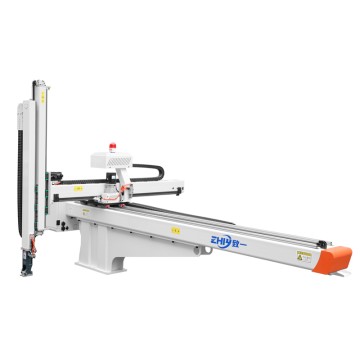
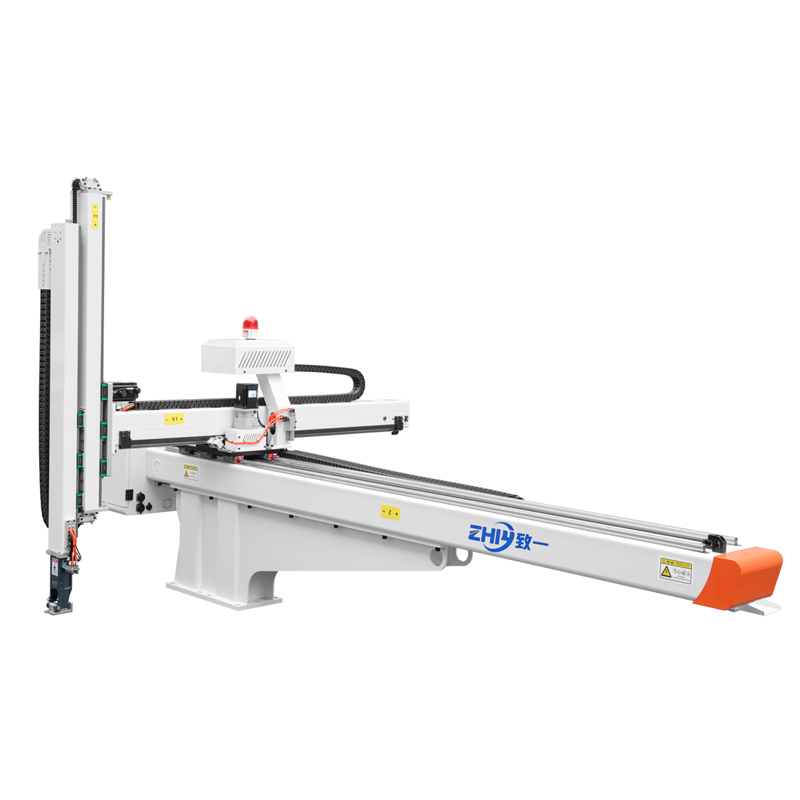
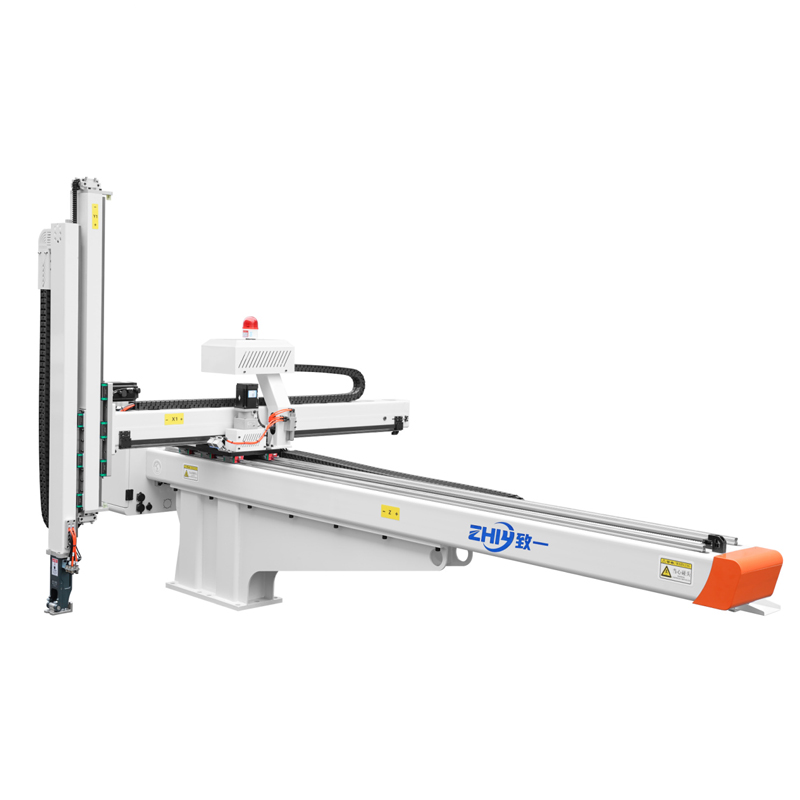
3-Axis Bull Head Heavy Load Servo Robot


3-Axis Heavy Load Servo Robot
- Core advantages: Ultra-high structural rigidity, maximum 50kg rated payload, stable linear high-speed movement, low failure rate under continuous heavy load cycling.
- Best fits: Simple pick-and-place of large heavy moldings, single product demolding, stacking finished goods without complex rotation actions.
- Limitation: Lacks wrist rotation function, cannot complete in-mold labeling, insert molding or multi-angle placement operations.
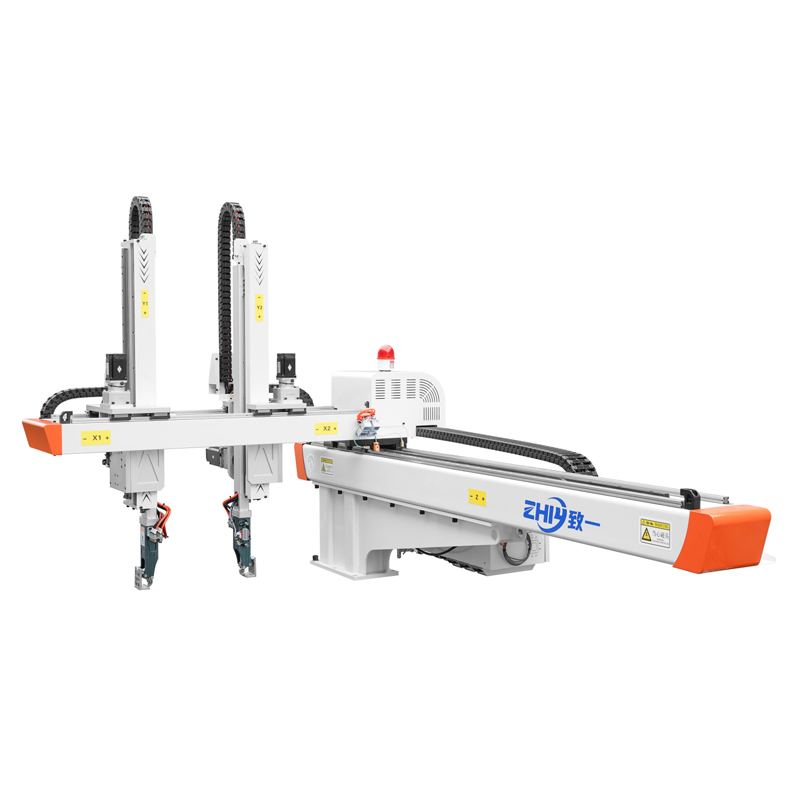
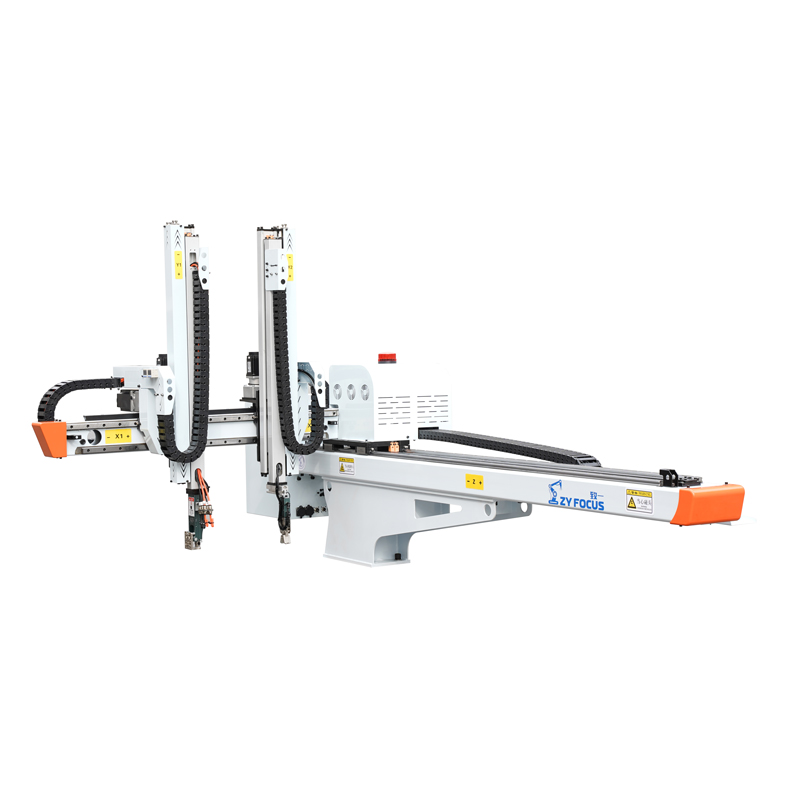
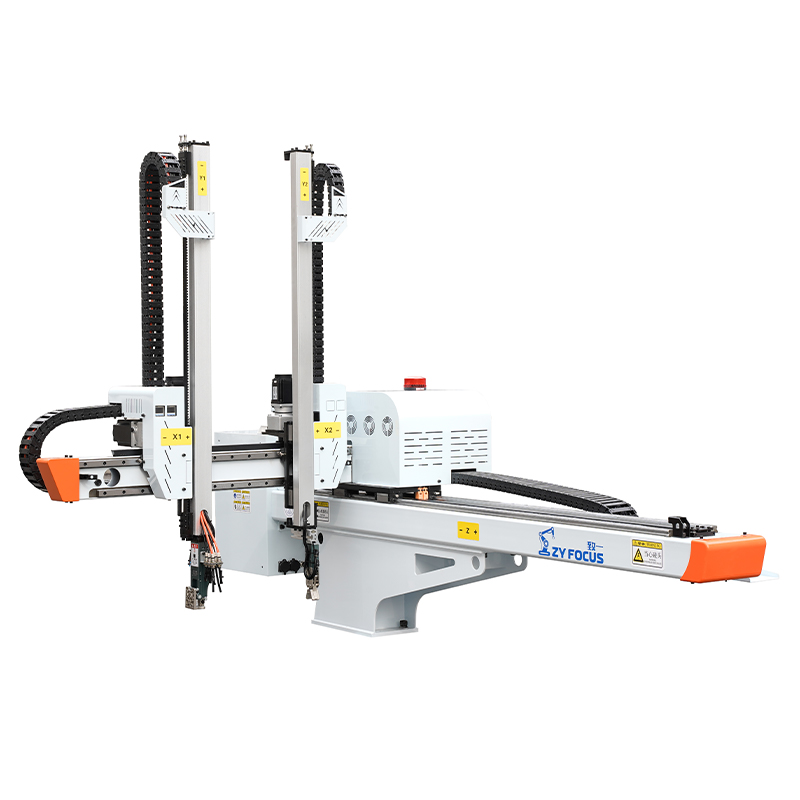
5-Axis Dual-Arm Heavy Load Servo Robot

5-Axis Dual-Arm Heavy Load Robot
- Core advantages: Dual-arm synchronous operation, servo wrist rotation, supports complex secondary processes inside molds, balanced load distribution to reduce single arm pressure.
- Best fits: Automotive component production requiring in-mold metal insert placement, dual-product simultaneous demolding, multi-angle finished part stacking and post-mold trimming integration.
- Limitation: Higher equipment cost than three-axis models, slightly larger footprint on the production floor.
Selection Tip: If your production line only needs basic heavy part removal without secondary mold operations, a three-axis heavy-load robot delivers better cost performance. When complex multi-step processing is required, five-axis dual-arm configurations are the only viable long-term solution.
Step 3: Verify Working Stroke, Stiffness & Dynamic Performance
Even with sufficient payload rating, insufficient stroke or weak frame rigidity will render a heavy-load robot unusable for your workshop layout.
- Horizontal (X-axis) travel: Must fully cover the injection molding machine opening width, plus extra space for finished product transfer to receiving stations. For heavy mold machines above 1000T, X-axis stroke should reach 1800mm–3500mm.
- Vertical (Z-axis) stroke: Calculate based on mold height, machine safety door clearance and stacking height of finished goods. Double-section vertical arms are recommended for factories with low ceiling height to reduce overall equipment height.
- Beam & column stiffness inspection: Heavy-load models adopt thickened extruded aluminum beams and reinforced cast iron base supports. Light thin-wall aluminum frames will produce obvious vibration during high-speed movement, leading to unstable product grabbing and fast guide rail wear.
- Dynamic load test standard: Reputable manufacturers complete full-load cycle testing at 120% rated payload before delivery; avoid suppliers that only test static load without dynamic acceleration/deceleration verification.
Step 4: Check Precision, Servo Drive & Mechanical Structural Durability
Long-term heavy load operation imposes extreme wear on servo motors, reducers and linear guides. Prioritize these hardware indicators during supplier evaluation:
Precision Index
Heavy-duty production does not require ultra-micro precision, but stable repeatability is non-negotiable:
- Standard heavy-load robot repeat positioning accuracy: ±0.03mm ~ ±0.05mm under full rated payload.
- Avoid models where accuracy drops sharply when carrying maximum load; this signals insufficient motor torque and weak mechanical rigidity.
Servo & Transmission Components
- Servo motors: Select large-torque AC servo motors with built-in overload protection, supporting continuous torque output under sustained heavy load.
- Reducers: Planetary reducers with high reduction ratios are mandatory for heavy load joints; ordinary gear reducers will suffer rapid tooth wear and backlash expansion.
- Linear guides: Wide-width heavy-load linear guide rails with double slide blocks on each axis to evenly disperse workpiece weight and vibration impact.
Frame Anti-Corrosion Design
Workshops with oil mist, plastic dust and humidity require robot frames with anti-rust coating, IP54 or higher electrical cabinet protection ratings to extend service life under harsh heavy-duty working conditions.
Step 5: Match Robot Specifications to Factory Operating Environment
Production site conditions directly determine the service lifespan of heavy-load servo robots, and buyers must align equipment protection grades with on-site hazards:
- Oil mist & dust environment (standard injection molding workshop): Choose IP54 electrical cabinets, sealed servo motor casings and dust-proof guide rail covers to prevent oil contamination from blocking transmission components.
- High-temperature workshop (above 35℃ ambient temperature): Confirm the servo drive system has built-in heat dissipation fans and high-temperature resistant wiring harnesses to avoid automatic overheat shutdown during summer continuous production.
- Low-ceiling factory buildings: Prioritize double-section vertical arm heavy-load robots to reduce overall equipment height and avoid collision with overhead workshop cranes.
- Limited floor space: Cantilever-mounted heavy-load three-axis robots save ground area compared with column-mounted dual-arm models.
Step 6: Evaluate Cycle Time & Production Efficiency Targets
Heavy load handling often becomes the bottleneck of the entire injection molding cycle, so cycle time matching is critical for mass production lines:
- Clarify target hourly output first, then communicate cycle time requirements with suppliers. Heavy parts have larger inertia, so robot movement speed will be slower than light-duty manipulators.
- Professional suppliers optimize motion curve algorithms for heavy load, balancing speed and stability to cut unnecessary waiting time in each molding cycle.
- Avoid blindly pursuing ultra-fast movement speed: Excessive acceleration under heavy load will shorten guide rail and servo motor service life, increasing long-term maintenance costs.
Sample Cycle Reference: A 40kg payload three-axis robot completes full demolding and stacking within 12–18 seconds for large automotive bumpers under standard production rhythm.
Step 7: Compare After-Sales Support, Certification & Long-Term Operation Cost
Heavy-load servo robots are long-cycle production equipment with a service life of 8–12 years, so procurement decisions cannot focus solely on upfront purchase price.
Core Supplier Evaluation Standards
- Certification compliance: Verify ISO9001 quality management certification and CE safety certification for export-ready equipment, ensuring compliance with global factory safety standards.
- Mass production capacity & project cases: Suppliers with annual output above 2000 units and 500+ heavy-load automation project cases demonstrate mature production technology and stable component supply chains.
- After-sales service system: 24-hour global technical consultation, on-site installation debugging, regular preventive maintenance plans and readily available spare parts inventory reduce production downtime risk.
- Long-term maintenance cost: Confirm the service cycle and replacement cost of core wearing parts (guide rails, reducers, servo motors). Equipment using standardized universal components has lower post-purchase maintenance expenses.
Real-World Heavy Load Application Matching Table
| Industry Vertical | Typical Workpiece Weight | Recommended Robot Payload | Recommended Axis Layout | Core Process Requirements |
|---|---|---|---|---|
| Automotive exterior molding | 10–45kg | 30–50kg | 3-axis single arm / 5-axis dual arm | Stable high-speed demolding, optional in-mold insert function |
| Large household appliance housings | 8–25kg | 15–30kg | 3-axis bull head robot | Simple pick & stack, low investment cost |
| Blow molding large plastic barrels | 12–30kg | 20–35kg | Custom heavy-load single arm | High vertical stroke, anti-slip suction fixture matching |
| Palletizing & bulk material transfer | 30–60kg | 50kg+ heavy duty model | Custom multi-axis gantry robot | Ultra-high rigidity, long horizontal travel |
Common Buyer Mistakes to Avoid When Selecting Heavy-Duty Robot Arms
- Ignoring safety load margin: Only calculate product weight without adding fixture weight, leading to motor overload, frequent alarms and shortened equipment lifespan.
- Confusing static rated load with dynamic full-load performance: Many suppliers mark high static payload but lose accuracy and stability during high-speed cyclic movement. Always request full dynamic load test reports.
- Overlooking workshop space constraints: Selecting single-section vertical arms for low-ceiling factories causes installation failure and costly rework.
- Prioritizing low price over structural rigidity: Cheap thin-frame heavy-load robots generate severe vibration, scratch finished moldings and need frequent component replacement.
- Neglecting after-sales spare parts supply: Small manufacturers discontinue component production after 2–3 years, leaving buyers unable to source replacement parts when faults occur.
Frequently Asked Questions
Q1: How much safety margin should I reserve for heavy load robot arms?
A: For 24-hour non-stop mass production, reserve 20%–30% extra payload redundancy. For discontinuous batch production with short daily operation hours, 10%–15% margin meets operational safety standards. Always include grippers, cables and auxiliary fixtures in total load calculation.
Q2: Is a five-axis dual-arm robot always better than a three-axis heavy-load model?
A: No. Three-axis bull head robots feature stronger rigidity, lower cost and simpler maintenance for basic heavy part demolding tasks. Five-axis dual-arm solutions are only necessary when your workflow requires in-mold insertion, multi-angle rotation or synchronous dual-product handling.
Q3: Will heavy load servo robots lose positioning accuracy after long-term operation?
A: High-quality heavy-duty models use thickened beams, wide heavy-load guide rails and high-precision planetary reducers to maintain stable repeatability for 8–10 years under standard maintenance. Low-cost thin-frame robots will experience accuracy drift within 1–2 years of continuous heavy cycling.
Q4: What IP rating is suitable for standard injection molding workshops with oil mist?
A: IP54 protection rating is the minimum standard for heavy-load robots in molding plants, effectively blocking oil mist and plastic dust from entering electrical cabinets and servo components. For foundry or high-corrosion workshops, upgrade to IP65 rated equipment.
Conclusion
Selecting a suitable heavy-load servo robot arm balances precise technical parameter calculation, production process matching, on-site environmental adaptation and long-term supplier service capacity. The core logic of procurement is to calculate full total payload with sufficient safety margin first, then match axis layout, stroke and mechanical rigidity to your molding equipment and workshop layout, and finally verify hardware durability, certification and after-sales support.
Skipping any of these evaluation steps will lead to mismatched equipment, production bottlenecks or excessive long-term maintenance expenditure. Industrial buyers can sort out clear production parameter documents (workpiece weight, fixture weight, molding machine tonnage, workshop ceiling height, required secondary processes) before communicating with suppliers, to quickly filter matching heavy-load robot models and obtain accurate quotation solutions.