Leave Your Message
0102030405
How to Choose Robot Arm for Factory Upgrade
2026-07-29
How to Choose Robot Arm for Factory Upgrade
Table of Contents
- Core Pre-Work: Map Your Factory’s Real Automation Needs
- Key Technical Specifications to Compare Before Quotation
- Match Robot Arm Types to Your Production Workflow
- Evaluate Operating Environment & Compatibility
- Calculate Full Lifecycle Cost & ROI Timeline
- Common Mistakes to Avoid When Sourcing Robot Arms
- How to Select a Reliable Robot Equipment Supplier
- Final Checklist for Robot Arm Procurement
1. Core Pre-Work: Map Your Factory’s Real Automation Needs
Before browsing robot arm models or requesting price quotes, manufacturing buyers need to lock down clear production requirements—this eliminates mismatched equipment and unnecessary overspending. Many factory owners rush to purchase robot arms only to find the machine cannot match their mold size, cycle speed or product weight, leading to production downtime and wasted investment.
Document these core factory details as your selection baseline:
- Production target: Required parts output per hour, daily working shifts and planned annual capacity expansion
- Core tasks: Simple product picking, insert molding, multi-angle flipping, secondary assembly, packaging or integrated vision inspection
- Product parameters: Maximum weight of finished parts, size range, material (plastic, metal, medical precision components)
- Existing equipment: Injection Molding Machine tonnage, mold opening stroke, template spacing and conveyor layout
- Floor space: Available installation area, ceiling height and safety guard layout limits
- Long-term plans: Whether the line will switch to multi-variety small-batch production within 1–3 years
These details help suppliers customize robot stroke, payload and functional modules instead of offering generic standard models.
2. Key Technical Specifications to Compare Before Quotation
Every robot arm’s performance hinges on 5 non-negotiable parameters; buyers should prioritize these comparisons across different manufacturers.
2.1 Payload Capacity (Most Commonly Miscalculated Index)
Payload is not only the weight of your finished product. The full load formula is: Total Required Load = (Product Weight + Gripper/Suction Tool Weight + Sensor Fixture Weight) × 1.2–1.5 safety margin
Running a robot arm at full rated payload shortens servo and reducer service life by nearly 50%, causes vibration during high-speed operation and reduces positioning stability. For heavy automotive molded parts, choose a robot with 30% extra load margin; lightweight electronic components can adopt a 20% safety buffer.
2.2 Stroke & Working Envelope
Three core strokes must fully cover your production path:
- Horizontal X stroke: Reach from machine standby position to finished product stacking area
- Vertical Z stroke: Match injection mold opening height and top ejection distance
- Y cross stroke: For multi-station placement, insert feeding or side flip operations
Verify no collision interference with mold frames, cooling fans and conveyor frames during full movement. A robot with sufficient static reach may get stuck at narrow mold opening gaps, delaying cycle time.
2.3 Positioning Repeatability
Precision standards differ by application:
- Standard plastic part picking: ±0.1 mm repeatability
- Insert molding, medical component assembly: ±0.02–0.05 mm high precision requirement
- Bulk palletizing and simple sorting: ±0.5 mm acceptable tolerance
Servo-driven robot arms deliver far more stable repeatability than traditional pneumatic manipulators, critical for reducing defective rates in precision manufacturing.
2.4 Cycle Time Matching
The robot’s empty cycle time must be shorter than your injection molding cooling cycle. If robotic movement takes longer than mold opening waiting time, the entire production line will be restricted by arm speed and fail to hit output targets. High-speed servo arms cut pick-and-place time to under 0.7 seconds for thin-wall plastic products.
2.5 Protection Grade & Durability
Workshops with oil mist, mold release agent residue and high temperature require IP54 or above protection rating. Low-grade sealed arms suffer internal circuit corrosion within 1–2 years of continuous operation, triggering frequent breakdowns and maintenance costs.
3. Match Robot Arm Types to Your Production Workflow
Different axis configurations serve distinct factory upgrade scenarios. Below is a clear comparison for injection molding and general manufacturing lines:
| Robot Arm Type | Core Advantages | Best Factory Upgrade Scenarios | Limitations |
|---|---|---|---|
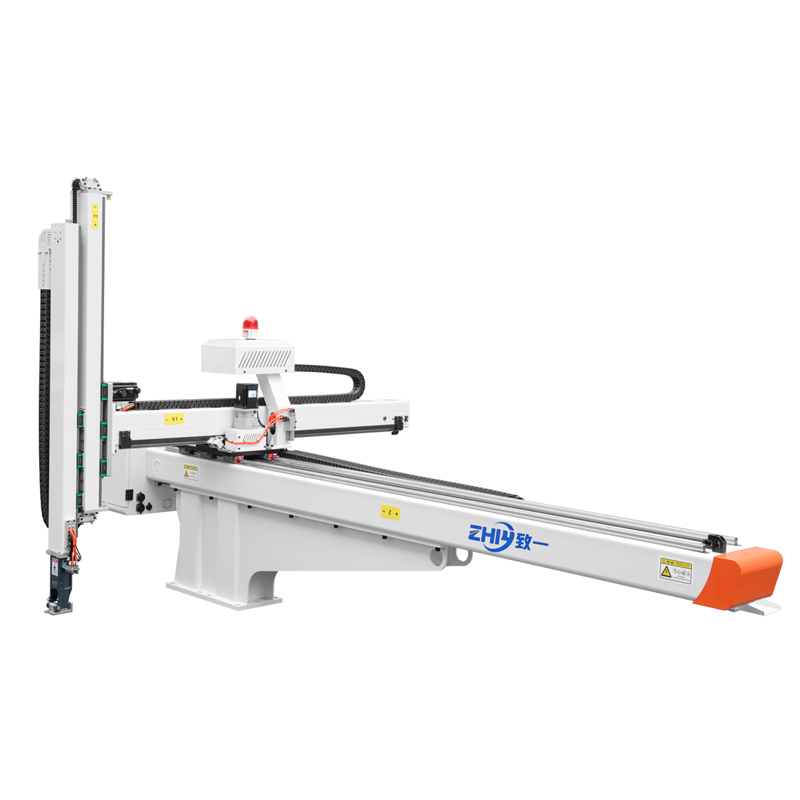
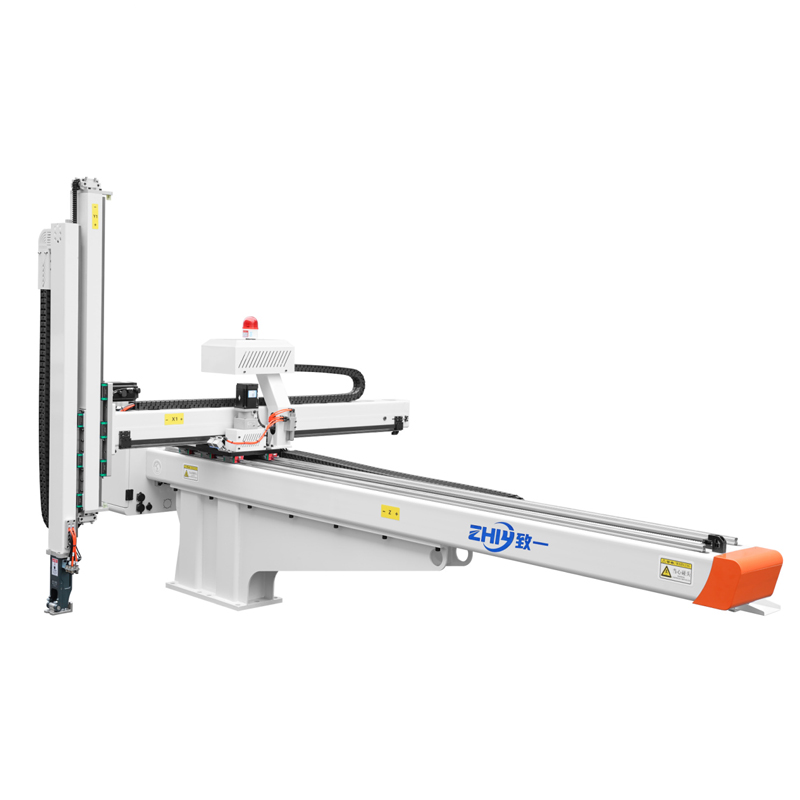
| 3-Axis Single Servo Robot | Low investment, simple programming, stable high-speed picking | Small/medium tonnage injection machines, single product mass production, basic take-out only | Limited multi-angle movement, not suitable for insert molding or complex secondary processing |
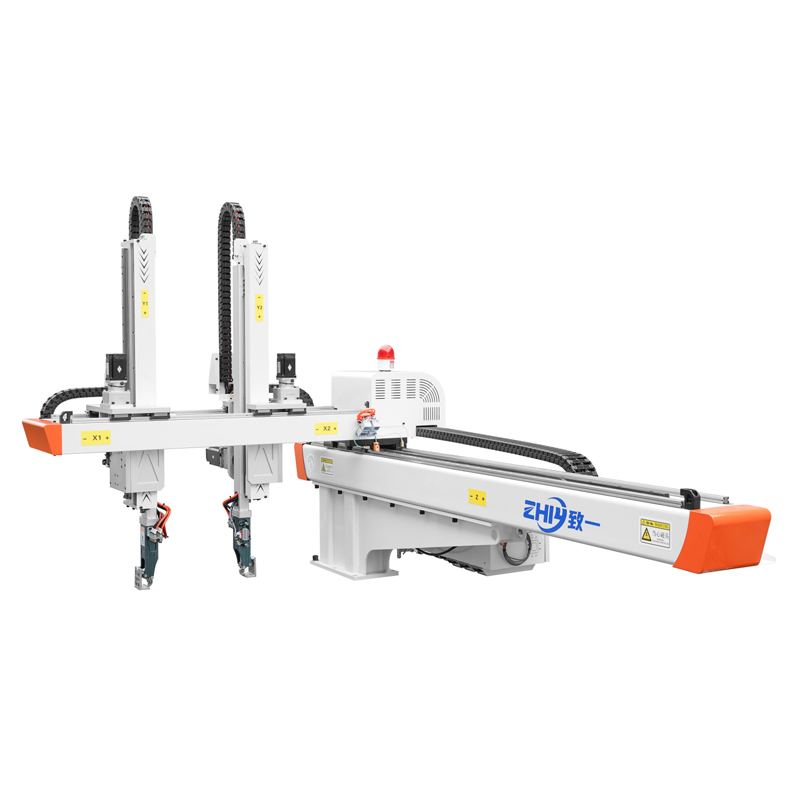
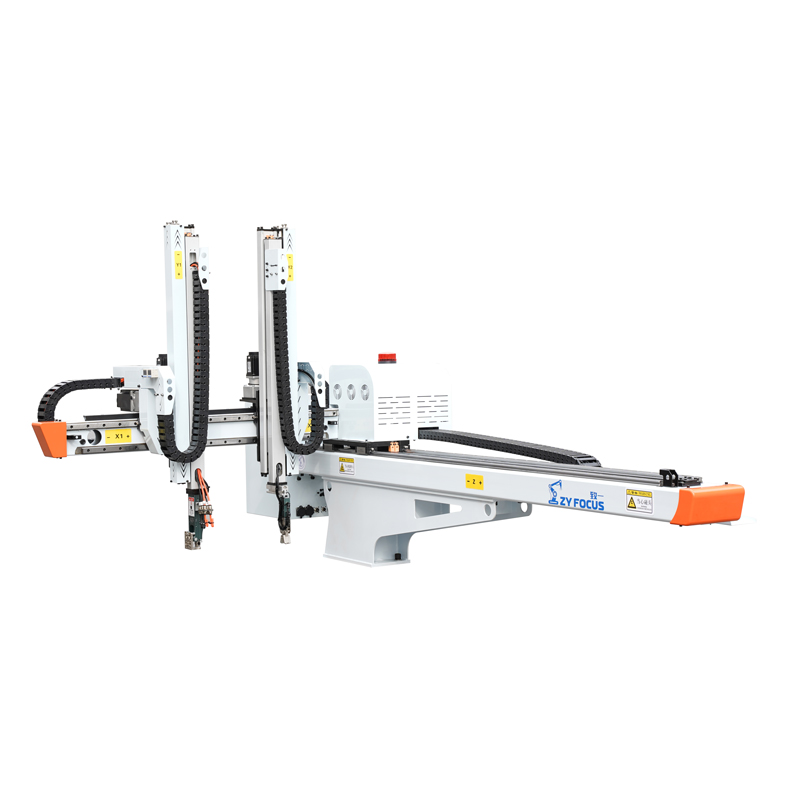
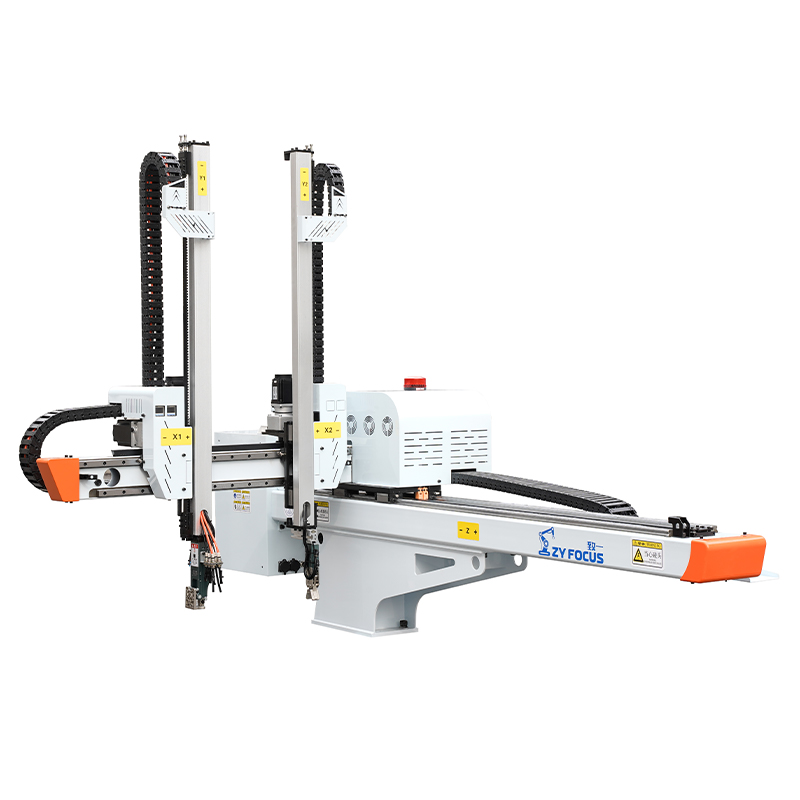
| 5-Axis Dual-Arm Servo Robot | Extra rotation & flip axes, flexible multi-direction movement, high precision | Automotive parts, medical plastic, insert molding, multi-station stacking | Higher cost than 3-axis models, needs longer training for new operators |
| Bull Head Heavy-Load Robot | Max 50kg heavy payload, extended stroke, rigid mechanical frame | Large mold, oversized plastic housings, thick industrial components | Larger installation footprint, matched for 300T+ injection machines |
| 6-Axis Universal Robot | Full spatial freedom, compatible with polishing, assembly, vision integration | Multi-process intelligent unmanned workshops, mixed production lines | High upfront cost, complex programming, requires dedicated engineering staff |
For most small and medium manufacturers upgrading from fully manual operation, 3-axis or 5-axis servo robots deliver the fastest ROI without overpaying for unused advanced functions.


3-Axis Servo Robot

5-Axis Dual-Arm Robot
4. Evaluate Operating Environment & Compatibility
Factory environment and equipment compatibility directly impact long-term robot stability. Focus on these factors during selection:
- Workshop temperature & dust: High-temperature injection molding workshops need heat-resistant servo motors and anti-dust cable chains; clean medical workshops require stainless steel surface and low-particle structural design.
- Existing machine communication: Confirm the robot control system supports signal docking with your injection molding machine brand, enabling synchronous mold opening, ejection and arm movement without extra relay transformation.
- Floor space constraints: Single-section compact arms suit narrow production workshops; double-section telescopic arms are ideal for long-distance product transfer.
- Safety standards: CE and ISO9001 certified robots comply with global factory safety regulations, avoiding customs clearance barriers for cross-border manufacturers. Safety light curtain linkage and emergency stop functions are mandatory for unmanned production cells.
5. Calculate Full Lifecycle Cost & ROI Timeline
Many buyers only compare upfront machine price and ignore long-term operating expenses, leading to hidden cost losses. The full cost calculation covers four parts:
- Initial procurement cost (robot body, gripper, control system, installation)
- Annual power consumption: Servo robots save 30–40% energy vs hydraulic manipulators, lowering monthly utility bills
- Maintenance cost: Spare parts replacement, regular lubrication, annual calibration
- Labor cost reduction: One robot replaces 1–2 manual operators, eliminating continuous wage expenditure
Standard injection robot arm projects usually achieve full cost recovery within 12–24 months. Factories with three-shift continuous production see faster ROI due to higher labor savings. When communicating with suppliers, request a detailed ROI breakdown based on your actual shift schedule and labor wages.
6. Common Mistakes to Avoid When Sourcing Robot Arms
After analyzing thousands of factory upgrade cases, these recurring errors lead to poor automation results:
- Under-sizing payload to cut costs: Overloaded arms wear out quickly and drop finished products during high-speed movement
- Over-specifying advanced 6-axis robots for simple pick-and-place tasks: Wasting 30%+ capital on unused motion functions
- Ignoring mold stroke matching: Vertical stroke shortage causes scraping of molded products and mold damage
- Skipping after-sales evaluation: Low-cost unbranded equipment lacks global spare parts supply, resulting in multi-day production shutdowns when faults occur
- Neglecting operator training: Complex control systems without on-site training extend production debugging cycles
7. How to Select a Reliable Robot Equipment Supplier
The robot arm is a long-term production asset; the supplier’s service capacity equals your factory’s production guarantee. Use these evaluation standards:
- Project experience: Over 500 completed factory automation cases covering your industry (injection molding, automotive, medical plastic)
- Independent R&D capability: Own utility patents for servo control and mechanical structure, not simply assembled generic components
- Global service network: 24-hour remote technical support, local spare parts warehouses for fast delivery
- Customization capacity: Offer tailored welding, insert molding and stacking functional upgrades instead of only standard stock models
- Training support: Free on-site operation training, graphic programming tutorials for factory staff with limited automation experience
8. Final Checklist for Robot Arm Procurement
Cross-check every item before signing purchasing contracts to eliminate post-delivery disputes:
- Calculated total required payload with 1.2–1.5 safety margin
- Verified X/Y/Z stroke fully matches injection machine and mold dimensions
- Confirmed repeatability meets precision standards of finished products
- Confirmed cycle time fits existing molding production rhythm
- Checked CE, ISO9001 quality certification and protection grade
- Confirmed communication compatibility with current injection molding equipment
- Clarified full after-sales terms: warranty period, spare parts lead time, remote support response speed
- Received customized quotation with full lifecycle ROI analysis
- Confirmed on-site installation and operator training arrangements
FAQs
Q1: Is a 5-axis robot always better than a 3-axis model for factory upgrades?
A1: Not necessarily. If your production only needs simple product removal and stacking, a 3-axis servo robot meets all demands with lower investment. 5-axis arms are only worthwhile when insert molding, 90° flipping or multi-angle placement is required.
Q2: How much safety margin should I reserve for robot payload?
A2: 20% for small lightweight electronic parts; 30–50% for heavy automotive or industrial plastic housings. Always calculate the total weight of product plus gripper tools, not just the finished piece alone.
Q3: Can robot arms work in high-temperature injection molding workshops?
A3: Yes, select models with heat-resistant servo motors and high-temperature cable chains, minimum IP54 dustproof and oil-proof protection grade. Standard low-protection arms will face circuit failure under long-term high-temperature exposure.
Q4: How long does it take to recover robot arm investment?
A4: For two-shift production lines, average ROI ranges from 12 to 24 months. Factories running three daily shifts cut recovery time to under one year due to higher labor cost savings.
Conclusion
Upgrading factory production with robot arms is a strategic investment rather than a one-time equipment purchase. The correct selection logic starts with sorting out your unique production demands, comparing core technical parameters, matching robot types to workflow, calculating full lifecycle costs, and verifying supplier service capacity.