
Leave Your Message
Cobots vs Servo Take-Out Robots for Injection Molding: A Practical Comparison for Plant Buyers
For two decades the standard answer to the question of how to get molded parts out of the tool faster and safer has been a servo take-out robot — the three-axis or five-axistraverse unit mounted on the platen or running across the tie bars. Lately, however, a different question has started appearing in procurement meetings: should we be looking at a Collaborative Robot instead? Collaborative arms have matured, fallen in price and become far easier to program, and plant buyers who once dismissed them as slow and fragile now see real use cases on the molding floor. This article gives purchasing and engineering leaders a practical, side-by-side view of the two approaches so the next capital request is built on facts rather than vendor enthusiasm.
Why Plant Buyers Are Starting to Look at Cobots for Take-Out
The appeal of a collaborative robot in injection molding is not raw speed. It is flexibility. A six-axis articulated cobot can be wheeled to a machine, taught a pick-and-place path in minutes by a line operator, and then redeployed to a different press or a different task the following week. For plants running high-mix, low-volume programswhere tooling changes and part designs shift constantly, that adaptability has real value. Traditional Traverse Robots are engineered for one machine and one cycle; reconfiguring them means changing servo programs, possibly regripping the end-of-arm tooling, and re-validating the take-out window. A cobot, by contrast, is repositioned and re-taught rather than re-engineered.
Another driver is the labor profile. Many molding operations struggle to find technicians who can program PLC-based robot controllers. Cobots are typically taught by hand-guiding the arm or by using a tablet interface with visual blocks, which lowers the barrier so that a molding operator — not A Robotics engineer — can set up a new job. This matters for buyers who want to spread automation across many machines without expanding the controls engineering team.
How the Two Systems Are Built and How They Move
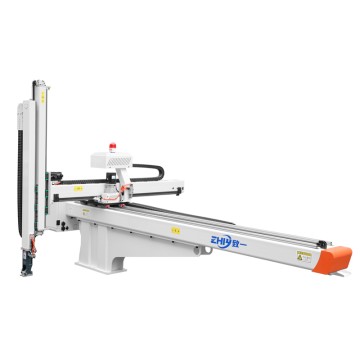
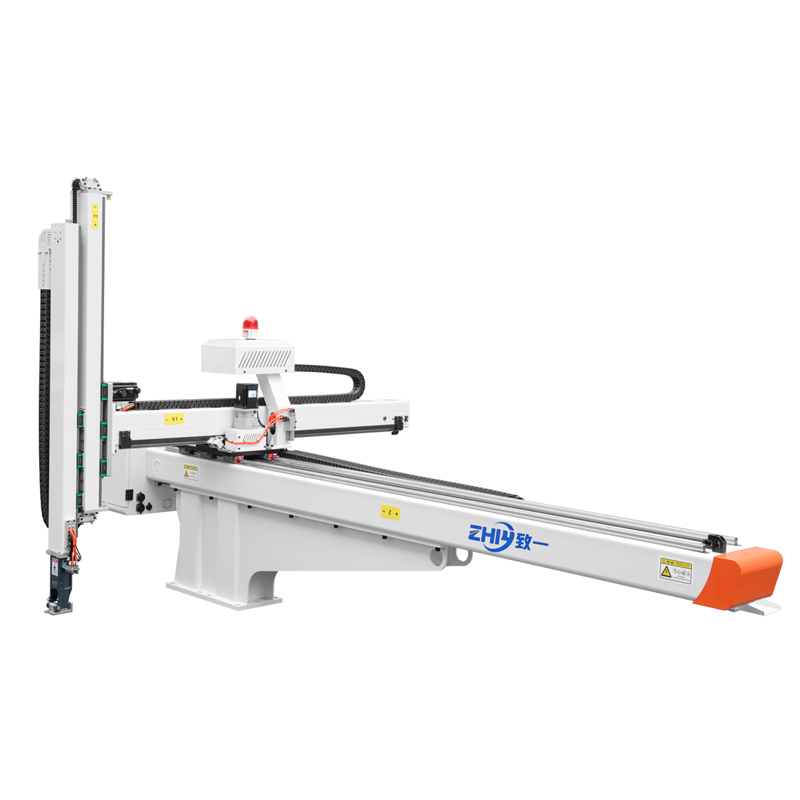
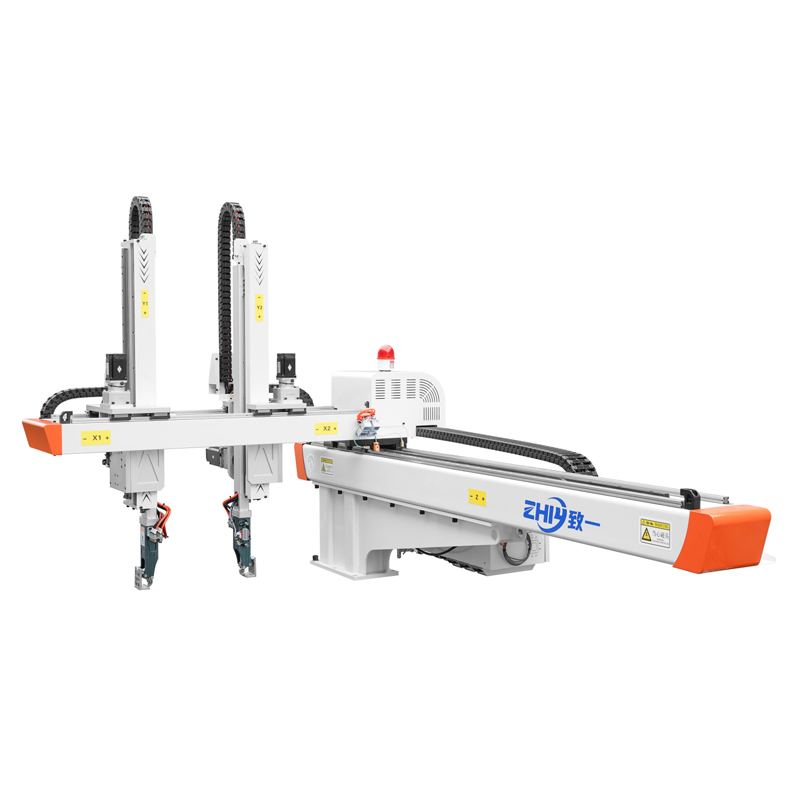
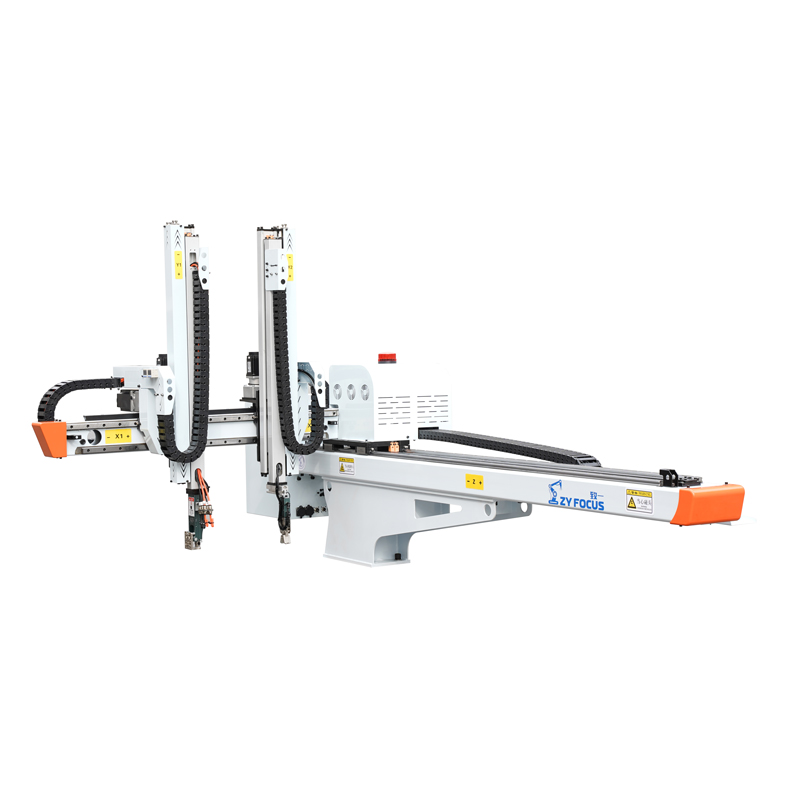
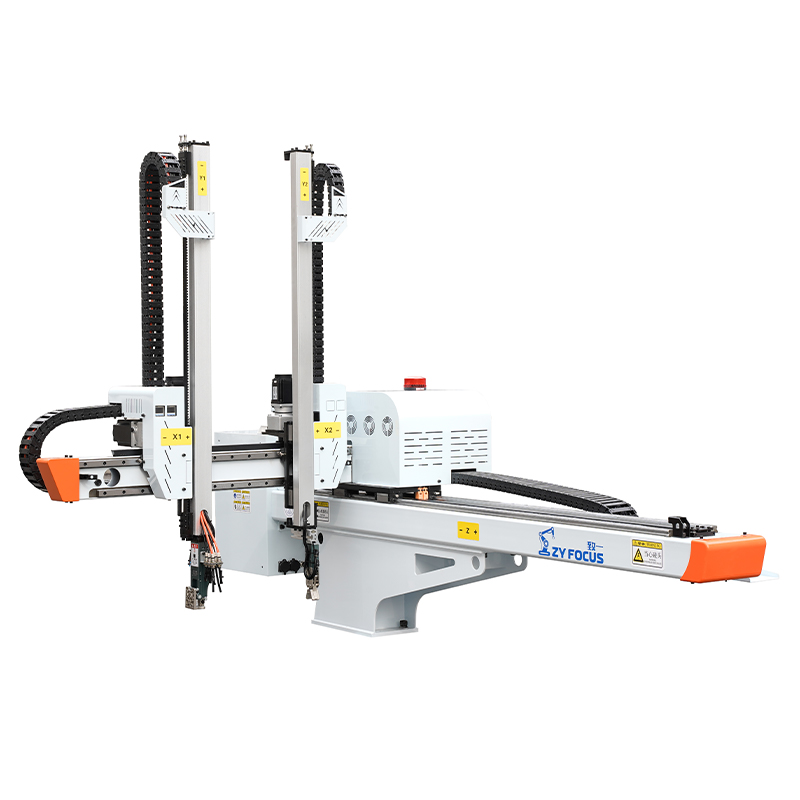
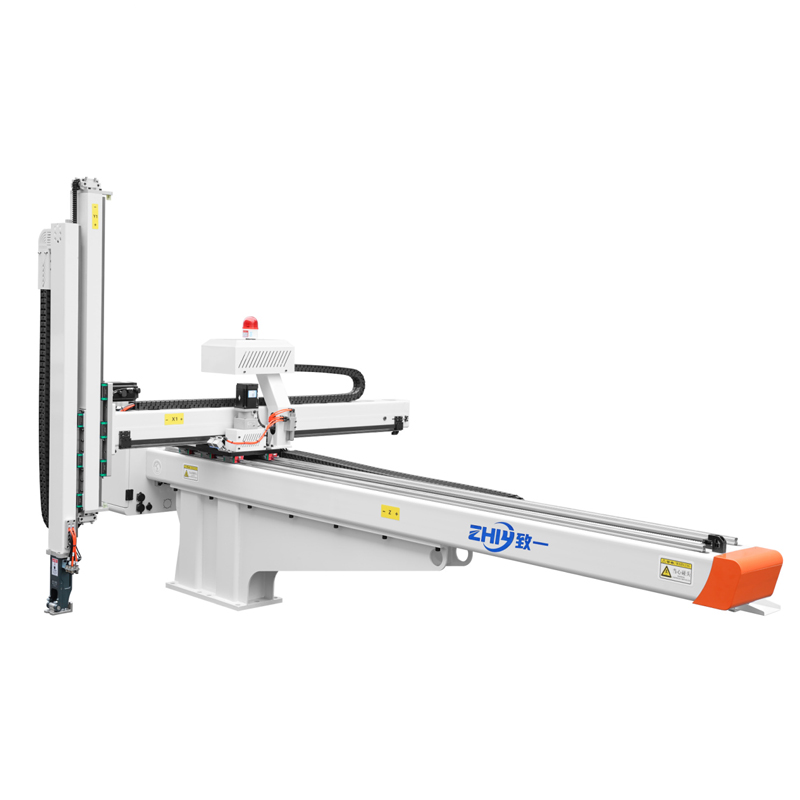
A servo take-out robot for injection molding is almost always a cartesian or gantry-style mechanism. A three-axis unit moves in the take-out (stroke out of the mold), vertical (up and down) and traverse (across the machine) directions on rigid linear rails. A five-axis unit adds wrist rotation and sometimes a secondary rotary flange so the part can be oriented for downstream equipment. The structure is bolted to the machine platen or a dedicated base, and it is built to live in the same envelope as the molding cycle, day in and day out.
A cobot is a jointed, articulated arm with six or seven rotary axes. It does not ride on a gantry; it stands on a pedestal or a mobile base beside the machine and reaches into the mold area. The kinematic difference is the whole story: the traverse robot is optimized for a straight, repeatable plunge into the mold and a fast retreat, while the cobot trades that single-purpose speed for a wide working radius and the ability to follow complex, curved paths. Neither is "better" in the abstract — they are built for different problems.
Speed and Cycle Time: The Mold-Open Window
Injection molding is governed by the mold-open window: the brief period the tool is parted and the part is accessible before clip-close. A well-tuned traverse servo robot completes its in-out stroke in well under a second to a few seconds depending on stroke and payload, and it is designed to be fully clear before the press closes. Because it moves along the shortest possible path and is rigidly guided, it loses almost no time to acceleration limits or path-shaping.
A cobot is fundamentally slower in this specific task. Its articulated joints must accelerate and decelerate a heavier cantilevered structure, and its safety-rated monitoring caps speed when a person might be near. In a high-cavity, fast-cycling consumer goods cell running sub-ten-second cycles, a cobot will almost always be the bottleneck. For slow-cycle industrial and technical parts with cycle times of twenty seconds or more, however, the cobot's extra seconds are absorbed without hurting throughput, and the trade becomes acceptable.
The practical rule many buyers adopt: if the take-out must beat a tight mold-open window on a high-volume program, the traverse robot wins; if the cycle is long enough that a few extra seconds of handling do not cost you parts per hour, a cobot becomes viable.
Footprint, Mounting and Cell Layout
Traverse robots mount on the machine itself — above the platen for top-entry units or alongside for side-entry configurations — so they add almost no floor footprint. The cost is that they are tied to that machine and that platen geometry. Reaching them for service means working around the press.
Cobots need floor space beside the machine, plus a defined collaborative workspace. The upside is mobility: a cobot cell can be relocated, and in many regions a properly risk-assessed collaborative application needs no physical fence at all, only speed-and-separation monitoring. That changes the layout conversation. Instead of building a guarded robot island, the buyer plans a shared zone where an operator can stand next to the arm. For plants with congested floor plans where adding a fenced cell is impossible, that difference alone can justify the cobot.
Heat, Dust and the Realities of the Molding Floor
This is where the comparison gets honest. The molding environment is hostile: radiant heat from the platen and tool, airborne mold-release agent and plastic dust, occasional steam or oil mist, and the ever-present risk of a hot sprue or flash contacting the equipment. Traverse take-out robots are built for exactly this. Their actuators, cabling and grippers are specified for the thermal and dirty conditions, and their EOAT is designed to survive thousands of hot contacts.
Most general-purpose cobots are not. Their joint housings, gripper options and especially their vision and force sensors are sensitive to heat, oil and fine dust. Running a standard cobot next to an open tool without protection invites premature bearing wear, contaminated optics and false force faults. Buyers who want a cobot in this role usually need heat-shielded EOAT and environmental protection, which adds cost and complexity and narrows the apparent price advantage. This is the single most common reason a cobot trial on a molding line underperforms expectations.
Safety Standards: ISO/TS 15066 vs Traditional Guarding
The compliance conversation for a traverse robot is well established and centers on perimeter guarding, interlocked gates and risk assessment under ISO 10218 and machinery directives. The robot works inside a fence; people stay out while it runs. Buyers familiar with injection molding already know this pattern.
A cobot is governed additionally by ISO/TS 15066, the technical specification for collaborative operation. It demands a documented power-and-force-limiting analysis: the integrator must prove that in every plausible contact scenario the arm's speed, force and geometry keep a person safe without a fence. That means a careful risk assessment of grip surfaces, pinch points and the specific molded part being handled. In practice this is a different and sometimes heavier documentation burden than simply installing a guard — not because cobots are unsafe, but because "collaborative" is a claim that must be validated per application, not assumed from the product label.
Cost Comparison: Purchase, Integration and Re-Deployment
Headline purchase prices are closer than they used to be, but the total cost picture differs. A traverse servo robot is priced as a machine accessory, often quoted together with the press, and its integration is a known, repeatable procedure documented by the supplier. Programming is included or low-cost because the motion is simple and standardized.
A cobot may look cheaper on the spec sheet, yet the buyer should budget for the peripheral reality: protective EOAT for heat and dust, a stable pedestal or mobile base, any conveyors or tables it feeds, and the engineering time to perform the ISO/TS 15066 assessment. The saving appears later, in redeployment. When a program ends, a traverse robot is largely stranded on its machine; a cobot can be retasked to kitting, inspection or packing elsewhere with modest effort. Over a mixed-product plant's lifetime, that reuse can outweigh the higher all-in first-cost of the cobot cell.
Where a Cobot Makes Sense — and Where a Traverse Robot Wins
A cobot is the stronger choice when the work is slow-cycling, variable, or secondary to the take-out itself. Good fits include inserting metal or threaded inserts into the mold by hand-feeding the cobot, performing a light deburring or inspection right after extraction, packing low volumes into boxes, and any cell where the same arm must serve two or three nearby machines across the day. It is also compelling for plants that want to pilot automation on one line before committing to a full fleet.
A traverse servo robot remains the right answer for high-speed, high-cavity, high-volume production where every tenth of a second in the mold-open window translates directly into parts per shift. It is also the safer bet where heat, dust and hot-part contact are unavoidable and where the part must move on a fixed, reliable path thousands of times per day without deviation. For most dedicated automotive, packaging and consumer-goods molding cells, the traverse robot is still the workhorse.
A Hybrid Cell: Traverse Robot Plus Cobot
The either-or framing is not the only option. A growing number of plants run a hybrid cell: a fast traverse robot handles the primary take-out and places the part on a buffer or conveyor, and a cobot stationed downstream performs insert loading, trimming, testing or packing. This keeps the high-speed extraction on the machine-optimized device while giving the plant the flexibility of a cobot where speed is not critical. For buyers with both high-volume core programs and a long tail of custom or seasonal work, the hybrid layout often delivers the best return because each technology is used only where it is genuinely superior.
Tip: run a timed take-out test on your real part and machine before trusting any vendor's cycle-time claim, because the mold-open window — not the brochure — decides whether a cobot can keep up.
A 9-Question Buying Checklist
Before issuing a capital request, answer these nine questions with your process and layout data:
- What is the actual mold-open window, and can a cobot clear the part before clip-close at your real cycle time?
- Is the program high-volume single-cavity, or high-mix low-volume where redeployment matters?
- How hostile is the environment — tool temperature, release agent, dust, oil mist — and what EOAT protection is required?
- Do you have floor space beside the machine for a collaborative workspace, or only platen-mounted room?
- Who will program the cell, and does your team already know PLC robot controllers or prefer hand-guided teaching?
- What does the ISO/TS 15066 power-and-force analysis require for your specific part and grip surfaces?
- What is the all-in cost including EOAT, base, guarding or assessment — not just the arm price?
- If the program ends, can the device be reused, and at what reassignment cost?
- Does a hybrid layout — traverse for take-out, cobot for secondary work — fit your mix better than a single device?
FAQ
Can a cobot really take parts out of an injection mold?
Yes, but only in the right conditions. Cobots are routinely used for slow- to medium-cycle parts, insert loading and post-mold operations. For very fast cycles they struggle to clear the mold-open window and a traverse robot is the better tool.
Is a cobot cheaper than a servo take-out robot?
Not necessarily. The arm may cost less, yet heat and dust protection, a stable base, downstream equipment and the collaborative risk assessment add to the total. The real saving comes from redeploying the cobot to other tasks later.
Do I still need a safety fence with a cobot?
Only if the risk assessment under ISO/TS 15066 shows that speed-and-separation monitoring alone is insufficient. Many molding-adjacent tasks still require partial guarding, so "no fence" should be earned through analysis, not assumed.
What wears out fastest on a cobot in a molding cell?
Joint seals and bearings suffer most from heat and fine dust, and any vision or force sensing gets contaminated by release agent mist. Proper EOAT shielding and a clean-air purge extend service life considerably.
When should I choose a hybrid cell instead of one device?
Choose a hybrid when you run high-volume core programs that need fast extraction and also a tail of custom or seasonal work that benefits from flexible, re-teachable handling. The traverse robot does the speed-critical job; the cobot adds adaptable capacity.