
Leave Your Message
Bull Head Robot Arm: Unique Advantages for Complex Molded Parts
Bull Head Robot Arm: Unique Advantages for Complex Molded Parts
Table of Contents
- Introduction: The Pain Points of Complex Molded Part Handling
- What Makes Bull Head Robot Arm Structure Different From Standard Manipulators
- 5 Unique Core Advantages for Complex & Heavy Molded Components
- Real-World Application Scenarios For Bull Head 3-Axis Servo Robots
- Cost & Efficiency ROI Comparison: Bull Head vs Conventional Cross-Beam Robots
- Key Selection Tips When Sourcing Bull Head Robot Arms
- Final Takeaways & Frequently Asked Questions
Introduction: The Pain Points of Complex Molded Part Handling
For injection molding facilities producing large, irregular, deep-cavity or multi-feature plastic components, standard cross-beam Robotic Arms often fail to deliver stable, damage-free production. Complex molded parts—automotive structural housings, large appliance panels, thick industrial pallets, deep bucket containers and multi-insert molded assemblies—bring three consistent production headaches for manufacturers worldwide:
- Narrow mold clearance and protruding part geometry cause frequent mechanical interference during extraction
- Heavy single-piece weight creates arm sagging, leading to scratched surfaces and high reject rates
- Limited internal working space restricts secondary in-mold operations like metal insert placement, labeling or pre-cutting
Many production teams are forced to rely on manual part retrieval to avoid product damage, which triggers labor cost inflation, inconsistent cycle times and safety risks on the production floor. This is where bull head 3-axis servo robot arms fill a critical automation gap, engineered specifically to overcome the unique handling challenges of complex molded products.
What Makes Bull Head Robot Arm Structure Different From Standard Manipulators
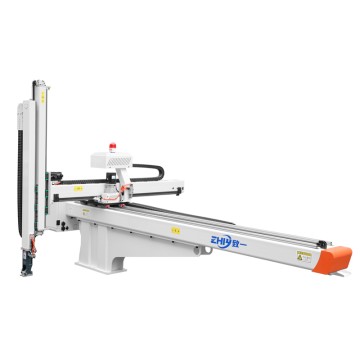
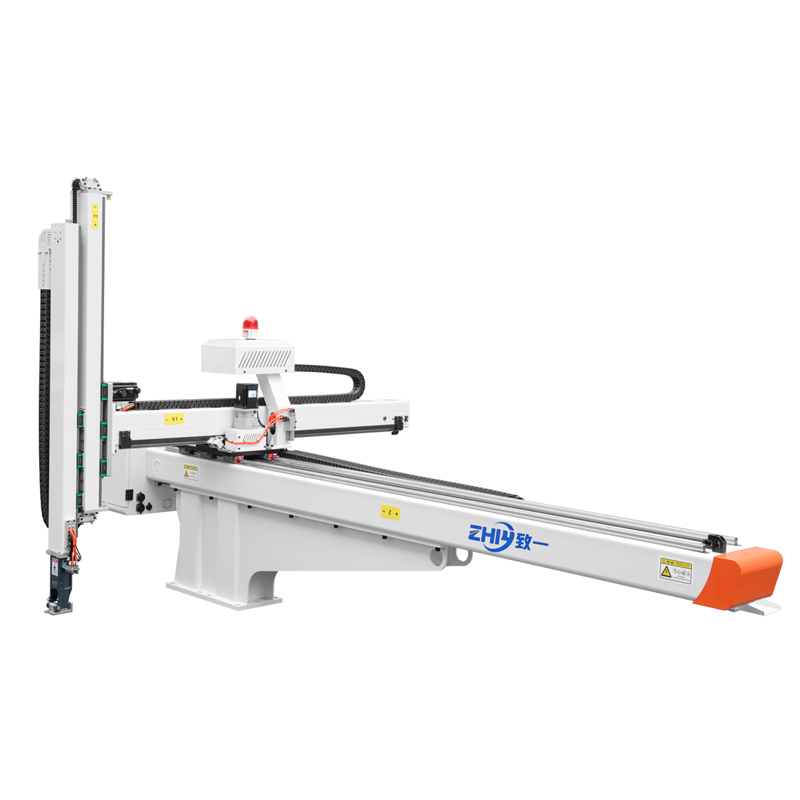
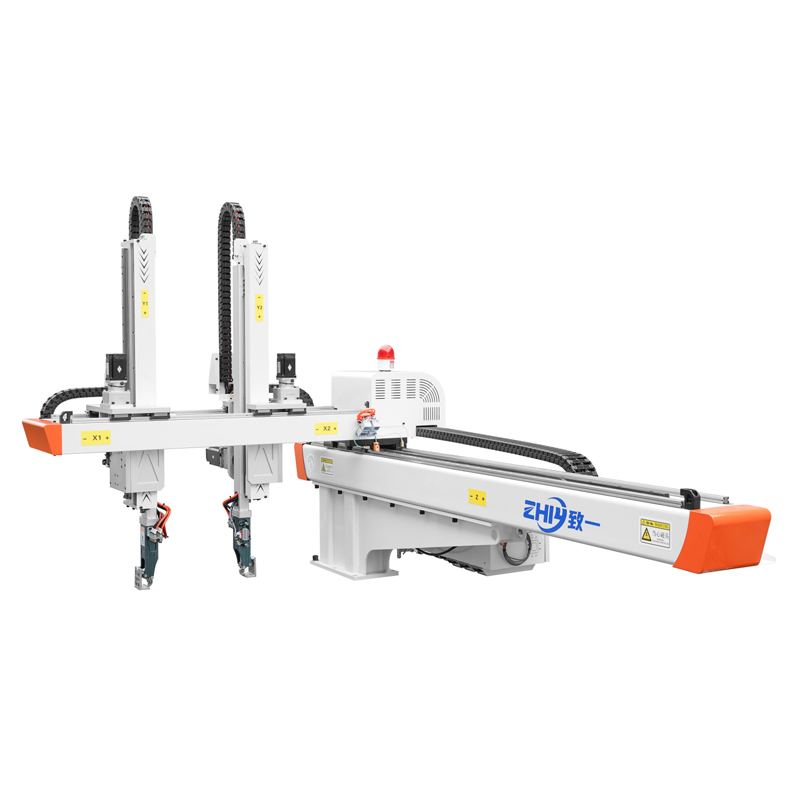
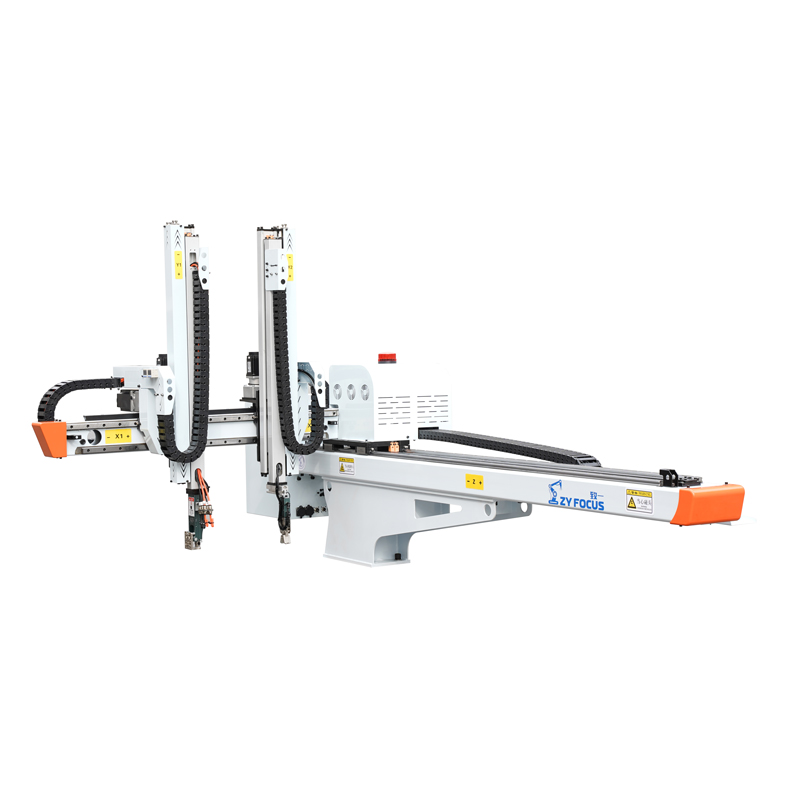
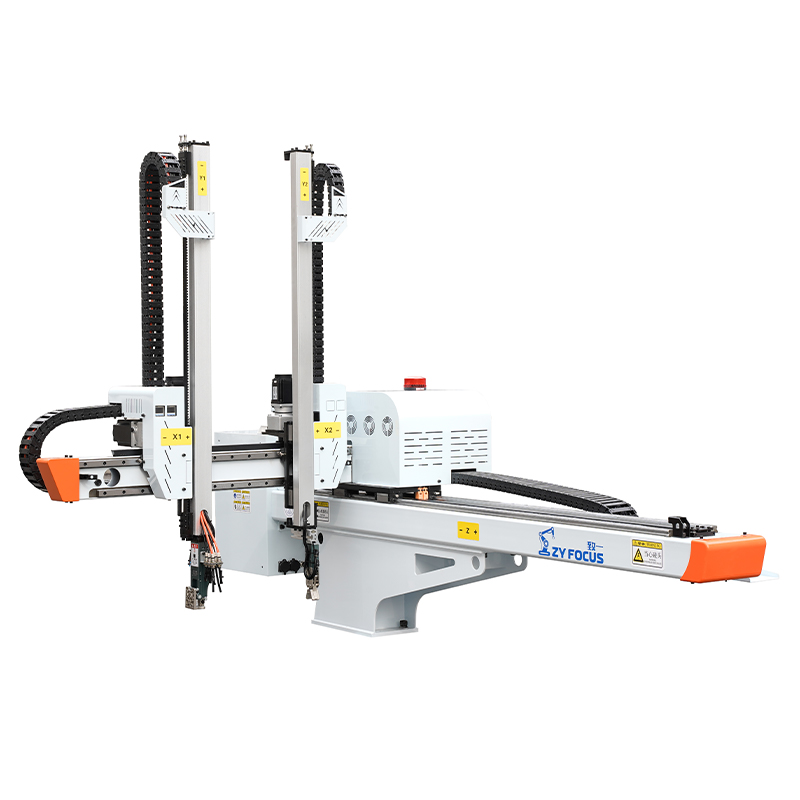
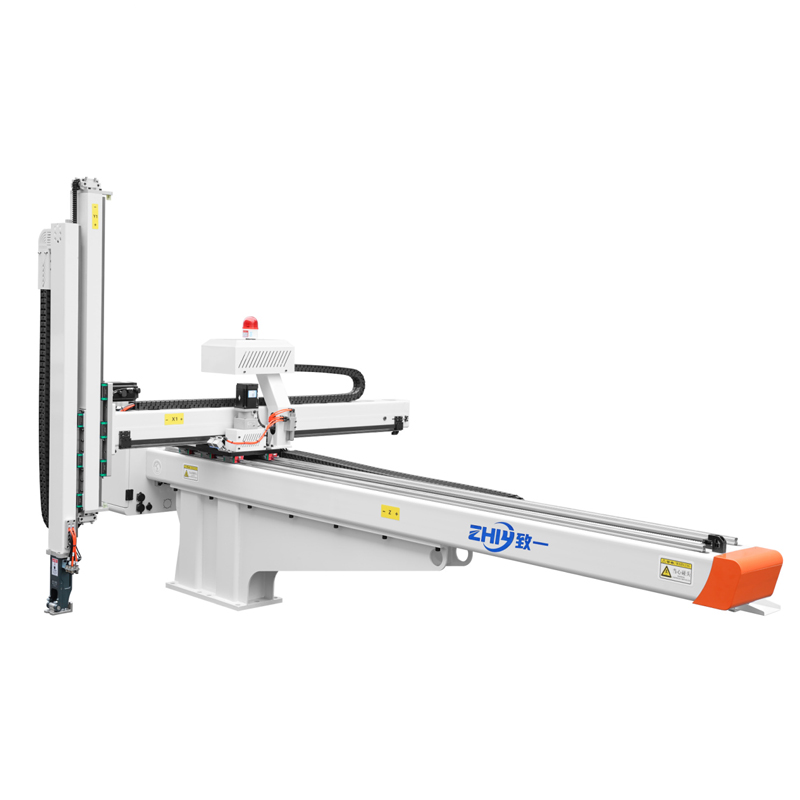
The defining feature of a bull head manipulator lies in its open, front-mounted vertical slide framework, a stark contrast to enclosed side-column cross-beam robot designs used for small, simple plastic parts.
Traditional cross-beam robots install vertical movement columns on the side of the main beam, creating physical barriers that block access to wide, oversized or irregular molded parts. Bull head robots relocate all vertical drive components to the forward tip of the horizontal beam, forming an unobstructed three-sided working zone around the mold opening.
Complemented by a fully reinforced load-bearing bull head joint and full X/Y/Z servo control, this structural re-design addresses the core limitations of standard robotic arms when working with complex molds and bulky finished products. The short, rigid force arm evenly distributes heavy payload weight across the entire beam, eliminating deflection during high-speed extraction cycles.
5 Unique Core Advantages for Complex & Heavy Molded Components
1. Ultra-High Payload Capacity Up To 50kg For Large Molded Assemblies
Bull head servo robot models support a maximum handling load of 50kg, far exceeding the 3–15kg limit of conventional single-section cross-beam manipulators. This capability directly caters to heavy complex molded parts including automotive bumpers, refrigerator inner liners, large plastic pallets and thick wall industrial enclosures.
The reinforced aluminum alloy bull head joint disperses concentrated weight evenly across the horizontal beam, preventing arm bending or vibration even under full payload. Manufacturers eliminate part deformation and surface scuffing caused by unstable lifting, cutting product reject rates linked to robotic handling by up to 28%.
2. Three-Sided Open Working Zone Eliminates Mold Interference
The front-mounted vertical slide removes side column obstructions, creating an unblocked access window to the mold cavity. This is the single biggest advantage for complex molded parts with protruding ribs, deep undercuts, wide flange edges or asymmetrical geometry.
When extracting irregular, wide-format components, standard robots often collide with mold side plates, delaying cycles and damaging mold surfaces. Bull head robots freely navigate all dimensional extremes of complex molds, supporting seamless retrieval of extra-long, ultra-wide or deep-cavity molded goods without collision risk. The open workspace also simplifies fixture customization for multi-cavity complex molds.
3. Superior Structural Rigidity Delivers Micro-Level Positioning Precision
The triangular load distribution of the bull head frame delivers exceptional structural rigidity, with repeat positioning accuracy held steady at ±0.1mm through millions of production cycles. For complex parts requiring precise secondary processing—such as pre-installed metal threaded inserts, in-mold labeling or post-mold trimming—consistent positioning eliminates misalignment defects.
Unlike lighter cross-beam arms that develop incremental deflection over long-term heavy use, bull head mechanical frames resist fatigue deformation. Facilities running 24/7 mass production of high-precision complex components maintain uniform product quality without quarterly mechanical calibration downtime.
4. Expanded Internal Space Supports Integrated In-Mold Auxiliary Operations
Complex molded product manufacturing rarely stops at simple part removal. Most production lines require secondary steps within the mold window: metal nut insertion, film labeling, hot runner gate cutting and pre-assembly of small sub-components.
The bull head’s unobstructed front workspace allows full integration of auxiliary fixtures and end-of-arm tooling without spatial constraints. Operators can mount dual-function grippers, insert feeders and labeling modules simultaneously on the robot arm, combining multiple production steps into one robotic cycle. This consolidates two to three separate manual stations into a single automated workflow, shortening overall molding cycle times.
5. Long Telescopic Stroke Adaptable To Large Tonnage Injection Molding Machines
Bull head robot arms feature extended double-section telescopic strokes, fully compatible with medium-to-large injection molding machines ranging from 650T up to 3200T. For complex molds with deep cavity draw distances or oversized mold opening travel, the extended reach ensures full part extraction without partial gripping that warps delicate complex geometries.
The optimized telescopic movement maintains smooth, low-vibration motion at maximum extension, critical for thin-wall complex automotive and medical plastic parts prone to bending during retrieval.
Real-World Application Scenarios For Bull Head 3-Axis Servo Robots
Bull head robotic arms are the preferred automation solution across verticals manufacturing complex molded components, with proven deployment in these core sectors:
- Automotive Molding Production Complex structural plastic parts: lighting housings, instrument panel carriers, wheel arch liners and large bumper assemblies. The high payload and open frame safely handle multi-feature automotive molds with integrated metal reinforcement inserts.
- Large Household Appliance Manufacturing Refrigerator liners, washing machine outer casings, air conditioning chassis and oversized furniture plastic panels. Wide, asymmetrical appliance components avoid collision thanks to the three-sided open working zone.
- Industrial Heavy Plastic Goods Logistics pallets, storage bins, thick chemical containers and construction plastic profiles. 50kg maximum load enables fully automated handling of solid, heavy single-piece molded products.
- High-Precision Medical & Electronic Complex Assemblies Multi-cavity medical device housings, large electronic equipment enclosures with internal mounting ribs. Micro-level positioning precision ensures scratch-free extraction of delicate complex geometry.
- Blow Molding & Large Container Lines High-volume production of deep plastic drums, storage tanks and large blow-molded vessels, paired with sorting and stacking downstream automation.
Cost & Efficiency ROI Comparison: Bull Head vs Conventional Cross-Beam Robots
Many procurement teams initially weigh upfront equipment costs, but long-term operational savings make bull head robots the more economical choice for complex molded part production.
| Performance Metric | Standard Cross-Beam 3-Axis Robot | Bull Head 3-Axis Servo Robot | Measurable Production Benefit |
|---|---|---|---|
| Max Handling Payload | 3–15kg | Up to 50kg | Automate heavy complex parts without manual labor |
| Risk of Mold/Part Collision | High for wide/irregular molds | Near-zero | Reduce mold maintenance and defective parts |
| Supported In-Mold Auxiliary Tasks | Limited by side column space | Full multi-function fixture support | Cut 1–2 manual production stations |
| Long-Term Position Drift | Noticeable after 6 months heavy use | Minimal over 5+ years | Eliminate monthly calibration labor |
| Labor Cost Reduction Potential | 15–20% | Up to 30% | Aligns with SME automation cost-reduction targets |
| Service Lifespan Under Heavy Load | 3–4 years | 6–8 years | Lower equipment replacement frequency |
Facilities producing complex molded components typically recoup bull head robot investment within 12–18 months through eliminated overtime labor, reduced scrap rates and faster line throughput.
Key Selection Tips When Sourcing Bull Head Robot Arms
When evaluating bull head manipulators for complex molded product lines, procurement and engineering teams should prioritize these critical specifications:
- Match robot payload to the total combined weight of finished part + fixture; reserve a 20% payload buffer for oversized complex assemblies.
- Confirm telescopic stroke length matches your injection molding machine’s maximum mold opening distance and cavity depth.
- Verify full servo drive across X/Y/Z axes; pneumatic hybrid models sacrifice precision for intricate complex parts.
- Confirm customizable end-of-arm tooling compatibility, including dual grippers, insert feeders and labeling attachments.
- Prioritize units with ISO9001 and CE safety certification, with factory-supported on-site training for fixture programming.
- Review project case records matching your industry’s complex molded product type to validate real-world performance.
Final Takeaways
Complex, heavy, irregular molded components create unique automation barriers that generic cross-beam robotic arms cannot fully resolve. The bull head robot arm’s patented open-frame structural design delivers unmatched payload capacity, collision-free mold access, high rigidity precision and integrated auxiliary operation space—four non-negotiable requirements for stable, cost-effective complex part production.
For molding plants aiming to cut labor dependency, lower scrap rates and streamline multi-step molded part workflows, bull head 3-axis servo robots deliver clear, measurable operational advantages that standard manipulator designs cannot replicate. When paired with customized end-of-arm fixtures, they form a complete turnkey automation solution for all complex injection molding production lines.
Frequently Asked Questions
Q1: Can bull head robot arms work on small-tonnage injection molding machines?
Bull head models are optimized for 650T and larger molding machines producing complex large-format parts. For small tonnage lines manufacturing simple lightweight components, compact cross-beam servo robots offer better cost efficiency.
Q2: Is a 5-axis bull head robot required for all complex molded parts?
Standard 3-axis bull head robots cover 90% of complex molded part extraction and in-mold insert tasks. 5-axis dual-arm bull head variants are only necessary if your production requires full 360° part rotation, dual simultaneous retrieval of product and runner sprues, or multi-angle stacking downstream.
Q3: How much cycle time improvement can I expect after switching to bull head robots?
Cycle time gains depend on part complexity. For large complex molded goods with wide mold opening travel, facilities typically reduce total pick-and-place cycle time by 12–22% by eliminating collision delays and consolidating auxiliary operations.
Q4: What safety certifications do reputable bull head robot manufacturers provide?
Qualified industrial bull head robot systems carry CE mechanical safety certification and ISO9001 quality management certification, with full safety interlock systems for mold access, emergency stop and overload protection as standard equipment.
Would you like me to adjust this article to add more buyer-focused ROI calculation content, or shorten it into a concise 800-word version for homepage featured blog display?