
Leave Your Message
0102030405
Best Robot Arm for Plastic Injection Factory
2026-06-04
Best Robot Arm for Plastic Injection Factory: Complete Buyer’s Guide for Injection Molding Automation
Published Date: Latest Industry Update | Target Audience: Injection Factory Procurement Managers, Production Engineers, Plant Owners
Table of Contents
- Introduction: Why Modern Injection Plants Need Purpose-Built Robot Arms
- Core Criteria to Pick Suitable Injection Molding Robotic Arms (5 Key Buying Metrics)
- Four Main Types of Robot Arms for Plastic Injection & Their Ideal Production Scenarios
- Pneumatic vs Servo-Driven Robot Arms: Cost, Speed & Output Comparison
- End-of-Arm Tooling (EOAT) Selection: Gripper & Vacuum Cup Guide for Different Plastic Parts
- Industry-Specific Matching Recommendations by Product Category
- Common Procurement Pitfalls to Avoid When Purchasing Injection Robots
- ROI Calculation Reference for Factory Automation Upgrade
- Frequently Asked Questions From Global Injection Factory Buyers
- Final Buying Tips & Next Steps
1. Introduction: Why Modern Injection Plants Need Purpose-Built Robot Arms
Global plastic injection manufacturing is shifting from manual part picking to full automated workflow to offset rising labor costs, stabilize product yield, and shorten molding cycle times. For procurement teams sourcing robot arms, the biggest pain point is picking mismatched automation equipment: over-specification leads to unnecessary capital waste, while underpowered robotic arms drag down full production line efficiency and increase defective product rates.
Every injection factory runs unique production conditions, varying by injection machine tonnage, finished plastic product specs, mold design, daily output volume and available workshop space. This buyer’s guide breaks down all critical selection rules based on decades of real-world injection workshop deployment data, helping overseas procurement teams make data-backed purchasing decisions without relying on blind brand promotion or exaggerated parameter labels.
In recent industrial surveys across Europe, Southeast Asia and North America, well-matched robotic automation can cut factory manual labor expenditure by 60%–75% and reduce product scrap rate by over 40% within the first year of installation, making robot arm investment one of the highest-return upgrades for mid-to-large injection molding workshops.
2. Core Criteria to Pick Suitable Injection Molding Robotic Arms (5 Key Buying Metrics)
All qualified procurement starts with clarifying five fixed factory production parameters; confirm these details before contacting any robot supplier to filter unsuitable options quickly.
2.1 Payload Capacity (Maximum Carrying Weight)
Calculate total weight including finished plastic component + runner/sprue + end tooling weight, not just bare product weight.
- Light-duty (1–5kg): Small electronic accessories, cosmetic caps, thin-wall food plastic containers
- Medium-duty (5–15kg): Household appliance shells, daily-use plastic goods, automotive small interior trims
- Heavy-duty (15kg+): Large logistics plastic crates, vehicle bumpers, oversized industrial plastic housings
2.2 Stroke & Working Reach Matching Injection Machine Tonnage
Robot vertical stroke directly links to your existing injection press tonnage, the core matching benchmark for gantry/cartesian robotic arms:
- Below 160T small injection machine: Vertical stroke 700mm–900mm, compact swing arm design preferred
- 160T–470T medium injection machine: Vertical stroke 800mm–1200mm, mainstream 3/5-axis cross cartesian arms
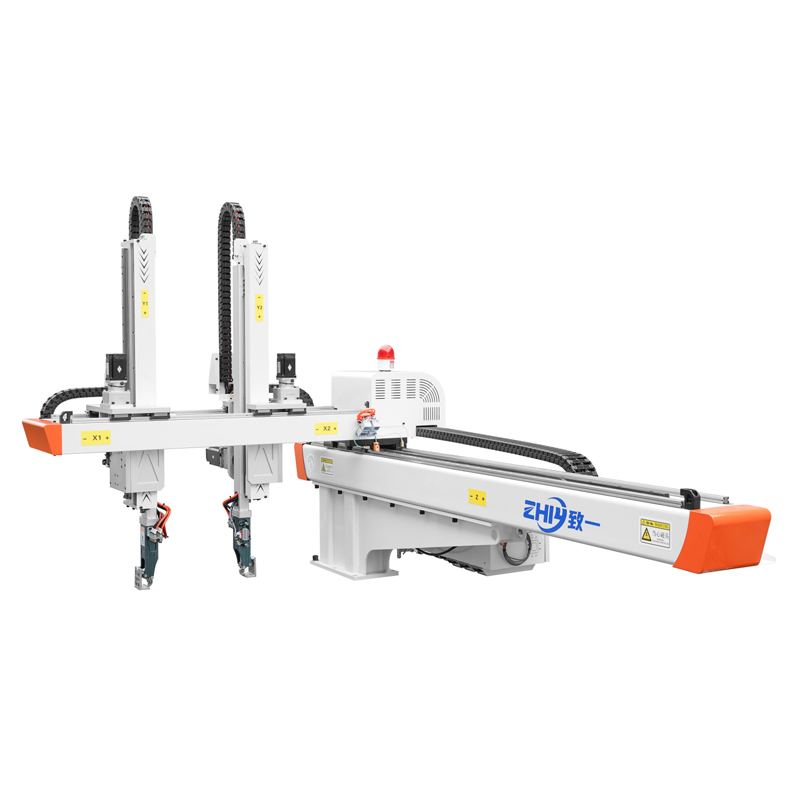
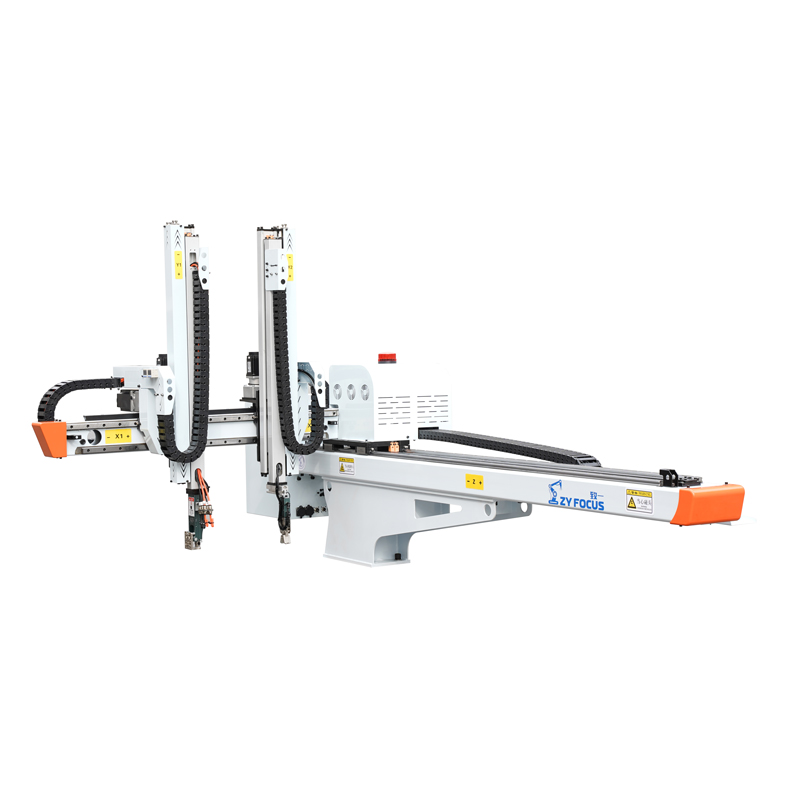
- 500T–1600T large injection machine: Vertical stroke 1200mm–1800mm, heavy-load dual-beam servo robotic systems
2.3 Repeat Positioning Accuracy Requirements
Different plastic products have distinct precision thresholds for robot positioning:
- General commodity plastic (PP/PE daily goods): ±0.1mm repeat accuracy meets production standard
- Precision electronics, medical-grade plastic components, automotive structural parts: ±0.02mm~±0.05mm high-precision servo robot required to eliminate clamping indentation and assembly tolerance issues
2.4 Production Cycle Compatibility
Rule of thumb for procurement: Robot empty cycle time must be 10%–20% faster than the full injection molding cycle of target products.
- Ultra-fast thin-wall molding (disposable plastic cups, cycle <3s): High-speed 5-axis full servo robot mandatory
- Thick-wall large plastic parts (automotive casing, cycle >25s): Stable low-speed mechanical arm prioritized over extreme speed specs
2.5 Workshop Installation Space Limitation
- Compact small-batch workshop with narrow layout: Swing inclined arm, side-mounted mini robotic solutions
- Spacious standardized mass-production plant: Top-mounted cross-beam cartesian robot for flexible downstream integration (conveyors, trimming stations, automatic stacking)
3. Four Main Types of Robot Arms for Plastic Injection & Their Ideal Production Scenarios
Each robot structure is engineered for specific injection workflow; below is scenario-based breakdown to help buyers match equipment with their product lines.
3.1 Inclined Swing Pneumatic Robot Arm (2-Axis Basic Model)
Core Advantages: Low upfront purchase cost, compact installation footprint, minimal maintenance cost, simple programming and operator training Best Fit: Small injection machine (<180T), small-batch frequent mold change factories, only basic sprue cutting and finished part picking tasks for low-value general plastic products Limitations: Limited movement flexibility, cannot complete post-pick rotating/flip stacking or in-mold insert placement; slower cycle speed for high-volume production
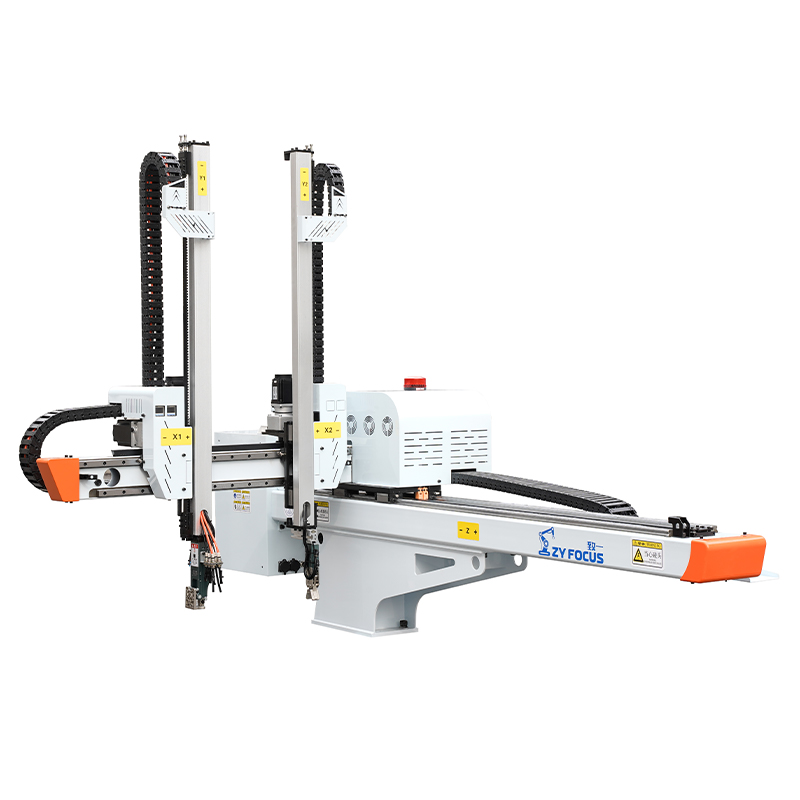
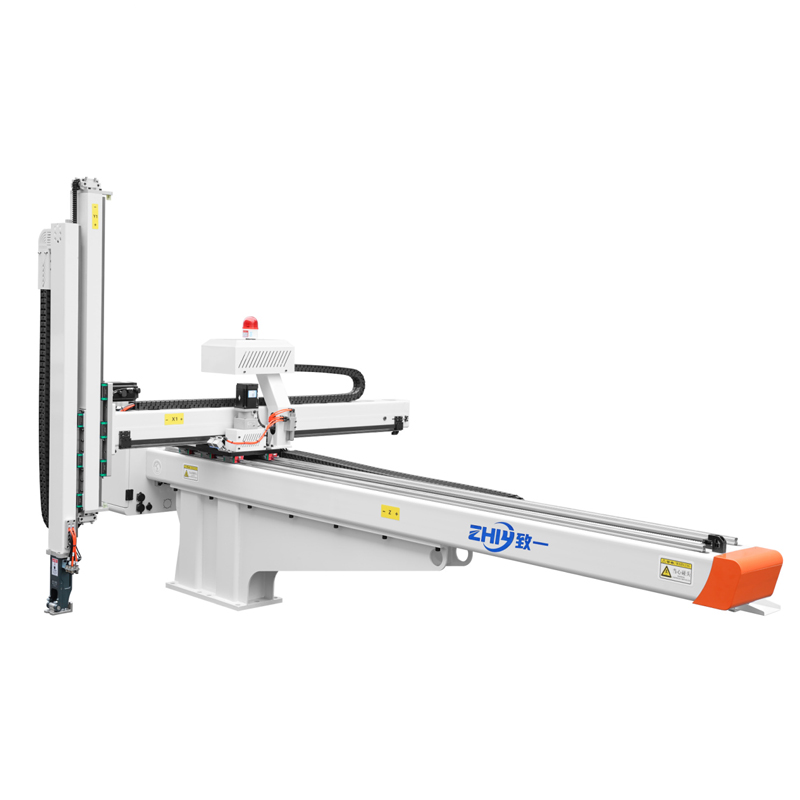
3.2 3-Axis Cartesian Gantry Robot (X/Y/Z Linear Movement)
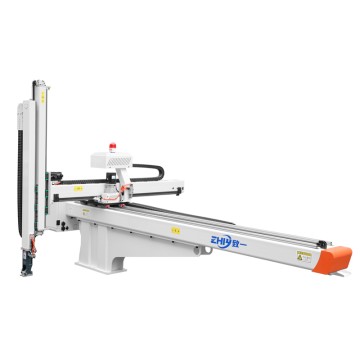
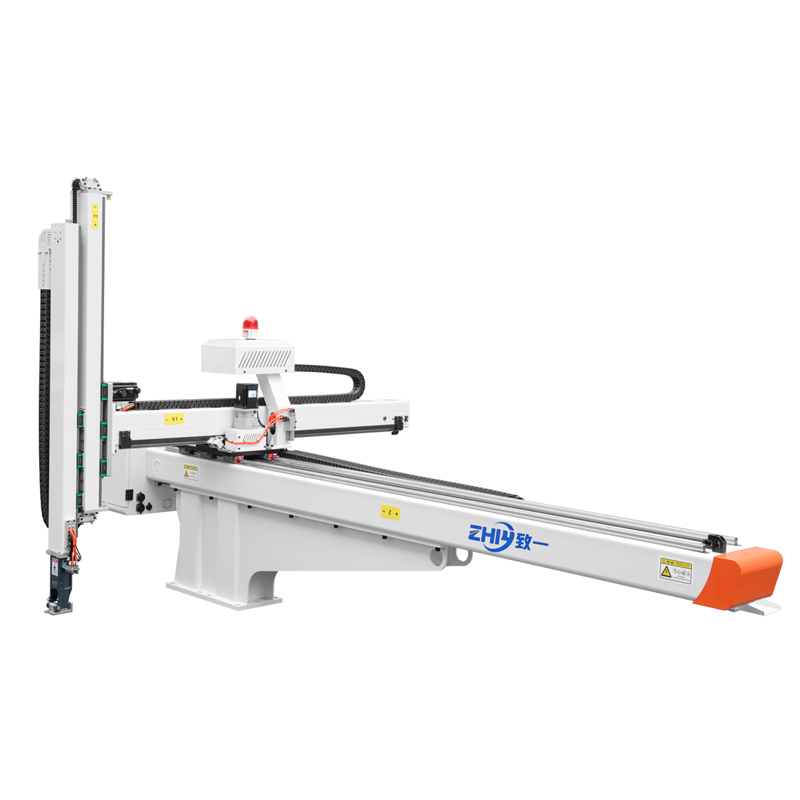
The most widely deployed workhorse in global standard injection factories, moving linearly along three orthogonal axes above injection molds. Core Advantages: High operational stability, cost-effective servo configuration, mature accessory supply chain Best Fit: Medium-volume standardized mass production (phone casings, bottle caps, home appliance small parts), tasks limited to mold ejection, product removal and flat conveyor stacking without complex post-processing
3.3 5-Axis Full Servo Cross Travel Robot
Add rotating and flipping axis based on 3-axis foundation for multi-angle flexible movement.
Core Advantages: Complete multi-step automation: in-mold insert embedding, post-pick part flipping, automatic runner cutting, multi-layer pallet stacking, seamless docking with downstream visual inspection equipment Best Fit: Mid-to-high end plastic manufacturing: automotive interior parts, precision electronic plastic frames, multi-cavity complex mold products with diversified post-molding operations
Core Advantages: Complete multi-step automation: in-mold insert embedding, post-pick part flipping, automatic runner cutting, multi-layer pallet stacking, seamless docking with downstream visual inspection equipment Best Fit: Mid-to-high end plastic manufacturing: automotive interior parts, precision electronic plastic frames, multi-cavity complex mold products with diversified post-molding operations
3.4 6-Axis Articulated Multi-Joint Robot Arm
Full spherical workspace movement with unrestricted joint rotation, highest flexibility among all injection robot categories. Core Advantages: Free three-dimensional movement, adapts to irregular workshop layout and offline secondary processing like plastic trimming, ultrasonic welding after part picking Best Fit: Custom low-volume high-mix production lines, multi-process integrated injection workshops combining molding + post-processing, oversized irregular plastic component production
Quick Reference Checklist: ✅ Small batch + simple picking → Inclined swing arm ✅ Large volume single product + basic stacking → 3-axis cartesian arm ✅ Multi-process automation + precision parts →5-axis servo arm ✅ Mixed production + offline secondary machining →6-axis articulated robot
4. Pneumatic vs Servo-Driven Robot Arms: Cost, Speed & Output Comparison
One of the most frequent procurement decisions is drive system selection; the table below summarizes verified real production data collected from global injection molding workshops across Europe, Southeast Asia and North America.
| Comparison Item | Pneumatic-Driven Robot | Full Servo-Driven Robot |
|---|---|---|
| Initial Procurement Cost | 35%~50% lower than servo models | Higher upfront investment |
| Part Pick Cycle Efficiency | Baseline reference speed | 30%~62% shorter cycle time |
| Repeat Position Accuracy | ±0.3mm~±0.5mm | ±0.02mm~±0.1mm adjustable |
| Annual Power & Maintenance Cost | Low component wear, cheap spare parts | Slightly higher regular maintenance expense |
| Suitable Molding Cycle | Molding cycle ≥20s, low-speed simple production | Fast cycle (<20s), high precision & high yield requirement |
Buyer Suggestion: If your factory runs long molding cycles and tight upfront budget, pneumatic robot is a practical short-term choice; factories pursuing long-term production efficiency and reduced total ownership cost over 5+ years should prioritize full servo-driven equipment to cut hidden losses from slow cycle and high defective rate.
5. End-of-Arm Tooling (EOAT) Selection: Gripper & Vacuum Cup Guide for Different Plastic Parts
Even high-performance robotic arms will fail production due to mismatched end effector design, one of the most overlooked procurement details by factory buyers. Two mainstream EOAT options cover over 95% of plastic injection picking needs:
5.1 Silicone/PU Vacuum Suction Cups
- Application Scope: Flat, smooth-surface plastic products (food containers, cosmetic lids, thin transparent plastic sheets), surface cannot allow jaw clamping indentation
- Material Selection Tip: High-temperature silicone cup for freshly ejected hot plastic parts (<200°C); polyurethane cup for oily plastic surface in harsh workshop environment
- Common Mistake Avoidance: Never undersize suction cup specification; single cup failure dropping parts inside molds may incur over $500 downtime cleanup cost per accident
5.2 Pneumatic Mechanical Grippers
- Application Scope: Heavy solid plastic parts, rough-texture components, plastic runners/sprues unable to be fixed via vacuum suction
- Key Setting Rule: Calibrate clamping air pressure strictly; excessive clamping force easily cracks thin-wall ABS/PC plastic housing during picking
For ultra-specialized custom-shaped plastic components, suppliers can design 3D printed customized EOAT per part geometry to maximize picking stability.
6. Industry-Specific Matching Recommendations by Product Category
6.1 Daily Consumable Plastic (PP/PE Containers, Bottle Caps, Disposable Tableware)
- Preferred Robot: 3/5-axis full servo cross cartesian robot + vacuum cup EOAT
- Core Reason: Ultra-short molding cycle requires fast servo speed; smooth product surface suits vacuum picking without surface damage
6.2 Automotive Plastic Parts (Interior Dashboard Trims, Bumper Shells, Small Structural Plastic Brackets)
- Preferred Robot: Heavy-load 5-axis servo robot or large 6-axis articulated arm + mixed gripper/vacuum combined EOAT
- Core Reason: Big part weight, complex post-mold placement and embedded insert requirements demand high payload and multi-angle flexibility
6.3 Medical & Precision Electronic Plastic (Syringe Components, Phone Internal Frames, Micro Connector Plastic Shells)
- Preferred Robot: High-precision 5-axis servo robot (±0.03mm or better positioning accuracy)
- Core Reason: Strict cosmetic and assembly tolerance standards eliminate clamping marks and picking dimensional deviation
6.4 Low-Volume Custom Industrial Plastic Components
- Preferred Robot: Compact 6-axis articulated robot
- Core Reason: Frequent mold switching and irregular product specs need unrestricted flexible movement to adapt variable production demands
7. Common Procurement Pitfalls to Avoid When Purchasing Injection Robots
Based on global procurement after-sales case statistics, these four mistakes cause over 70% of post-installation automation failure:
- Blindly chasing maximum parameter specs: Buying oversize high-load high-axis robot for small lightweight products leads to idle performance and wasted procurement budget; match payload/stroke strictly with actual product specs instead of overbuying future uncertain production expansion.
- Ignoring EOAT customized design: Sign robot contract without confirming end effector drawing, suppliers deliver universal standard grippers unsuitable for your specific plastic parts, triggering continuous part dropping and high reject rate.
- Neglect compatibility with existing injection machines: Confirm robot communication protocol and control interface match your current injection press brand before order placement; incompatible equipment requires costly secondary modification after delivery.
- Underestimate after-sales service distance: Prioritize suppliers with local technical service teams; remote-only support leads to multi-day production halt when equipment breaks down urgently during peak production season.
8. ROI Calculation Reference for Factory Automation Upgrade
Most mid-sized injection factories can recover robot procurement investment within 9–18 months via labor saving and scrap reduction; sample simplified calculation logic for buyer reference:
- Average single injection workstation manual cost: $2200–$3000 monthly per operator (global average factory labor expense including benefits)
- Single servo robot replaces 1–2 full-time pick operators per molding machine
- Annual scrap reduction benefit: 30%–45% less defective plastic parts from stable automated picking vs inconsistent manual operation
Procurement Tip: Request official ROI simulation report from robot supplier based on your monthly output, labor cost and defective ratio before signing purchase contract.
9. Frequently Asked Questions From Global Injection Factory Buyers
Q1: Can one robot arm serve multiple injection molding machines?
A: 6-axis articulated robot can realize multi-machine feeding via programmed movement path for small scattered injection presses; cartesian gantry robots are fixed above single injection machine by default, one robot matches one molding unit under most standardized production layouts.
Q2: Is it necessary to reserve spare robot spare parts during initial procurement?
A: Suggest purchasing core wearable components (suction cups, gripper jaws, servo filter elements) together with main equipment; bulk spare part stocking can be arranged after 3–6 months stable operation to cut initial capital occupation.
Q3: Can old existing injection machines without digital interface install new servo robotic arms?
A: Yes, most robot suppliers provide retrofitted external signal adapter kits to connect legacy analog injection presses with modern servo robot control systems, no full machine replacement required for automation upgrade.
Q4: What’s the standard robot service lifespan for injection workshop environment?
A: Proper maintenance servo robot runs steady production for 8–12 years; pneumatic basic swing arm service life averages 6–9 years under continuous daily shift production.
10. Final Buying Tips & Next Steps
Before formal procurement of injection molding robot arms, complete three preparatory steps to lock optimal purchasing solution:
- Document full production datasheet: injection machine tonnage list, product weight/surface material, molding cycle time, workshop installation dimension drawing and downstream process layout.
- Invite qualified robot suppliers to complete on-site factory survey for customized robot specification proposal and EOAT design drawing.
- Compare at least three qualified suppliers’ quotation, after-sales term and local service coverage instead of selecting lowest-price option blindly.
With customized robotic automation matching your unique injection production workflow, your factory can steadily boost output stability while controlling long-term production cost amid increasingly competitive global plastic manufacturing market.