
Leave Your Message
0102030405
Best 5 Axis Robot for Manufacturing
2026-06-11
Best 5 Axis Robot for Manufacturing: A Complete Buyer’s Guide
For modern manufacturing facilities aiming to balance operational flexibility, production precision and cost efficiency, 5 Axis Robots have become a mainstream automation solution. Different from3 axis robotswith limited movement and 6 axis robots with higher overall costs, 5 axis robotic arms strike a perfect middle ground for a wide range of standard and semi-complex production tasks. This guide breaks down the core advantages, key selection criteria, top-performing 5 axis Robot Models and real-world application scenarios, helping manufacturing buyers pick the ideal 5 axis robot to match their production lines, budgets and long-term operational goals.
What Makes 5 Axis Robots Stand Out in Modern Manufacturing
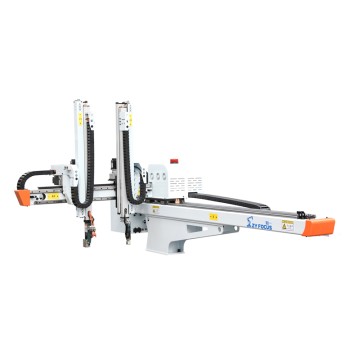
A 5 axis robot is built with five independent motion axes, combining three main structural axes for spatial movement and two wrist axes for angle adjustment. This unique axis configuration differentiates it sharply from other robotic solutions and creates distinct value for manufacturing operations.
Compared with basic 3 axis robots, 5 axis units deliver far greater movement flexibility. They can adjust the angle of end effectors freely within a certain range, which enables them to handle curved workpieces, multi-angle loading and unloading and semi-complex finishing tasks that 3 axis robots cannot complete. Meanwhile, they avoid the excessive complexity and premium pricing of 6 axis robots. Since 5 axis robots omit the full 360-degree continuous rotation of the wrist, their control systems are simpler, daily maintenance costs are lower, and the overall procurement and deployment expenses are more friendly for mid-sized production lines and mass-production workshops.
In actual production, 5 axis robots also excel in operational stability. The streamlined axis structure reduces mechanical vibration during high-speed operation, which helps maintain consistent processing quality. They also cut down production setup times significantly. Many multi-step tasks that require repeated workpiece repositioning with traditional equipment can be finished in a single clamping process with a 5 axis robot, lowering positioning errors and boosting overall line throughput. These strengths make 5 axis robots a go-to choice for industries that pursue stable output, moderate precision and controlled automation investment.
Core Selection Criteria for Manufacturing 5 Axis Robots
Before browsing specific models, manufacturing buyers need to clarify core evaluation metrics. These standards cover performance, adaptability, compliance and after-sales service, covering every link from on-site deployment to long-term operation.
1. Load Capacity and Working Radius
Load capacity is the most fundamental parameter. Buyers need to calculate the total weight of workpieces plus end tools, and reserve a safety margin of 1.2 to 1.5 times to prevent long-term overload from shortening the robot’s service life. 5 axis robots are divided into light-duty (5kg to 20kg), medium-duty (20kg to 200kg) and heavy-duty (200kg to 500kg) types. Light-duty models fit electronics assembly, small parts sorting and precision gluing; medium-duty versions are widely used for auto parts processing, stamping line loading and unloading; heavy-duty units target large component handling and palletizing.
The working radius determines the robot’s effective operating range. It must match the layout of production stations. A too-small radius will limit working coverage, while an overly large radius will waste floor space and increase unnecessary movement strokes. It is recommended to measure the actual operating area of the workstation first and select a model with a working radius that fits the layout.
2. Repeat Positioning Accuracy
Accuracy directly influences product yield, and different industries have distinct requirements. For conventional handling, palletizing and simple loading/unloading tasks, a repeat positioning accuracy of ±0.5mm is sufficient. For precision scenarios such as 3C electronic parts assembly, surface polishing and light cutting, the accuracy needs to reach ±0.01mm to ±0.05mm. High-quality 5 axis robots adopt closed-loop servo drive systems, which ensure stable accuracy even during long-duration continuous operation. Buyers should prioritize models with clear accuracy test reports and real on-site operation data.
3. Running Speed and Cycle Time
Production cycle time is closely tied to line efficiency. The operating speed of a 5 axis robot includes idle movement speed and working speed. When selecting, do not blindly pursue the highest speed. Excessively high speed may cause jitter and reduce operation stability. It is better to select a model with adjustable speed gears to match different production processes. For high-volume mass production lines such as injection molding and packaging, robots with short cycle times (3 to 6 seconds) are preferred; for precision processing stations, stable medium-speed operation is more important than extreme speed.
4. Control System and Compatibility
A user-friendly control system reduces staff training costs and line integration difficulty. Excellent 5 axis robot controllers support mainstream industrial communication protocols, enabling seamless connection with PLC, production monitoring systems and other workshop equipment. Simple programming logic is also essential. On-site operators can quickly edit and switch production programs to adapt to frequent product changeovers. In addition, check whether the system supports secondary development to reserve space for future production line upgrades.
5. Certification, Reliability and After-Sales Support
International certifications are basic guarantees of product quality. Qualified industrial 5 axis robots should pass CE, ISO 9001 and other standard certifications to meet the access requirements of different production environments. Mean Time Between Failures (MTBF) is a key indicator of operational reliability. Mainstream high-quality models have an MTBF of more than 10,000 hours, which lowers unexpected downtime risks.
After-sales service cannot be ignored. Buyers need to confirm the supplier’s local service network, on-site response speed (preferably within 24 hours), warranty period and spare parts supply cycle. Long-term stable operation relies on timely maintenance and parts replacement, so suppliers with complete after-sales systems are more worthy of cooperation.
Top 5 Axis Robots for Manufacturing in 2026
Combining global market reputation, on-site application feedback, performance parameters and cost performance, we have sorted out five outstanding 5 axis robot models covering light, medium and heavy load scenarios, adapting to different manufacturing industries and production scales.
1. High-Speed Light-Duty 5 Axis Servo Robot (For Electronics & Injection Molding)
This series is specially designed for high-cycle light-load production scenarios such as electronic component assembly, injection molding machine pick-and-place and product packaging. It adopts an integrated 5 axis servo structure, with a load range of 5kg to 20kg and a repeat positioning accuracy up to ±0.01mm. The optimized mechanical arm structure realizes ultra-short cycle time, and the continuous operation cycle can be controlled within 6 seconds, fully meeting the high-frequency operation demands of injection molding and 3C electronics workshops.
The robot features a compact body design, occupying little workshop space and being easy to install in narrow production stations. The built-in 100 sets of mold memory and multiple standard programs support one-click switching between different products, greatly shortening the product changeover time. Its closed-loop control system ensures smooth movement without jitter during long-term high-speed operation, maintaining consistent product quality. It is the preferred choice for small and medium-sized electronics factories and injection molding manufacturers pursuing high efficiency and precision.
2. Standard Medium-Duty 5 Axis Articulated Robot (For Auto Parts & General Machining)
As a universal model for general manufacturing, this medium-duty 5 axis robot has a load range of 20kg to 150kg and a flexible working radius, covering most loading/unloading, grinding, deburring and handling tasks of auto parts, hardware workpieces and mechanical components. Its five-axis linkage structure can easily cope with multi-angle processing of irregular workpieces, eliminating the need for multiple manual repositioning.
The robot uses high-rigidity mechanical materials and high-performance reducers, with strong anti-vibration ability. It runs stably under long-term full-load conditions, and the repeat positioning accuracy is stably maintained at ±0.03mm to ±0.05mm. The control system is simple to operate. Field technicians can master programming and debugging in a short time. It has strong compatibility and can be seamlessly integrated with lathes, milling machines, stamping equipment and other machine tools to build a fully automated processing unit. With moderate procurement cost and low daily maintenance difficulty, it is suitable for most mid-sized manufacturing enterprises and traditional processing workshops.
3. Heavy-Duty 5 Axis Handling Robot (For Large Workpieces & Palletizing)
Targeting heavy-load scenarios such as large mechanical parts handling, finished goods palletizing and warehouse transshipment, this heavy-duty 5 axis robot supports a load of 150kg to 500kg. The reinforced base and mechanical arm structure ensure structural stability during heavy-load operation, and the optimized axis power distribution avoids torque loss during large-range movement.
Although it is a heavy-duty model, it retains the angle adjustment function of two wrist axes, which can adapt to palletizing and handling operations of goods with different stacking angles. The equipment is equipped with multiple safety protection mechanisms such as overload protection and collision emergency stop, which complies with international industrial safety standards and effectively guarantees on-site operator safety. It is widely used in machinery manufacturing, building materials, logistics and warehousing industries, helping enterprises realize unmanned handling and palletizing and reduce labor costs for heavy physical work.
4. Precision 5 Axis Finishing Robot (For Polishing & Surface Treatment)
This model is customized for surface finishing processes such as metal polishing, plastic trimming and workpiece surface sanding. It balances high precision and flexible angle adjustment. The two wrist axes can achieve fine angle changes, enabling the grinding tool to fit the curved surface of the workpiece in all directions and effectively improve surface finish.
Its repeat positioning accuracy reaches ±0.01mm, and the movement track is highly controllable, which avoids uneven polishing and missing processing. The robot is equipped with a dust-proof and wear-resistant structure, adapting to harsh working environments with dust and debris generated during polishing. The adjustable operating speed gears can switch between rough grinding and fine grinding modes according to the process requirements. It solves the pain points of low efficiency and unstable quality in manual polishing, and is favored by manufacturers of sanitary ware, hardware accessories and furniture parts.
5. Compact Desktop 5 Axis Robot (For Small-Batch & Laboratory Production)
For small-batch customized production, laboratory testing and small parts assembly, this desktop 5 axis robot is an ideal choice. It has a small footprint, light overall weight and convenient movement and installation, and can be deployed on ordinary workbenches without special foundation construction. The load is within 5kg, and the working radius is compact, which is very suitable for precision operation of tiny parts.
The programming system supports graphical operation, with a low learning threshold, and is suitable for small factories, R&D laboratories and prototype production stations. Although the size is small, it retains the complete five-axis linkage function, which can complete multi-angle assembly, gluing and micro-processing tasks. With low procurement cost and flexible deployment, it is the best choice for enterprises engaged in customized production and product R&D and trial production.
Industry-Specific Application Recommendations
Different manufacturing industries have differentiated demands for 5 axis robots. Combining production characteristics and process requirements, we provide targeted matching suggestions for mainstream industries.
- Electronics Manufacturing: Prioritize high-speed light-duty 5 axis robots. Focus on operating speed, miniaturization of the body and compatibility with automated assembly lines to adapt to high-frequency assembly and handling of small electronic parts.
- Automotive Parts: Choose standard medium-duty models. Pay attention to load capacity, operational stability and compatibility with machine tools to meet the loading/unloading, deburring and preliminary processing of auto parts.
- Hardware & Mechanical Processing: Select precision finishing robots plus medium-duty handling robots. Match corresponding models according to whether the process is polishing, grinding or conventional loading/unloading.
- Injection Molding Industry: High-speed servo 5 axis robots are the first choice. The short cycle time and mold memory function can greatly improve the production efficiency of injection molding lines.
- Logistics & Palletizing: Deploy heavy-duty 5 axis handling robots. Focus on load capacity, safety performance and continuous operation ability to realize unmanned palletizing and cargo transshipment.
- Small-Batch Custom Production: Desktop compact 5 axis robots are recommended. Make use of its flexible deployment and low cost to cope with frequent product changes.
Final Tips for Buying 5 Axis Robots
Selecting a suitable 5 axis robot is not about choosing the model with the most complete parameters or the highest configuration, but about finding the product that best matches your own production demands. Before finalizing the purchase, you can follow these steps to avoid selection mistakes.
First, sort out the actual production demands clearly, including workpiece weight, processing procedures, required accuracy, production cycle and on-site space, and lock down the load, working radius and accuracy range of the robot. Second, require suppliers to provide real cases of the same industry and the same working conditions. If conditions permit, go to the customer’s production site to inspect the equipment’s actual operation effect, and conduct sample testing with your own workpieces on the machine. Third, compare the overall cost comprehensively, not just the bare machine price. Take into account later maintenance costs, spare parts prices and after-sales service terms to avoid hidden costs in the later stage. Fourth, confirm the compatibility between the robot and the existing production line to ensure smooth integration and avoid additional transformation expenses.
A well-matched 5 axis robot can bring stable efficiency improvement and quality upgrade to the production line. By combining your own process characteristics and referring to the above criteria and model recommendations, you can complete the procurement work efficiently and lay a solid foundation for workshop automation upgrading.